couples coaching

The Gates of Grief

Last week a friend of mine passed away. I got the news early in the morning when I was at the gym.  This is unusual because I never take my phone with me when I am working out but for some reason this particular morning, I slid it unconsciously into the side pocket of my tights, put my headphones on and off I went.  I love listening to music when I exercise, I find it motivating and uplifting.  Normally I turn on my playlist on my phone and leave the phone in the locker; the bluetooth in my headphones is great and picks up the signal from quite a distance.  On this day I did not, I put my phone in my pocket.  

I have known this friend for twenty five years, I met him through my husband.  He was 90 years old, there is no tragedy in the death of a ninety year old but it is sad. He was our friend, we met him in Italy and got married in his town, which is a very beautiful place.  We were looking forward to seeing him next year.  Just a week ago, whilst out for a walk we were talking about him and we admitted to each other that there was a chance he might not be there next year and we talked about our feelings about that, should it eventuate.  Needless to say both of us were very sad when we found out.  I had a few tears at the gym, when I read it, walked home and hugged my husband for an hour.  He was very upset.

It got me thinking about the gates of grief that I learned off Francis Weller who is a psychotherapist who does a lot of work in the grief space.  If you google him you will find many conversations and interviews with him.  I did 12 months of training with him about 5 years ago, more for myself, when I noticed about 6 months out of chemotherapy treatment, I had a lot of grief about my medical experience.

Weller completely reframed the meaning of grief for me in this program.  What he has done is  create a profound contribution to soul-centered psychotherapy because he helps us shift the Western cultural narrative of grief, which often treats grief as private, pathological, and linear, toward one that is relational, ancestral, and integrated.  His map of the five gates of grief help us understand that we can experience grief for many different reasons in our life, beyond the experience of losing someone we love.

So I thought I would take you through them and add my thoughts on it.  I have found in my own experience and in working with clients that there are often many other emotions that get wrapped up with grief, and how it shows up in our lives changes all the time.  There is no unique experience of grief, it changes every time within us and it is different for every individual.

I often talk about grief as a crucible.  A container that can withstand great heat and stress to create something new.  We could see that Weller’s gates create that container by naming different types of loss, we allow others to stop bottling up their grief and sorrow and allow it to flow.  This is what helps us process transitions.

The first gate is, Everything we love we will lose.  Grief is an essential part of being a human.  Weller says one of grief’s most important teachings is everything is a gift, nothing lasts.  To accept this is to live on life’s terms.  This is what the Buddhists called impermanence.  There are no exceptions.  When we acknowledge grief we acknowledge that everything we love we will lose.

I notice lots of people are sad about things that did not happen in their lives or if they didn’t get what they think they deserve.  I think there is a difference here, this is more disappointment and it is totally ok to be disappointed with what has or has not happened in your life and you might experience great sadness with this.  There is a distinction for me between the two, it is nuanced for sure.

People do experience grief in big life transitions like parenthood and menopause and events like a chronic or acute illness like cancer.  These are all very big initiations and initiations take us into places that are unknown.  We wonder will we ever be the same again, who will we be on the other side?  We are not meant to be the same person on the other side, these are times of sheddings and endings and often we are brought face to face with our own mortality.  Often these experiences strip away all our defence strategies we created to adapt as children and we are forced to face our adult world that is much sweeter, riper and vivid.  Many people discover they can actually be with all the emotions we experience as humans and we will not only be okay, we can thrive.

The second gate is; The places that have not known love. This gate is about the parts of ourselves that we have separated from that are untouched by love.  These are the parts of ourselves that have been banished to the basement of our psyche because they are surrounded in shame.  They haven’t experienced kindness, compassion, warmth or a welcoming smile.  What we think or experience as a part of ourselves being defective or wrong is often what we experience grief for.  Weller explains that it is hard to grieve for parts of ourselves that we have banished because we feel they are unworthy of our grief.  Some of you might be familiar with IFS as a therapeutic modality.  It is very helpful to many people to help them bring these banished parts back on line.  When we bring them back it makes sense that we would experience grief having disconnected from them.  Shame separates us from our soul. It is an insidious emotion and I understand why academics like Brene Brown have spent their professional lives trying to understand it.

The third gate is, The sorrows of the world.  We experience this most days just looking at the TV and watching the news.  The grief we experience at lives lost to war, around climate change and natural life being destroyed, cultures being destroyed, people living without a home.  It takes everything that we have within us to walk down a street and not be affected by the sorrows of our world.  This is where being in community, ritual and grieving together is a very powerful process for people to process grief.  Often we do this through art, music, and dance.  Ancient cultures have been doing this for years.  We live in relational fields, in fields of consciousness, indigenous cultures have known this for years.  

The fourth gate is, What we expected we did not receive. This one is a little trickier to explain but I believe it links to belonging.  We are born into families, into communities.  There are certain things we are born to expect.  Weller says we are designed to hear (as babies) soothing sounds, to be comforted, and hear soothing sounds and noises to soothe and comfort us.  Yet some of us don’t experience that.  We are wired to want to belong, it is a very primal need of humans, we are not wired to do life on our own.  Our nervous systems are wired for connection.  Our feelings of not being enough, of feeling like we are lacking are most often not a sign of personal failure but of a community or a society that has failed to offer us what we are designed to expect.  I believe this is where marginalisation and discrimination deeply wounds us.  One of the rituals of Italian life I love is the passigiata.  This is where Italians go out at night before dinner and take a walk with family and friends. There is both communion and spectacle in this event, often dressed in their very best, the passigiata gives rise to a bit of theatre as well as connection with others. As the Italians meet in the community and talk about their day, maybe have a cafe or gelato or aperitivo.  It is a beautiful ritual where people come together at the end of our day.  

The fifth gate is Ancestral Grief.  This is the grief that we carry in our bodies that is handed down by our ancestors.  This can be held for generations and often creates secondary coping strategies of addiction, rage or silence in families.  Things that are never spoken of for generations until they turn up generations later in unexplained maladies like illness or chronic health conditions repeated throughout families. Or ways of being and showing up in the world that we think is personality but actually trauma.  People who lost touch with their cultural  rituals of dance, art, song and moved into survival strategy which is often silence.  I have a few Mexican friends and they all say borrow our Day of the Dead.  This is the 1st of November and it’s the day they all honour and remember their deceased ancestors.  I have started doing this, it's so lovely.

To help grief flow it must be witnessed by another.  Like trauma, grief requires a witness who can acknowledge and witness our experience.  That is why ritual and grieving in community are so important.  This allows us to live more fully as we are opening our heart to our emotions and not repressing them.  We learn to hold what is both bitter and sweet at the same time, what is painful and pleasurable.

I could write pages about grief. I feel like I have barely touched the surface here.  It is such an essential human experience that helps us let go, to keep growing as humans.  I often say to clients, the tears of our grief are like windscreen wipers for our heart.  They help us process our experience of being a human.  

I will finish with a quote from Martin Prechtel, a Mayan Shaman who is also a grief specialist.  “Grieving should never be avoided or postponed; griefing is absolutely necessary.  Without grief the world would never renew itself; the world would cease to exist”.

If you want to read more I highly recommend Francis Weller’s, The Wild Edge of Sorrow and Martin Prechtel’s, The Smell of Rain on Dust.

Building Circles of support

When I was about nine years old, the grandchildren of some elderly neighbours died.  My neighbours who were probably in their 60s at the time, although they looked really old to my nine year old self, were devastated.  What was more devastating was that during an acute experience of severe post-partum depression or psychosis, their daughter in law took the lives of the two young children.  The children were very young, I can remember the eldest being about three years old and the other child a baby.  I can still see the little boy running around on his grandparents front lawn.  The front lawn was the best lawn in our street; it was like a bowling green, so smooth and even, we all loved to walk over it in our bare feet.   The case went to court and she was found not guilty, thank goodness, it was clear that this lady had been suffering terribly.  Devastating for everyone.  This was 45 years ago, did we even know that post-partum psychosis was a thing back then? I don’t know the answer to that. So lately the case involving Lindsay Clancy in the USA, which is currently underway, has brought this memory back for me.  We also had another case happen only a month ago close to where I live in Australia.

This is troubling to me because what is very clear is that we are failing mothers.  I feel terrible for these mothers who have not received adequate care and support from the health system that is supporting them.  I know post-partum psychosis is rare but what I also know is that many women have a pretty tricky time during this life transition. Becoming a mother is called Matrescence; did you know of this word? Many people don’t and I think that in itself is cause for us to think more compassionately about our rites of passage and becoming a parent in particular.   Many of us who have had children find there is a big hole in the mental health care and adjacent services that new mums receive.  I also see this mirrored in the midlife time when women go through menopause.  

I also think to myself, what is going on with us as a community, as employers, who have people who are very vulnerable working for them during these transitions?  I question whether we are looking out for people enough and where and with whom is the line for responsibility and care?  These are tricky questions and issues of change often fall apart in the space between.

This is one of the big reasons why I choose to work with Life Transitions because I have seen over the years both in my corporate life, and now private practice, that people are grossly under-supported in these huge changes.  But more than that, they are expected to come back to work and be the same old person they have always been.  Not only is it delusional and dismissive, it is extremely toxic for families.  This socially constructed myth of life being a solitary journey and having to manage, medicate or white knuckle major life transitions of parenthood, midlife, menopause and ageing is toxic. The felt sense of navigating a massive life transition in isolation sees the body automatically go into hyper-vigilance, bracing, and feelings of overwhelm, before we even start.  I have been at times furious with the fear mongering I have seen propagated by medical doctors on social media regarding menopause, who are telling women if they don’t take HRT they will get very sick.  

Our human bodies are wired for connection; we are not meant to do life on our own.  There is a reason people used to live in tribes.  The female nervous system in particular is predisposed to a fawning response, or a tend and befriend response, over fight or flight because oxytocin is a neuromodulator of the female nervous system.  This was brought by Shelly Taylor's research in 2000 that showed that female nervous systems heavily utilise oestrogen and oxytocin pathways under stress to ‘tend and befriend’ the threat in order to protect themselves and their children.  Her work brought this tend and befriend response to our attention.  There is a little nuance to this though. Her research found that oxytocin requires a safe and supportive container to be produced and absorbed. When the female nervous system faces these big life transitions without that safe and supportive circle, the oxytocin pathways get blocked and what is left is a body stuck in a high cortisol state.

These big rites of passage are when our body needs a circle of support the most.  Historically our ancestors held these rites of passage as collective experiences and we were held in the transition space by our community.  I will say in Australia we have this thing called the Mothers Group, where new mothers are randomly assigned to a group of new mothers soon after birth.  They are gatherings initially facilitated by the community health nurse organiser and then we branch off on our own to self-organise.  Some people have very strong life long friendships that come out of these groups.  We need these groups because the raw un-armoured nervous system of a new mother needs community support for co-regulation so her body can drop out of threat detection when it needs to.  Women navigating Menopause need support because it is not just a hormonal shift; their brain is re-wiring as is their nervous system. Hello Brain Fog.   The reduction in estrogen that happens in menopause tends to drop away any fawning, people pleasing tendencies we have, creating a fierce need for a supportive, authentic, non-judgemental community.  We have all heard midlife women say one of their greatest joys is they don’t care anymore!! In our elderhood transition, stepping into wisdom means we need to be held by a community that can receive, hold and honour that wisdom; otherwise ageing feels like we are disappearing.

Why is it so hard to build these supportive circles?  Well the individualist culture is one reason, but I also believe sisterhood wounding is a very big issue for many women.  Women can be very mean to other women when they are competing for limited resources, approval or safety.  Then there is the whole mean-girl dynamics many experience in early teen years, which is both developmental and somatic.  These wounds often happen in early teens and they can leave big imprints on our nervous system.  They make us compete with each other and frankly it's not very nice and it causes relational trauma that makes women shy away from female only spaces.  When women experience betrayal, micro-aggressions, exclusion and conditional warmth in these spaces, their nervous systems maps other women as a threat rather than a resource.  The irony is most women crave a circle of support during these life transitions but their nervous system and adaptive armour fears it.  That creates self-dialogue of an inner critic whispering, Do I belong here?  Am I enough?  Are they judging me?

What is the answer?  Micro-dosing relational safety.

You don’t have to jump into a twenty person retreat.  Start with health practitioners like a coach or therapist, or body workers who you can work on your transition with.  Put yourself in the centre of your own circle.  If you can work with practitioners who you feel safe with, who can hold space for you without judgement, help you complete adaptive stress responses that are still operating underneath, and learn to feel safe being held and witnessed by others (other women in particular), you will slowly start to build the capacity to sit in these held spaces.  You want someone who can work slowly with you, pace yourself.  The nervous system likes slow.

If you are forming a circle container I want to caution you that it is not just a social event.  There is anatomy to a circle space, it needs supportive connection.  I am not talking about having lots of people who agree with you; I am talking about creating an ecosystem of people with different relational capacities.  Often these groups need people who can naturally take up “implicit roles” like the person who is a grounding presence, whose steady nervous system can help you settle when you are activated.  Or the mirror/truth teller, the person who can gently call you out when you are using your adaptive strategies without shaming you.  Or maybe you need a strong co-regulator who can witness your grief, rage and joy without having to fix, dismiss or intellectualise what is going on.  We need people with these skills and capacities in our lives.

Circles of support are not just a social calendar event when they are well held.  When they are well held by skilled facilitators they become a nervous system container, a co-regulation resource and an antidote to isolation and self abandonment.

And for the men reading this, yes, you need circles of support during your life transitions. Men also move through profound rites of passage too and we were never meant to navigate life on our own.

Autumn doesn't ask the leaves to stay

Autumn is my favourite season by far. Where I live, the days are warm and the nights start to become cooler. Coming off the back of summer holidays, most people have a lot of energy and life is busy but there is an invitation somewhere in the air to start to slow down. I find myself being very reflective. The earth starts to have that pungent earthy smell and there is a feeling of letting go. Often there is a bit of sadness in the air; grief for the ending of what has happened and also what didn’t come to fruition.

Midlife is the autumn season of our life and I find that all these feelings are mirrored in people’s experience at this time. Yet many of us struggle to deal with the Autumn season of our life.

Nature does not cling to what has completed its season. Yet humans often do. We hold onto identities, roles, relationships, beliefs, coping strategies, and versions of ourselves long after they have fulfilled their purpose. Much of the suffering of midlife comes not from change itself, but from our resistance to the natural ending of things.

One thing that strikes me is how many humans see decay and loss as personal failure rather than a natural cycle of life. Autumn's leaves falling isn't a failure of the leaf or a punishment for anything, it's the design working correctly. Often I find with clients in midlife transitions, whether they are dealing with divorce, career endings or kids leaving home; they often carry a private sense that the loss means they did something wrong, or that they should have been able to prevent it. There is a natural intelligence in our body, we have these things called emotions that are superb at helping us process life and our experience of being human. It is just that modern culture doesn’t really like them, so many of us repress them so we can keep functioning. You know the leaves fall so the tree can bud again. Grief and sadness are regenerative, they help us let go of what we have loved that we have lost. Sometimes what we are losing is that is part of ourselves that we can let go of because it was an adaptive survival strategy that we created as a child and we don’t need it any more. It is not serving us in our adult relationships.

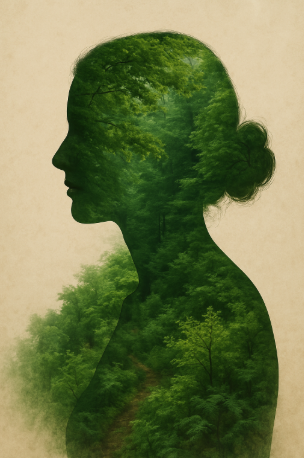
Digital Art- Kellie Stirling

If I was tucked inside a clock, then Autumn would be the magic hour.
— Victoria Erikson

Autumn doesn't ask, bargain, or explain itself to the leaves, it simply arrives, and the season changes regardless of whether the leaves are ready. There's no negotiation, no guilt, no over-explaining. One thing I find about the midlife season of life is that for many people it highlights where they have been abandoning themselves and their own needs. This often shows up as Anger. Anger tells us where our body is saying No. It helps us set up our boundaries. No doesn’t have to be coming from a fight or flight response. A clean no doesn’t need force behind it for it to be true. This is one of the gifts of midlife, when we pay attention to the anger we find places where we have really porous boundaries and our body is exhausted and finally had enough. When we explore our inner world and find where our Yes and No live inside of us, we get clearer on our desires, what we really want in life. A no that comes when we feel safe, comes from a place of internal certainty that is so settled it doesn’t need defending. That is a no coming from someone who has arrived in a place in their life, where they know down to their bones, who they are.

Many people talk about letting go as a mindset shift, a decision to stop holding on. I don’t agree with this, it is physiological first and the mind follows. Autumn doesn’t decide anything. The leaves release when the tree stops sending resources to it. There is that wisdom again; its time. This reminds me of the somatic process in the body. When the body starts to feel safe, the body starts to let go of old trauma and stress it has been holding onto for a long time. There is a loosening or a letting go that happens before the story and belief systems catch up. There is a natural wisdom and intelligence in our body that moves with our life transitions. Insight alone doesn't create change, for someone to truly let go of an identity, relationship, or role, the body has to be able to feel safe enough to let go of the protective strategy it has been holding onto. In midlife, many clients experience emotional distress or pain and it is the bodies way of saying, it is time. We are in the autumn season of life, come home to the truth of who you really are.

Autumn doesn't ask the leaves to stay. It doesn't judge them for changing colour or rush their falling. Nature trusts the wisdom of the cycle. Perhaps there are parts of us that are ready to be released too; not because they were wrong, but because their season is complete. Perhaps what feels like an ending is also making space for something deeper to emerge. Not a new self, but a truer one.

When our children trigger us

Children invite us into rooms within ourselves that we spend a lifetime avoiding

Nothing will expose your early wounds quite like trying to get children out the door before school.  In our house, mornings were often the hardest part of the day. One child moved slowly, just as I do. The other was quick and efficient. I hated the rush because slowness is my natural rhythm, and every morning felt like a collision between who I was and what the day demanded.

These days I meet many parents who are psychologically literate.  They have read a lot but they haven’t necessarily done their inner work.  So, even if you understand your inner child, can name your attachment style, have listened to the podcasts and read the parenting books; your child will meet the unconscious parts of you that haven't yet been integrated. Because it's when you're stressed and exhausted that those parts show up.

So when a little person cries, do you rush to fix them? Or do you shut down, explode, withdraw, go numb, feel guilty? Do you physically or psychologically leave the room?  With your teenagers do you find them too much and hard to handle so you leave them alone?  None of that makes you a bad parent. It makes you human with coping strategies you use to manage your internal experience.  We all have them.  Some of us experience these triggers a lot when our kids are little, some of us later when they are teenagers or young adults.   They are a signpost to where you need to explore your unconscious patterns.

Children have a way of touching our greatest wounds.  The places where our younger parts learned: I'm too much. I'm alone. Love has to be earned. There's no room for my needs.

Those beliefs don't live in your mind. They live in your body. That's why a toddler's tantrum, a refusal to put shoes on, a teenager's stonewalling, can awaken old grief, anger or fear inside of us because our nervous system doesn't know the difference between then and now.

The child isn't creating your triggers. Your triggers belong to you.  They're revealing the places where your younger self is still waiting for someone to choose them, for someone to stay and listen.  For someone to be interested in your emotional world.

That's why parenthood can feel so overwhelming. Children invite us into rooms within ourselves that we locked long ago and forgot existed.  Most of these rooms live in the basement of the psyche. We buried them there because what we were feeling at the time was simply too much. We dissociated, adapted, fragmented and survived. The problem is that the parts we left behind don't disappear. They wait.

Our child doesn't need us to be perfect. They need us to be conscious.  To be able to notice, to stop and pause, to repair when we have a rupture, to stay contained within ourselves whilst allowing them to have their emotional experience.  They need us to soothe them when they are young to help their nervous system learn how to soothe.  Our teenagers need some stabilisation and containment when their emotional swings are really big, so they feel safe and that there is room for them to explore who they are in the supporting container of our love.  That means when they are overwhelmed we can stay in our body, in our internal experience, soothe ourselves and stay connected to them.

Our children call us to choose differently, to make a choice that isn't reactive.  This is how we end generational patterns. Ancestral trauma gets passed down from one generation to the next until someone does the work on themselves.  When you choose to explore your inner world, to understand your coping strategies and pull them out of the basement and into the present, you are choosing to love parts of yourself that have been desperate for connection for many years.  

We can reclaim our inner child. We can reconcile with the parents who passed these patterns to us. But the greatest legacy we leave is to do our inner work, we do this for our children, they call us to be better people.

We don't need to keep carrying everything that came before us.

When we do our own healing, our children benefit. Our partners benefit. Our friendships deepen. Every relationship in our life becomes more honest, more connected and more alive.

Relationships are where we are wounded, but they are also where we heal. This is perhaps one of the greatest gifts our children offer us.

When a Child's Survival Strategy Becomes a Culture's Dysfunction

One of the things I love about the nervous system is how plastic it is.  We adapt for survival and our autonomic nervous system which drives our behaviour, adapts to keep us safe.  It is clever, so masterful in how it drives us to adapt so that we stay safe, feel a sense of belonging and receive the love we need to grow and flourish as humans.

That same survival system is also what drives maladaptive behaviour.  When we look at toxic cultures, we have to look systemically at what is driving the threat.  Often it is a leader with maladaptive traits that were developed as a child to survive.  But it can be other things too. It may also be remuneration and compensation structures that aim to foster never ending financial growth, which we know is completely unsustainable.  Maybe it is further out than that.  Maybe it is laws that are overly rigid and drive dysfunctional behaviour, it happens, and there is irony in that because in theory laws are put in place to promote safety, prosperity and harmony in society.  The point is all of this ripples out. We all know that cultural and geopolitical hegemony exists and have to look broadly at what might be going on. Most often in culture it is all these happening together.

Back to the individual though.  Our adaptive strategies start forming sometimes whilst in the womb.  Babies cannot regulate their own nervous system, they need co-regulation of parents and caregivers to learn how to soothe themselves.  We do that by attending to their cries for help, through touch, a soothing voice and meeting their needs to feed or change or soothed back to sleep.  Babies can’t survive without a parent/caregiver, they need to be fed and cared for.  When those needs aren’t met or parents are miss-attuning to them, they start to develop little strategies to receive the love, feel safe and feel like they belong to the family.  You see for a small baby or small child to not receive this attuned care, it feels like death to them.

These are adaptive strategies and as Gabor Mate says, children will choose adaptive over being their authentic selves every time.

It is here our adaptive strategies begin.  Now this is okay in childhood but as we grow and age they get in the way of our adult relationships and often lead to conflict in our intimate and platonic relationships.

I want to add that its not always about our parents.  Some of us were bullied at school, some of us had lots of sports accidents when we were teenagers that really impacted our proprioception which is our bodies’ sense of where it is in space and time.  This can cause some of these strategies to develop also.

Digital image - Kellie Stirling. An adult soothing their inner child who is metaphorically holding the ‘armour’ of their adaptive strategies.

Let's talk about some of the common strategies that I see.  Some of these are mine too!

Hyper-vigilance — We flinch at footsteps, scan every room we walk into. There's nothing wrong with us; we were just watching for the next threat so we’'d never be caught off guard.

Control — We white-knuckled every plan, every outcome, every unknown. When our past was unpredictable and unsafe, we learned that controlling the details was the only way we could sleep at night.

Overthinking — We stay awake at night, ruminating, replaying conversations from years ago, when one wrong word used to cost us everything. We thought that if we studied every angle, next time we'd see it coming.

Overexplaining — We write an essay to prove that we aren't the problem. When words were twisted or used against us, we thought if we gave enough context, we'd finally be believed.

People pleasing — We agree to things we don't really want because saying no cost us our safety when we were younger. We learned to keep everyone happy; that was the only way we stayed alive.

Perfectionism — Making a mistake felt like a death threat to us. Perfectionism shields us from the pain of losing love, avoiding criticism, and preventing abandonment by being completely flawless.

Self-abandonment — We make ourselves the last person on our list of who we look out for. When choosing ourselves meant punishment, self-abandonment taught us that disappearing, or receiving the crumbs of what was left in the love and attention department was the safest thing we could do.

Shame — Shame made us feel like we were the problem for things that were done to us. We were made to feel like we weren’t deserving of receiving love and attention.  We carried the blame because the person who hurt us didn't have the capacity to take responsibility and we have to hold it for a really long time.  

Freeze — We go deathly quiet, mid-sentence, vacant behind the eyes. When fight and flight aren't options, we froze in place so danger would pass over us. This is such a natural biological response when we are experiencing extreme threat, animals do it too.  It is just that animal’s bodies know how to shake it off and somewhere along the way our bodies stop remembering how to do that.

Dissociation — It makes us disappear when things get too loud, too close, too much. When our body couldn’t run or fight, dissociation came in and it took us somewhere we couldn't be reached.

Isolating — It made us cancel our plans, dodge the calls, and stay behind the locked door. After the people who were supposed to love us hurt us, being alone was the only place we knew to feel safe.

Growing into adulthood isn’t about eliminating these strategies, it is about becoming aware of them and not letting them run your life.  When we work with them somatically, we become so aware of them and we learn to expand our capacity to feel them so we have the choice to pause and slow them down in the moment.  To be actually present to what is happening right now and not disappear into our survival response.

I want to add that many of these strategies can give us superpowers. Here are a couple of examples. In clients that are hypervigilant, I notice they don’t miss anything going on in the meeting at the office.  Super attentive people.  The over-thinkers and over-explainers are great at managing risk in my experience.  The people pleasers, natural carers and they are always very attentive to people’s moods.  The perfectionists, whilst they can be hard to work with, their attention to detail is always exceptional in my experience, and they are generally pretty good at finishing and completion of tasks.  

It’s just that when one of these strategies (or maybe a few together) is the dominant operating strategy, it gets in the way of honesty, deep intimacy and being able to listen to and be okay with different perspectives on life and how we live it.  That is what causes friction at home and in the office.  It is what causes greed and manipulation.  It causes wars and conflict.

In my opinion, healthy adult relationships are the bedrock of a happy life. Loosening these strategies makes room for deeper intimacy, happier lives and healthier cultures.

Will I Still Belong If I Become Who I Am Becoming?

There is a question that sits quietly beneath many of life's biggest transitions.  Most of us never say it out loud.  Instead, we ask questions about careers, relationships, ageing, health, identity, purpose, or the future.  But underneath those questions is often another one:  Will I still belong if I become who I am becoming? With that there is often fear and also a quiet awareness that life as we know it cannot continue in the same way.  Sometimes it is a whisper and sometimes it is a crisis.  Either way we become aware that change is asking something of us.

That question lives somewhere below the throat. You might not have words for it yet. You might not even know you're asking it. But if you're in the middle of a significant life transition, becoming a new parent, a relationship ending, a career dissolving, a sudden life threatening illness, a version of yourself becoming suddenly ill-fitting, your nervous system is asking it on your behalf, constantly, in the background of everything.

It's not really a question about the future. It's a question about whether you are fundamentally safe to change.

What I have discovered is that thinking your way to the answer doesn't work. Not because you're not intelligent enough, but because the question isn't being asked by your intellect. It's being asked by something much older and much more fundamental, the part of you that is wired, before anything else, for connection and survival.

Last Saturday I sat in a room with a group of somatic experiencing and TCM practitioners and learned something that my body already knew.

We were working with the Five Elements of Chinese Medicine, an ancient framework that maps all of life onto a seasonal cycle. Being taught by the incredible Alaine Duncan (TaoTrauma). Metal, Water, Wood, Fire, Earth. Autumn, Winter, Spring, Summer, Late Summer. Each element with its own quality, its own organ system, its own emotional signature, its own role in the great turning of things.

What stopped me, what caused a kind of internal earthquake I'm not sure anyone else in the room noticed, was the moment I understood that these five elements describe not just the seasons of the natural world, but the seasons of every significant transition a human being moves through. More than that actually.  Each element carries precisely the quality of support a nervous system needs at that particular moment in the cycle.

I've been working with people in life transitions for nearly ten years. I thought I was learning something new about somatic touch work and I want to reaffirm to you that I absolutely did.  But I was also actually finding the map for territory I'd been navigating and creating by felt sense all along.  Every transition we go through has a cycle within a cycle.  These big transitions are not linear, they are fractals within a fractal.  Spirals that move in, out and around.

Digital Art, Kellie Stirling

Here's what I mean.

Every transition begins in Metal that sits with the season of Autumn. Something ends. Something is released, or taken, or outgrown. The Metal element governs our capacity for sensate awareness, the skin that registers the first chill, the gut that knows before the mind does that something has shifted, that sense we have when we experience slight arousal because our gut knows something is not quite right. The resource energy of Metal is respect. Respect for what is ending. Respect for the fragility of the threshold. Precision in how we hold what is being lost.  How might perimenopause be experienced if culturally we had more respect for what women experience at this time.  If we could offer that in a large container for them.  If getting older was not denigrated but rather respected.

In transition, Metal asks: can you let this be what it actually is?

Then comes Water, the element associated with Winter. The not-knowing. The fallow. The period that our culture is most brutal about rushing, most intolerant of sitting inside. Water is where fear lives, but also where wisdom gestates. You cannot see the shape of what's coming yet. The resource energy here is protection,  to anchor, to contain, to hold someone steady while they cannot yet hold themselves.  This is often where we reach out to others for help, trying to regulate through connection.  Our tribal need to connect to help us regulate ourselves through the fear that is rising up.  This is where providing a container of support is really useful.  In Australia, new mothers are connected with other new mothers in a mothers groups so they can have connection during this time.

Water asks: can you bear not knowing what comes next?

Wood is Spring.  Spring cannot be manufactured. But when the conditions are right, when there has been enough winter, something moves. Wood governs the mobilisation of life force, the capacity for healthy anger and also hope.  It is directed forward movement.  Life wants you to move, something new is trying to emerge. A dream that was never pursued, or a  truth that was never acknowledged. A boundary that was never spoken. The resource required here is encouragement. Encouragement is not pushing, it is standing alongside someone and quietly saying: "I think you can trust this next step."

 In our training room last Saturday, a colleague placed her supportive hands under my ankles. The intention with the somatic touch was encouragement and support in the spirit of a coach. As I was lying there I felt a moving forward energy in my body. Then an image arrived in my mind, unbidden, I was running through a field of flowers in pure delight. That's Wood. That's what an unimpeded mobilisation response actually feels like in a body that has been through enough winter. Whilst the resource energy for wood is encouragement, the felt sense is of something or someone believing in your capacity to move, even when you cannot yet believe it yourself.

Wood asks: what wants to emerge through you now?

Fire is Summer, coherence restored. This is the moment in a transition when you suddenly start to know yourself again, when the scattered pieces find their arrangement and come together in a new constellation, when connection becomes possible again. Fire governs the heart, and the heart's capacity to communicate both danger and equanimity to the whole system. The resource energy is love, not sentiment, but the agape quality of full, unconditional presence. Being truly met.

Fire asks: can you let yourself be known again?

Finally Earth, the arrival of late summer, the harvest. This is where the gristle gets digested. Where the lessons move from being things that happened to you into being part of who you are. Where the gut microbiome, the immune system, the capacity for giving and receiving, all of it comes back online. This is the time in a life transition where we have enough distance from the challenge that we can harvest the lessons we have learned along the way.  In menopause in TCM this time is known as the second spring.  The resource energy is support  coming from underneath, nurturing, a trust and knowing that the ground is holding you rather than you holding yourself up.

Earth asks: what has this made you?

Then we move back to Metal again.  Metal is both the beginning and ending of a cycle.  Life is nothing but a series of transitions, beginnings, middles and endings that keep on happening.

Respect. Protection. Encouragement. Love. Support.

Five different answers to the same question. Will I still belong if I become who I am becoming?

Yes. When we are in transition we feel like we have lost our inner compass because our nervous system is often rewiring and this affects other systems in our body.  When we experience all of this it offers a sense of what it feels like to belong within a transition.  Within each season of our life.

The reason transitions are so hard in our culture is not that we lack resilience. It's that we treat them as problems to be solved rather than seasons to be moved through. We try to think our way to summer while our bodies are standing in the frost. We pathologise winter and try to get out of it as soon as we can, often without support. We rush spring. We skip the harvest because we're already anxious about the next thing ending.

But the body knows. The body has always known. What it needs, what it has always needed is not a solution. It is the right quality of presence for the season it is actually in.

When you help someone belong to themselves through a winter they didn't choose, you are doing something that ripples far beyond the room. A nervous system that has been met in its fear, encouraged in its spring, and supported in its harvest doesn't mobilise that unresolved energy outward. It completes the cycle. It becomes available for connection, for contribution, for the next season, whatever it brings.

You don't learn this with your mind first. You learn it the way I did last Saturday through highly attuned presence of another person, sitting with you and holding space for you through it.  With that your  body suddenly remembers what moving forward safely feels like.

That's where we start. Not with the answer to the belonging question. With the conditions that make the question safe enough to ask.

Here are some reflection questions for you if this resonates with you.

Can I respect what is ending in my life? How can I protect myself in uncertainty? What do I need to be able to encourage what is emerging? Can I meet myself with love? What support do I need to foster time and space for the integration of my experience?

Leaning into longing: the distance between being heard and held.

There's something quietly poignant happening right now. People are turning to AI for something that feels like companionship.   A place to be heard. A presence that's available, patient, non-reactive. I don't say that dismissively, because I understand the impulse completely. We are living through an epidemic of loneliness so profound that we will reach toward almost anything that approximates the feeling of being held. The feeling of being connected with another, with each other.

What I keep coming back to is this, what people are actually reaching for isn't information or even reflection. It's the experience of mattering to another nervous system. That mattering to another nervous system, as much as we might wish otherwise, cannot be replicated by a machine.

That is because the nervous system is fundamentally a relational ‘organ’.  It likes to be with others to co-regulate.  It likes connection, choice and agency. What people are reaching for is not information but relationship. The nervous system develops in relationship, heals in relationship and, throughout our lives, continues to seek the regulating presence of other humans.

I must admit, I work on my own a little and I find myself craving the connection of other humans in person. When I have days when I am writing I will often go and plonk myself in a cafe just to be around other people. It might be surprising to you that these days are often my most creative.

We tend to think of connection as a social skill. Something we learn, practice, get better at. But underneath the social layer, connection is a somatic experience. It happens in the body before it happens anywhere else.

When you feel truly met by another person, that feeling of really being seen and being with a person who can hold your experience in their body and stay in connection with you, well something in your physiology shifts. Your breathing changes. Your muscles soften. The part of your brain scanning for threat quiets down just enough to let something else come forward. This is not a metaphor. It is the nervous system doing what it evolved to do: co-regulate with another.

This is why genuine connection is so hard to fake, and so hard to find. It requires two people who each have enough internal settledness to stay present, not just cognitively, but somatically, when things get uncomfortable. When the conversation touches something real. When the other person's activation starts to move through the room.

Most of us never learned how to do this. Not because we're broken, but because most of us grew up in environments where the adults around us hadn't learned either. Neither did their parents or grandparents.  The lack of capacity, inability to attune, it gets passed down through the generations.

Many people talk about the concept of moving our orientation from me to we.  This is not a new phrase, it has been around for quite a few years but what does it actually mean from an embodiment perspective?

Here's the paradox at the heart of relational work: you can't genuinely be with another person until you've developed enough capacity to be with yourself. This isn't about self-sufficiency or emotional independence. It's about having enough internal space to notice what's happening inside you without being completely run by it. To feel your irritation, your fear, your contraction and still stay in the room. Still stay in the relationship, still stay in your body and not dissociate or project it onto another person.

Without that internal witnessing capacity, connection collapses into reaction. We move fast. We get irritated, or angry and we defend. We assert. We project what we can't metabolise internally onto the people around us and then wonder why we feel so alone even in company.

The ‘me’ work isn't selfish. It's the foundation that makes ‘we’ possible.  To receive, we have to learn how to listen with our body, with all our five senses.  In a world where striving, action and constant motion is celebrated and rewarded, where people are expected to ignore their own basic bodily functions and boundaries all the time and keep on doing, this can be hard and slow work. It often feels unsafe for a body that is constantly in motion to slow down. It's also hard when your value is attached to productivity, the state becomes a trait. But it's not who you are. What if you could titrate your experience of slowing down a little bit at a time so that you could feel safe to just be. To receive the presence of another, to really listen and not have to fix anything or be fixed.

One of the things I notice consistently in my work, with individuals navigating midlife transitions, with leaders in organisations, with people doing the slow, courageous work of trauma integration, is how hard it is to receive.

Not just to receive care or support, though that's part of it. But to receive the experience of being held by another person and let it actually land. To feel it in the body rather than process it in the head. To let it matter.

For many people, especially those whose early experiences taught them that support wasn't reliable or safe, this is genuinely threatening. The nervous system that learned to survive on self-sufficiency doesn't easily soften into ‘we’. Even when ‘we’ is right there, available and real.

I've sat with individuals and groups in sessions where something quite profound has happened, a moment of genuine attunement, a shift in the room and watched them move past it almost immediately, back into their head, back into their story, because the body didn't yet have a map for what just occurred.

Building that map is slow work. It happens through repeated experience, not insight. Through the body, not the mind.

Back to AI.  Let's talk about what it can and cannot offer. I want to be honest here, because I think the nuance matters.  I think there is real value in AI as a reflection tool.

There is something useful in having a space to think out loud. A patient, available presence that reflects without reacting. I use AI in my own work to test ideas, to do business analyst work that I don’t have time to do.  That's real.

But nothing in an AI interaction is changed by contact with you. It isn't moved by your story. It doesn't carry you between sessions. It can't offer you the experience of mattering to another nervous system because it doesn't have one.  You can reflect to AI over a tricky experience you had with others and whilst it reflects back to you, nothing in it is changed by the experience that it is witnessing.  It doesn’t actually sense the relational field like our nervous systems do. It can recognise the significance of it but it doesn’t feel anything.  The mutuality of relationships is that our nervous system is changed by the interactions we have with others.  That fact is exactly what makes human relationships irreplaceable.

That mutuality, that being-changed-by-each-other, is precisely what makes human relationships the irreplaceable thing they are. Real connection leaves marks on both people. That's not a bug. That's the whole point.

There is a longing for ‘we’ that we are all desperately hungry for, that feeling of connection we receive from the nervous system of another human who is able to be with our experience and let it be.

What I believe people are reaching for in therapy, in AI, in every form of connection they can find, is the experience of not being alone with their inner life. Of having it witnessed, held, accompanied by another.

That experience is available. But it lives on the other side of the ‘me’ work. It requires a nervous system that has enough capacity to stay slow when things move fast. To receive when receiving feels vulnerable. To be genuinely present to another person without losing yourself in the process.

That's not a social skill. It's a somatic one that is learnable slowly, in the body, in relationship with others, over time. Which is, perhaps, the most human thing there is.

The Nervous System Never Lies

Attunement, the Inner Critic, and What We're Really Missing

Humans are relational by nature. Our bodies are hardwired for connection, and we regulate through co-regulation. When we try to regulate from a place of urgency, to fix ourselves or change something, we might be missing a vital step.

Breathwork and vagus nerve exercises are genuinely useful tools, and they can absolutely support us in the moment. But they are not what a young, developing nervous system misses out on. What gets missed is something far more fundamental: attunement.

Attunement is being seen, heard and known. Being met exactly where we are when we needed help from a caregiver. When we had big emotions, or overwhelmed, when we might have fallen and hurt ourselves, our caregivers were there to soothe us and had capacity to hold our big feelings. From these experiences, from them attuning to us in the moment, lending their nervous systems to soothe ours, our nervous systems develops and grows. When our caregivers did not lend us their nervous system to hold us through experiences that were overwhelming, we didn't receive the attuned attention we needed to learn how to soothe ourselves.

Babies are not born with the capacity to self-regulate. Caregivers lend them their nervous system, through gentle touch, a gentle voice, and responsive presence, and over time, through that repeated experience, the child's nervous system learns that the world is safe. Gradually, they internalise that capacity and begin to self-soothe. If that attuned care was inconsistent or absent, the nervous system may never have had the chance to fully learn it.

Digital Image - Kellie Stirling. Two women mirroring each other offering deep attunement

This is also where the inner critic is born, though it has other contributors too, including cultural and family messaging. The inner critic is often misunderstood as something we need to eliminate. But it usually formed for a reason.

The inner critic doesn't arrive in a single moment, nor from a single voice. It is shaped over time, like rings in a tree. Early relationships often form the core, particularly where attunement was inconsistent and a child learned to adapt in order to belong. But other layers gather around it: temperament, family expectations, cultural messages, moments of shame, and the quiet lessons about who it was safe to be. What we call the inner critic is often a protective ecosystem, one that once helped us stay connected and feel safe, even if it now feels limiting or harsh. It is often an aspect of our inner critic, which emerged to protect us, that shows up in our relationships when we are arguing.

So back to the breathwork and the vagus nerve exercises. These tools matter. But they are not the core of what our deeply relational nervous systems need.

When we learn to practise self-attunement, when we learn what safety actually feels like in the body, something begins to happen that was interrupted early in our development. This work unfolds most powerfully in the presence of a therapist or coach who is trained to hold this kind of space, and who has done enough of their own work to bring a stable, regulated nervous system to the room. That stability matters, because it recreates the very thing that was missing: a regulated system, a compassionate witness to co-regulate with. The body is being met in its experience, not shifted out of it.

From this level of attunement, something remarkable starts to grow: self-trust. We begin to learn how to attune to ourselves, to notice and stay with our inner experience. Another word for this is interoception; our capacity to sense what is happening inside us. As our interoception develops, our own voice starts to emerge. As distinct from the inner critic, which is so often the voice of the caregiver who couldn't meet us.

This is developmental work in the truest sense. We get to grow what didn't get to grow the first time around, so we can move through our lives as empowered, self-aware adults who know how to be in relationship, with others and with themselves.

You can't think your way into feeling

Feeling your feelings is harder than it sounds.

We have increasingly found sophisticated ways not to feel. We've all heard it. Just feel your feelings. It sounds so simple , almost obvious. Yet, for most of us, it's one of the hardest things we'll ever do.

Not because we're weak, or broken, or doing something wrong. But because somewhere along the way, we learned that feelings weren't entirely safe. Then, quietly and collectively, we built an entire world that confirmed it.

The interesting thing about feelings is that they show us one simple truth, the body knows first. You know when you walk into the room and sense the emotional climate? That is what I am talking about, the nervous system reads the room first and we feel it.

Feelings aren't thoughts about emotions. They are physical events.

A tightening in the chest. A hollow opening in the stomach. Heat rising in the face. Heaviness settling in the shoulders like something invisible just landed there. The body receives experience first, before the mind has a chance to name it, frame it, or find somewhere useful to put it. Feelings don't live in your head. They live in tissue, in breath, in the subtle language of your nervous system.

So when we talk about avoiding feelings, what we're really talking about is learning to move away from sensation. From the body's own signal system and most of us have been doing it for so long, we don't even notice we're doing it.

The avoidance rarely starts as a choice. For most of us, it began as an inheritance.

We absorbed it from the culture we were born into, a culture that prizes productivity over presence, resilience over vulnerability, and forward motion over the messy, necessary work of actually processing what's happening inside us. “Push through. Stay positive. Don't dwell”. We've dressed emotional suppression up in the language of strength for so long that many people genuinely can't tell the difference between regulation and repression.

The "good vibes only" movement, for all its cheerful intentions, is perhaps the most recent iteration of a very old story; that difficult feelings are a problem to be solved rather than a signal to be heard.

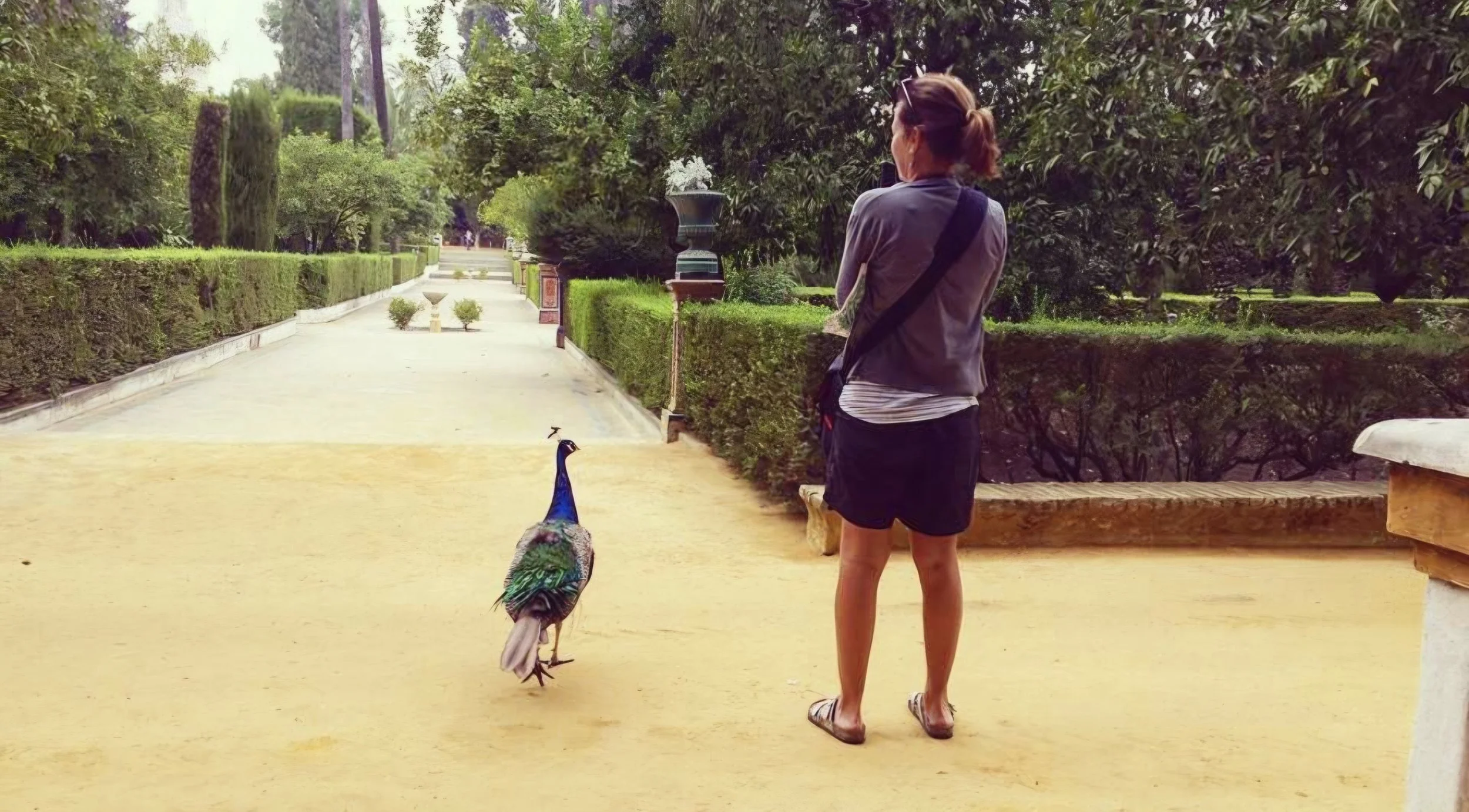
Image - Kellie enjoying the beautiful Alhambra Gardens, a few years ago. A quiet moment of feeling peace, awe and wonder, …….. with an unexpected new friend.

But culture is just the backdrop. The more intimate teaching happens closer to home.

In many families, emotions, particularly big, difficult ones, were not something that could safely exist in the shared space. Not because parents were cruel, but because they were human; carrying their own unprocessed histories, their own unmet needs, their own nervous systems doing the best they could.

Children are exquisitely attuned to the emotional climate of their home. They feel the tension before anyone speaks. They notice the shift in atmosphere when a particular topic is raised. They learn, with remarkable speed, which feelings are welcome and which ones make the air go strange.

So they adapt. They make themselves smaller. They learn to swallow the tears, contain the anger, perform the calm. Not because they were told to, though sometimes they were, but because they felt what happened in the room when they didn't. The withdrawal. The anxiety. The subtle but unmistakable signal that this was too much.

This is not a failure of the child. It is a profound act of adaptation. The child keeps the peace. The child holds the system together. The child learns that their inner world is less important than the emotional stability of the adults around them. The problem with this is it is not the child’s role in the family system to hold space. They don’t have the capacity in their own bodies to do this. Their nervous systems grow well when they have support and co-regulation for parents and caregivers.

That learning doesn't leave when we grow up. It becomes the architecture of how we relate to ourselves.

For some, this went even further. Perhaps there was a parent who struggled, with depression, with alcohol, with the weight of their own unresolved grief. Perhaps the emotional temperature of the household was genuinely unpredictable, and learning to monitor and manage it became a matter of felt safety.

These children became extraordinarily skilled at reading other people. They developed a finely calibrated sensitivity to mood, to need, to the earliest signs of distress in those around them. They learned to intervene before things escalated. To soothe, to deflect, to become whatever the moment required.

What they didn't learn was how to turn that same attention inward.

When your nervous system is organised around tracking others, when your survival, in some early and embodied sense, depended on getting that right , your own feelings become background noise at best. At worst, they feel like a liability. An indulgence. Something to be attended to only once everyone else is okay.

Which, of course, is never. Because these choices were intelligent strategies that our nervous system made, that helped us survive moments when protection, choice and support was missing. Over time they become habituated responses, very strong neural pathways that keep us alive. Those intelligent responses live in the nervous system and tissues; muscles stay contracted, breath stays shallow and the body stuck in a fight response, prepared for a fight that is no longer happening.

Culturally we started to notice in workplaces that we had a problem with poor emotional regulation and here's where it gets interesting.

Emotional disconnection, burnout, relational breakdown, it became impossible to ignore so we developed a response and we called it Emotional Intelligence.

We built frameworks. Competency models. Training programmes. We gave people a vocabulary for their inner world and a five-step process for navigating it. In many ways, it was very well-intentioned a genuine attempt to bring feeling back into professional and personal life. I want to say I think it is brilliant that organisations started to highlight this because left to their own devices, many people wound never come across this content. As I always say, you have to start somewhere.

But look at what we actually did. We took the most embodied, relational, lived thing there is and…. we put it in a PowerPoint. We made emotion into a skill to be optimised. Name the feeling, manage the feeling, deploy the feeling strategically. Which means it's still, fundamentally, a head operation. You're just thinking about feelings in a more sophisticated way. The body, where the feeling actually lives, barely gets a mention.

Emotions arise from the nervous system particularly the limbic system. This is a different part of the brain to the neo-cortex which is receiving this powerpoint information, which is all about logic and reason. If you want to build emotional capacity you have to work with those parts of the brain where implicit memory lives and you do it through the language of the nervous system, which we call ‘The felt sense’.

This, I think, tells you everything about how deep the conditioning runs. That even our solution to emotional disconnection had to be made safe by intellectualising it. We couldn't let it be messy and bodily and unquantifiable. It had to have a score. A framework. A return on investment.

We looked at the problem of not feeling and responded by finding a more sophisticated way to not feel. There is a huge cost of staying ‘just north of yourself’.

When we consistently move away from sensation, the feelings don't disappear. They go underground deep into our unconscious. They show up as anxiety without a clear source, as a vague flatness, as a body that's always tense for no reason you can name. They emerge sideways in sudden irritability, in chronic pain, in the persistent sense that something is off even when life looks fine on paper.

There's also a quieter cost. When we numb or bypass the difficult feelings, we inadvertently turn down the volume on the good ones too. Joy becomes harder to access. Aliveness feels further away. We go through the motions of a full life while feeling strangely absent from it.

Perhaps most poignantly, when we can't feel our own experience, we cannot feel others’ and we struggle to feel genuinely met by others. The connection we most want keeps glancing off a surface we've spent years polishing smooth. In relationships this is a major driver of loneliness because we cannot connect with our emotions let alone talk about them and share what is deep in our heart with another. That level of vulnerability is terrifying.

The body keeps the ledger, it waits, sometimes for decades, for the conditions to be safe enough to finally put some of it down.

We often talk about feeling feelings as though it's a matter of bravery of simply deciding to stop avoiding and diving in. But that framing misses something important.

Feeling, especially for those of us who learned early to move away from sensation, is a capacity that needs to be built. The nervous system needs to learn, slowly and with support, that it can be with experience without being overwhelmed by it. That sensation can be felt and survived. That there is enough space, enough ground, enough steadiness to actually let something land.

This is the heart of the somatic work I do with people. Not pushing into feeling, but gently expanding what can be experienced without the system needing to flee. It's slow work. It requires patience, curiosity, and a willingness to be a beginner in your own inner life.

It is some of the most important work I know.

Somatic work doesn’t force patterns to disappear it meets them with careful pacing and respect. Healing begins when we attend closely to the physiology and introduce layers of support that were not present in the original moment: co-regulation, steadiness, choice, support and the permission to be and move ever so slowly. Slow is more in somatic healing.

The nervous system begins to soften and loosen. It realises that it is no longer in a fight and the body learns that it does not have to hang on so tightly. The support that was missing is finally here.

If any of this resonates, here's a gentle place to start. The next time you notice an urge to reach for your phone, or to get suddenly very busy, or to launch into problem-solving mode, pause. Just for a moment.

Ask: what's happening in my body right now?

You don't need to feel everything. You don't need to go anywhere overwhelming. Just notice. A breath. A tightening. A warmth. A nothing.

That small, curious turn toward the body, that noticing, is the beginning of coming home to yourself.

This is unlike anything you'll find in a competency framework, nobody can teach it to you from the outside. It has to be lived, slowly, from within.

If you would like some support and learn how to build this capacity so that you have more energy to cope with what life throws your way, come talk to me.

Some reflections on Nostalgia and Collective Grief

There’s a trend circulating at the moment on social media. “Mum and Dad… what were you like in the 90s?” People are posting old photos, grainy images, oversized denim, sun-faded afternoons. There’s something almost tender about it. A collective wistfulness and I’ve noticed it in myself too.

Recently, I’ve been watching Ryan Murphy’s series on John F. Kennedy Jr. and Carolyn Bessette Kennedy. There’s something about it, the aesthetic, the pace, the feeling that evokes a different era. A quieter one. It stirs something. Not just memory but something deeper. The visuals evoke memories of my twenties living in London in the UK and times I visited New York in that time period.

Nostalgia is a slow form of grief where time shifts without our awareness. Chapters of our life end really quietly without much self awareness whilst we are living them. There are people, places and versions of ourselves that we never really got to say goodbye to, because we didn’t realise that we were at the end of something, until it was over.

We don’t really think of nostalgia as grief. Many of us learned that nostalgia was fondness or sentimentality. The yearning for the good old days. It is a felt sense, it’s very somatic; our senses are the gateway to our memories. A song comes on and reminds you of a time and place. You smell something and a whole era of your life comes flooding back. You might come across an old photo and as you look at it you remember the version of yourself that you see in your hand. How it felt to be that version of you. Sometimes you miss that version of yourself and sometimes you smile and think I am glad I am past all of that.

A few mornings ago, I was walking with my 17-year-old son. He’s been feeling the weight of the world lately like many young people are. The complexity of it. The uncertainty. The constant stream of information that never really lets the nervous system settle.

And he asked me: What was life like when you were 17, Mum?” So I told him about 1989. There were no mobile phones or internet. You rang your friends on the house phone and hoped they were home. People turned up when they said they would and most of the time you waited. We used to spend a lot of time waiting around for each other. Shops were closed on Saturday afternoons and Sundays. Nights were quieter. Life moved more slowly. As I spoke, I could feel something in my body soften. What was strengthened in our nervous system when we waited around was a greater capacity for uncertainty and a quiet trust that connection would come.

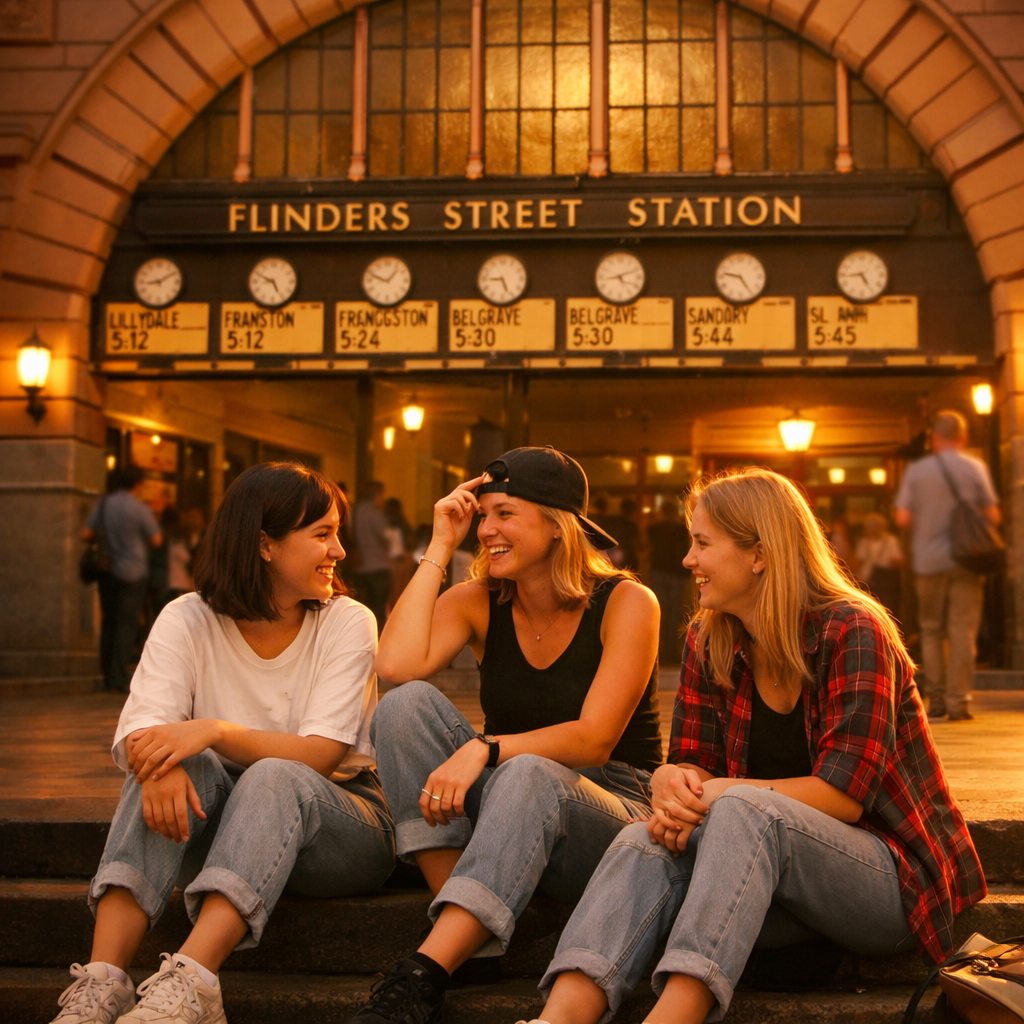
Digital image, Kellie Stirling. Waiting for our friends by the clocks.

Not because everything was better, it wasn’t. But because something about the pace of life was different. It was a little more contained, less exposed and relentless. I think that’s part of what we’re feeling when we experience nostalgia at the moment.

It’s often described as longing for the past but I don’t think we’re really longing for a decade. I think we’re longing for that felt sense. A way of being in ourselves when the world moved differently.

Later that day, I was in the car with my sons. My eldest, who’s nearly 20 and an engineering student at University, was driving. We were talking about fuel shortages and what might change in the future, electric cars, shifting systems, renewable energy options, the way the world is having to adapt.

I found myself asking: “What do you think we’ll learn from this?” He said, quite simply: “I think people have to realise that the only way we’re going to get through this is together. We have to collaborate. We have to support each other. We’ve got to change.”

I felt it land in my body as he spoke because in that moment, something shifted. Nostalgia looks back. But what he named looks forward. We can’t recreate the conditions of the 90s. The world is more interconnected now. It is more complex and demanding on our attention, our nervous systems, our capacity to process.

The slower pace we remember wasn’t just a lifestyle it was an environment that offered a kind of built-in regulation. There was less information, stimulation. and there were more natural boundaries between “on” and “off.”

That world doesn’t exist in the same way anymore. So the question isn’t, how do we go back? It’s: ‘How do we live well here? Perhaps this is where nostalgia becomes something more than wistfulness. Maybe it becomes a kind of remembering. Remembering not of a time but of what mattered and what was valued.

There was connection, presence and rhythm. It felt a little more spacious for our nervous systems and there was more connection and time spent in different types of community.

We are being asked to express those things differently now, not through simplicity, fewer inputs or retreating from the world, but through conscious collaboration with greater discernment. By learning how to stay connected within it.

What my son named, in that simple sentence, is something I see in my work every day. Whether I’m working with leaders, couples, or individuals navigating change the same truth emerges: we regulate in relationship and we find our way through complexity together.

So maybe the nostalgia many of us experiencing at the moment isn’t asking us to return to the past.

Maybe it’s helping us feel what we’re missing, so we can choose how to bring it forward. We may not get the slower world back, but we can create moments of slowness. We may not escape the complexity but we can learn to meet it with others, rather than alone.

I think perhaps that is the quiet invitation underneath all of this; not to go back but to become more intentional about how we live now.

Together.

Functional Freeze: When you are coping but not living

For many of the people I work with, they don’t arrive saying, “I’m traumatised.”  They arrive saying things like:  “I’m exhausted, and I am not sure why and I am thinking it might be related to trauma.” or “I am functioning but I really feel flat”.  Others feel like they have lost their spark and zest for life.  Some people know that something is inherently not right, their life looks fine but they feel ‘out of whack’, or sometimes stuck, something about their life is off.

They are holding jobs, relationships, families, leadership roles and often they are capable, intelligent, emotionally aware. Yet, deep inside, something feels stalled or a bit disconnected.

This is what we call, functional freeze.

What is functional freeze?

Functional freeze is a nervous system state where you are operational but disconnected.  Many of us have this in our body. Remember, our nervous system responses are very natural because our Autonomic nervous system (ANS) is our body’s surveillance system.  With functional freeze the brake and the accelerator are both on at the same time.  However, unlike collapse, where everything stops, functional freeze allows you to: keep working, keep caring for others, keep meeting expectations, keep “showing up”.

We can do all this but it comes at a cost.

We often find that the body is braced, that our emotional range narrows. So, joy, desire, creativity, and spontaneity have maybe quietly drained away.  From the outside, life looks fine. On the inside, we can feel numb, effortful, or strangely empty.

Functional freeze serves as a type of camouflage so it can render us, (or a part of us) invisible.  It allows us to be hidden in plain sight, just going through the motions.  The authentic part of ourself, our core essence, is unavailable for participation.

Digital Art, Kellie Stirling

How does functional freeze develop?

Functional freeze often develops in people who had to adapt early.  People who learned, consciously or not, to not be a burden.  They were told to just get on with it, that their feelings had to wait or, if they just kept on going, they would be ok.  It develops in children who couldn’t protest or leave, in relational systems where anger or need was not safe.  So people learn that compliance is a survival strategy.

Metaphorically, we become like the owl, invisible in the tree, feathers blending into the background.  Quiet, but with those big eyes taking everything.  Our flight is quiet and stealthy.  Often when we see an owl in the natural environment we are delighted. They are quiet, wise and all knowing and there are so many we often don’t see because of their expert camouflage. These strategies are not flaws.  They are intelligent adaptations to environments that didn’t reliably support emotional expression, rest, or dependency.

Many high-functioning adults grew up in families or cultures that rewarded: Independence, self-reliance, achievement and emotional restraint.  The nervous system learned to override sensation and emotion in order to keep moving. For a long time, this works.

Until it doesn’t.

Why functional freeze often shows up in midlife?

Midlife is a threshold.  Biologically, emotionally, relationally, the body begins to renegotiate capacity.  So what you could once tolerate, override, or push through starts to feel harder because hormonal shifts change stress tolerance.  This means that  emotional labour accumulates and this happens all in a time in life where caregiving, leadership, or relational demands increase.  Our nervous system starts to have less appetite for suppression and the allostatic load in our body, which is the amount of stress we can tolerate, hits a high.  Our body says “I can't do this dance of squashing everything done anymore, I am exhausted”.  To suppress our emotions and sensations requires an enormous amount of energy from our body.

Those old strategies that once kept you successful now feel unsustainable.

This is why people often experience midlife as a loss of motivation or meaning and where they may experience increased conflict in relationships.  Maybe they find themselves being emotionally reactive or irritable or that they are tired and wired, they have an exhaustion that rest does not fix.  Often there is a sense of “I can’t do this the way I used to’ and also a despair at feeling anchorless and uncertain of where to orient from and to next.

This isn’t failure.

It’s the body asking for a reorganisation, not more effort.

What is important to know is that functional freeze is not laziness or burnout.  It is not a low energy state, it is a contained energy state.  Mobilising energy is present but it is being actively inhibited, our body is working hard to not move.  People in functional freeze are often deeply conscientious.  They care a lot, they try and they keep on going.  What’s happening isn’t a lack of motivation, it’s a protective nervous system state.

Freeze conserves energy when the system has learned that stopping isn’t an option or that help wasn’t available.  It is a very quiet version of survival.

What helps functional freeze begin to thaw?

Functional freeze doesn’t resolve through insight alone.

Understanding why you feel this way can be validating  but it’s not enough.  What helps is gentle, titrated reconnection with the body, often through, slowing down without forcing rest and noticing sensation rather than analysing emotion.  It is about small experiences of choice, agency, and pleasure being experienced interoceptively.  It is about experiencing embodied relational safety and not having to perform anything.

We know when we are ‘thawing’ a bit because we might notice a deeper breath or an emotion coming up spontaneously.  We also might notice a clearer ‘no’ or ‘yes’ in our body when it comes to making choices or that we are able to rest for a moment without feeling guilty. These are not dramatic breakthroughs, they are signs of life returning.

The invitation of functional freeze

Functional freeze is not something to purge or cathartically push out.  It takes slow and gentle work and it is an invitation to stop living from adaptation and start living from presence.  To shift from coping to inhabiting your life.  With the right therapeutic support it is a nervous system state that you can come out of.

So that you can let your body, not just your mind, lead the next chapter.  For many people, this is the initiation of midlife: not becoming better at surviving, but becoming more available to aliveness, truth, and an authentic way of being in the world.

When our inner child is leading the fight

Our relationships can be the most fantastic containers for healing our inner child wounding. When we argue with our partners it is not our wise adult self having the argument it is almost always one of our adaptive childhood parts. These are the parts of us that learned very early how to survive emotionally in our families of origin.

When I work with couples through a systemic lens, I can see the recurring patterns that keep looping and generating conflict, alongside each partner’s adaptive child strategies. Once these patterns become visible, they’re impossible to unsee.

We think our fights are about the dishes, about a shutdown after a small comment, about tension around sex. Or maybe it is someone always needing to be right, or to be in control. Maybe it about someone who withdraws in the middle of tension, they clam up and say nothing. There is always something deeper there.

Artist unknown, From Burning Man

Once you see it, it makes a different kind of sense. The fight isn’t about the housework or the small irritations, those are just the signs. What’s really happening is that an adaptive child has taken the lead. The adaptive children are in the house.

It is our adaptive child that runs the fight. The problem with this is our adaptive child has no place running our adult relationships. It doesn’t have the discernment or capacity to make adult decisions.

The adaptive child is the part of us that learned how to stay connected, safe, or invisible in childhood. This is a very intelligent survival strategy that helped us survive when we were a child to stay safe. The only problem is that when this part is running the show in adult relationships, we don’t respond we react.

So when two adaptive children collide, the relationship quickly becomes a battleground rather than a place of safety.

In Terry Real’s framework, there are three common adaptive child imprints that often show up in adult intimacy. These are:

The Hero Child. This is the person who '“holds it all together.” They learned early that love came through competence, responsibility, or emotional caretaking. They took up a particular role in their family system and it was often either, the good one, the achiever, the surrogate spouse, the family therapist or they calmed things down.

They are often very competent, loyal and responsible people in their adult life. They show up, do their job and they do it well. They are often seen by others as competent, logical and good people.

When they are not good, what does that look like?

Well they can be passive sometimes and they are not particuarly good at being vulnerable because they have had to be good and responsible for a very long time. This means surrender, being open and receiving can be really challenging for them.

In adult relationships, this can look like:

  • Over-functioning

  • Carrying the emotional load for both partners

  • Resentment building beneath “being fine”

  • Struggling to ask for help or show vulnerability

When the Hero Child is activated, they often feel: “If I don’t manage this, everything will fall apart.” When they do eventually explode or withdraw, it often shocks their partner because their exhaustion has been invisible for a long time. The Hero child has had to hold a lot in the family system; in fact, they have probably been given more power than a child should have but it has not been based on them as an individual. It has been based on what the parents needed them to do to regulate the family system.

The Scapegoat Child. The scapegoat is the classic rebel or problem child. They learned that conflict, intensity, or acting out was the only way to stay seen. They often have very big feelings and express all that is not being expressed in the family system. They might be the person who fights with one of the parents all the time. Maybe the overbearing parent. They are often overtly or covertly shamed, being seen as the source of all the problems in the family.

In adult relationships, this can show up as:

  • Anger that feels bigger and disproportionate to the moment

  • Defensiveness or blaming

  • A sense of being misunderstood or unfairly criticised

  • Feeling chronically “wrong” or rejected

Underneath the reactivity is often a deep fear; fear that they are going to be shamed again. Often the whole family system can be organised around keeping this child in line. So they seem to carry a lot of power because everyone is walking around on egg shells around them. In some ways, they are the truth teller of what is not being expressed.

This child fights not to win but to protect against collapse. They are very emotional and often have big hearts. They are the rebels and the creatives of the world. Sometimes the bad boys. Why do we love the bad boys; because they have big hearts.

The Lost Child. The lost child runs their own race. Behind it is the belief, “If I disappear, I’ll be safe.”

The Lost Child adapted by minimising needs, emotions, and presence. The core wound here is often abandonment and that was learned early when this child went to their parent for co-regulation and they learned quickly that that was not available so they become independent and walled off as they have had to regulate themselves. They went and hid in their bedroom.

In adult relationships, this often looks like:

  • Withdrawal or emotional shutdown

  • Avoidance of conflict

  • Difficulty expressing wants or desires

  • A partner feeling shut out or alone

The Lost Child’s strategy isn’t disinterest, it’s self-protection. Their nervous system learned very early that connection is overwhelming or unsafe. There are lots of repressed emotions here because growing up there was no one they felt safe enough to be with to express how they were feeling.

When we eventually find a partner, the person we want to commit to, we often pick a partner that enables us to predictably repeat our role. Hence they saying ‘we marry our unfinished business’. We pair off with people who mirror the experience we received from our parents/caregivers so we can finally heal that pattern.

Why do fights often escalate so fast?

Here’s the key piece, when we are fighting from our adaptive child, we cannot access our Wise Adult self because our pre-frontal cortex, the part of our brain responsible for logical and rational thought, goes offline. We go into a survival response, our limbic system comes online and all our early adaptive patterns are alive and ready to go.

When we can stay in the Wise Adult part of ourselves we;

  • Can stay present

  • Can hold complexity

  • Can self-soothe

  • Can take responsibility without collapsing or attacking

But the adaptive child doesn’t have that capacity. Instead, the nervous system is organised around threat, survival and attachment loss. So the fight isn’t about the content. It is about our old unmet needs colliding in the present.

Two children are trying to feel safe, using strategies that once worked, but now damage intimacy. Our adaptive child strategies rarely serve us well in our adult relationships.

From Fighting to Repair

The work of adult relationship healing isn’t about erasing these parts. It’s about learning to:

  • Recognise when your adaptive child is running the interaction

  • Learning how to self soothe so that you can pause before responding

  • Build the capacity to come back online as your Wise Adult

  • Speak from the present rather than the past

This is deep nervous-system work. Because you can’t “think” your way out of an adaptive state.
You have to feel your way back into safety first. Only then can true repair happen.

The Quiet Shift That Changes Everything

When couples can see that this isn’t you versus me, but younger parts trying to keep us safe, the nervous system settles. Defensiveness eases, blame falls away, and curiosity makes space for compassion, for ourselves and for one another.

Very slowly, the relationship becomes less about winning or withdrawing and more about learning how to stay connected, even when it’s hard.

Here are some reflection questions for you to sit with.

  • When conflict arises in my relationship, what do I notice happening in my body first?

  • Do I tend to move toward fixing, fighting, or disappearing when things feel tense?

  • Which adaptive child strategy do you recognise most easily in yourself; the Hero, the Scapegoat, or the Lost Child? Do you see see a combination of two or maybe that you as you have matured you have moved from one to another?

  • What familiar loop do my partner and I seem to fall into when we’re under stress?

  • If this pattern had a job, what might it be trying to protect?

  • What old story or fear might be getting activated beneath the surface of our current conflict?

Fawning: why we mirror, merge and self-abandon

Seven years ago, I read Pete Walker’s book on complex PTSD, and it was the first time I truly understood the nervous system response of Fawning. I had known the behaviour as “people pleasing,” but I hadn’t realised until then that fawning was a protective response our body utilises. As I explored it more deeply, I realised it was everywhere and that it was not a personality trait, but a strategy our system uses to keep us safe, particularly in the face of a power-over dynamic.

How many times had I sat in conversations in the workplace where a person was labelled a people pleaser as it if was a personality flaw with no true understanding or curiousity of what was driving it. Let alone acknowledgement that this person does not feel safe. I realised right then that fawning shows up in so many ways. I see it in people who over-function, some organisations are run off the back of employing a workforce who constantly does this. Entire customer service cultures are built on fawning.

Fawning is a nervous system strategy that supports us to stay in connection when we feel unsafe and we are in a double bind; where there are real consequences for us not to fawn. We all do it. Women are a little more predisposed to it because we have lots of estrogen and oxytocin is the neuromodulator of our body. What that means is that bonding and connection helps us regulate and process our lives. It can come up at anytime because it is a strategy your autonomic nervous system uses to keep you safe. If it doesn’t work you go to fight and flight, then freeze. It is a cascade.

Men fawn too, not to soothe, but to belong. Male fawning often looks like “fitting in,” but underneath is the same physiology. In very masculine coded work cultures you see this all the time. Men fawn to avoid being the odd one out. They mute their sensitivity or complexity, mimic bravado or certainty, abandon their authentic relational needs and shape-shift to avoid being shamed.

Digital Art, Kellie Stirling. Woman merged with nature

When we fawn we shapeshift, so we morph into a version of ourselves that feels the most likely to keep us safe. For some people, fawning looks like becoming more of who they are; more charming, smart, generous, funny or adored. For other people it is about being less of who you are; less vocal, creative, smart, self-assured or even able to set boundaries. Fawning shows up sexually, in money situations or, in the constant emotional regulation of other people.

We all know about fight, flight and freeze. The fawning response is different because it is a hybrid of these. The hyperarousal part of fawning encourages us to lean into relationships that are causing us harm so we to appease the person. The flight response, self-abandoning to stay safe. The hypoarousal part, or freeze part, numbs our connection to our needs and desires, so we don’t feel the effects of the harm we are experiencing.

When we fawn, we mirror or merge with someone else’s desires or expectations of us to stay safe. We do this to defuse potential conflict because that is our best chance of maintaining safety. In most of these situations there is a power over relationship. Someone has power over us. When we merge or mirror, whilst it keeps us safe, we forgo our own desires and agency and become overly accommodating of others. We become shapeshifters moulding ourselves to each scenario and person. We abandon ourselves, what we care about, our opinions, desires and what we value.

Fawning is so culturally imbued in our society that we are conditioned from a young age to do it. Think of these statements: “give your uncle a kiss”, “be the better person”, “take the high road’, “be a team player’, “you have to learn to compartmentalise it'‘, “just go with it”. We say these every day and they normalise fawning.

Fawning is a common coping system for people dealing with ongoing relational trauma. It also occurs in larger systems of oppression or marginalisation where we must let go of aspects of ourselves to secure membership or a sense of belonging. Over time fawning becomes a systemic pattern.

Individuals don’t just fawn, systems induce fawning. Some examples I see frequently include: A leader who is dysregulated will have a whole team fawning to avoid triggering them. A family with a narcissistic parent creates children who become emotional caregivers or family systems with rigid hierarchy. Workplaces where vulnerability is punished. Relationships where one partner regulates through dominance.

Fawning is not a personal pathology; it’s a predictable adaptation to power-over cultures. So you can see it is not about being nice, it is a nervous system adaptation to relational power dynamics.

One of the deepest wounds of fawning I have observed is the disconnection from anger. Many fawners cannot feel their anger; not because it isn't there, but because it has been repressed for survival. Anger felt too dangerous, too destabilising, too likely to provoke retaliation or abandonment.

So internally, they learned that their anger was not safe and put them at risk. The thing is their anger doesn’t disappear, it goes underground. Into the unconscious.

Over time, this suppressed anger can turn into resentment, chronic tension because you are constantly bracing, exhaustion or collapse, health issues particularly autoimmune issues and a fierce inner critic who constantly self blames.

Restoring healthy aggression, the energy of our boundaries, clarity, and self-protection is essential. But it must be done slowly. Really slowly. Because letting that much anger thaw all at once can overwhelm the system that originally buried it to stay safe.

How do we stop Fawning?

Well it starts with finding safety in the body. You can’t talk yourself out of a fawn response nor can you mindset your way through it. Your nervous system needs to feel safe in the body to try anything new.

The work looks like being able to notice the early cues the anticipatory smile, the shallow breath, the scanning of the other person’s mood and gently interrupting the impulse to fix or appease. Learning to feel tiny drops of healthy anger in an incredibly titrated, slow and digestible way. Allowing the internal critic to soften, which often happens naturally when anger can finally move outward instead of being turned inward

Learning to stop the fawn process from being pervasive is the process of reclaiming power-within, instead of surviving through power-over dynamics. Our fawning response is wisdom it is not a flaw. It has kept us safe and will continue to do so, when we need it in the moment. Our fawn has kept the peace and helped us to function in environments that could not hold our full aliveness.

It is profoundly healing for us to notice our fawn patterns (and to continue to be able to notice them in the moment) and gently let them loosen their grip. Over time it becomes a survival strategy we have access to, not our default mode of functioning. When you start to let go of it you are not losing the nice aspect of yourself, you are becoming more You.

Menopause, coming home to the body's wisdom

It is world menopause awareness month, and like I do every year, I am going to write about it and focus on it for a few weeks. I coach clients through many different life transitions, and menopause wrapped into our broader midlife transition, is the most challenging many people experience. That is because for many of us, our body is going through such a profound shift and biological rewiring, that most of us cannot push through it.

Which is annoying for many because if you are a Gen Xer, you learned to be the Queen of the push through.

Much of the conversation around menopause today is about managing symptoms; balancing hormones, finding the right supplement, or seeking a medical fix for what feels uncomfortable. While these supports can be helpful, they only touch the surface of what this transition is truly inviting us into.

Menopause is not a medical condition to be managed. It’s a profound biological and emotional reorientation; a call to come home to the body’s wisdom after decades of living in our heads, pushing through, and taking care of everyone else.

For many of the women I work with, mostly Gen X women, this transition feels like hitting a wall. For those of us who grew up in the 1960s and 70s, a time when emotional awareness simply wasn’t part of family life, we are suddenly faced with a bucket load of previously ignored feelings and we cannot seem to stop them anymore. We never learned how to safely experience them in the first place. Major things happened in our families and in our communities when we were growing up, and often, no one talked about them. We spent our teenage years roaming the streets after school, hanging out with friends, figuring life out on our own. There was freedom in that, but also a quiet loneliness. We learned early on that to cope, we had to hold it together and we had to do that on our own or learn from each other.

I don’t know about you but I have never met a teenager with a regulated nervous system; its more about co-dysregulation that co-regulation. Which is not surprising given the hormonal shifts and brain rewiring going on in their bodies. Guess what? Our bodies are doing the same thing but in the opposite direction, preparing us for the next stage of life.

As a result, many of us became women who are both hyper-independent and who have incredibly high standards. We are for the most part, competent, capable, and relentlessly self-sufficient. We learned to fix things, to keep going, to never need too much. Somewhere along the way, we equated worthiness with being in control.

But menopause calls all of that into question.

The body begins to speak in new ways through heat, sleeplessness, tears, irritability, or sudden waves of emotion that can feel both foreign and inconvenient. These aren’t problems to be solved; they are signals from the body, asking for attention, softness, and presence.

In my work, I see how powerful it is when women learn to be with what’s happening rather than fight against it. When we slow down and notice the sensations moving through us, the tightness, the bracing, the pulsing, the warmth, the ache, we start to rebuild a relationship of trust with our own body. Over time, this presence helps us gently accept what arises and to fully inhabit our experience.

Many people find at this time in life they have to go back and educated themselves on many things about their body, particularly the impact of changes to our sex hormones, on the hormonal cocktail within our body. It is not just about estrogen and progesterone, there is also insulin, ghrelin, leptin and cortisol levels that are impact by these shifts. They impact both our metabolic health and also our emotional health because our endocrine system is the deepest system in our body and all our body systems work together.

As women learn about their changing body they become more comfortable in their it; they often notice that their relationships shift too. When we’re no longer fighting or fleeing from our own discomfort, we stop projecting it outward. There’s less reactivity with our partners, our kids, our colleagues. There’s more space for connection, empathy, and repair.

There is often a bit of work to do here because most of us did not have our emotional lives fostered as children and teenagers. Combine that with a good whack of cultural shame about having feelings, about women’s menstruality, about being a good girl and not rocking the boat, there is a lot of unpack.

Menopause will show you where you need to focus your attention because it will bring it up front and centre for you to pay attention to. If you don’t attend to it, it will just hang around until you do. So that anger and resentment that has reared its head. That is your body’s wisdom asking you to learn to hold healthy aggression in your body. We need to have anger, it protects our boundaries, it keeps us safe and it fuels our passions.

This is one of the quiet gifts of menopause: it brings us back into relationship, first with ourselves, and then with others.

But this process isn’t easy for our generation. We were raised to keep moving, to stay strong, to fix. Softening, resting, and receiving can feel unnatural, even wrong. Yet that’s precisely what this life stage is asking of us. It’s a somatic initiation, a shift from doing to being, from control to surrender, from self-criticism to self-compassion.

When we begin to trust the body’s wisdom, menopause becomes less about loss and more about liberation. It’s an opportunity to unlearn the old patterns that kept us safe but small, and to step into a more grounded, embodied form of power. One that no longer relies on effort, but on presence.

Menopause isn’t the end of vitality. It’s the beginning of living from a deeper, wiser rhythm, one that the body has known all along. It is a gentle reminder to pause, breathe and notice what your body is telling you.


Do you ever wonder why breakups physically hurt even when we are over the person?

I was reflecting recently on something I’ve felt myself and seen in many clients: that even when you know your relationship is over, your body might still ache with a different kind of grief — the loss of the other body. The loss of the nervous system pattern you've known.

You see when we end a long term relationship, whether it be an intimate or close platonic relationship, it is not only the financial and logistical separation and negotiation that happens. Our bodies keep the score and there is a physical separation of nervous systems that have entrained to each other.

Our nervous systems attune to the bodies we live with. Even if the relationship was painful or over long ago, your body might still long for their touch, their presence, even their smell.

This isn’t about wanting the person back — it’s about missing the co-regulation, the shared rhythm your nervous systems built together. It’s why sleeping alone can feel painful. Why your skin aches. Why you cry and you don’t know why.

Entrainment is when two nervous systems get in sync with each other, a bit like two clocks ticking together or two metronomes lining up. When you live with someone, your breath, heart rate, stress patterns, and even sleep rhythms start to line up with theirs. Your bodies learn each other. That’s why, when they’re gone, your body still remembers that pattern — and it can feel strange or even painful until you find a new rhythm.

The entrainment of nervous systems, especially in close relationships, is such a subtle and powerful force. It’s part of why even dysregulated relationships can be hard to leave — because the body gets patterned into that rhythm, even if it’s chaotic or unpredictable. I some times think of this phenomena as co-dysregulation.

In healthy relationships, this entrainment creates a deep sense of safety and grounding. But in any relationship with proximity over time, the nervous systems begin to sync — breath to breath, step to step, sleep cycles, even hormone levels. It's primal. It's ancient. And when it’s gone, the body doesn’t just let go because the mind says it should.

When this stops, the body reacts with disorientation, grief and longing.

This isn’t about missing the person romantically or doubting the decision. It’s about the withdrawal of co-regulation — a physical and energetic loss. Where there was once a warm body, there is now space. The nervous system goes through a recalibration, and sometimes, a kind of withdrawal.

We can experience shame and confusion around this.

Many people feel embarrassed or confused by their grief, especially if they initiated the separation or felt clear. They may wonder: “Why am I crying? Why does my chest ache? Why do I feel so alone? It is important to normalise that this is nervous system memory, not a sign that they’ve made the wrong choice.

What are some practices that can support you?

  • Orient to touch — a hand on the heart, a warm wrap, a pillow beside your body in bed.

  • Use scent, rhythm, and sound to create new patterns of regulation.

  • Let the body feel the grief — let the tears, the ache, the longing move. The body needs to move downward to express grief so sometimes, lying on a soft nest of pillows can be a really supportive way to do this.

  • Use nature, animals, breath, or trusted others to co-regulate in new ways.

Remember, relationships ending can be both a liberation and a loss. Our bodies are sometimes slower than our minds when it comes to moving on and they ask us to honour what was, whilst we are moving into what is next for us.

The invitation here is to trust the wisdom of your body and honour this unique grief without judgment.

Digital Art - Kellie Stirling

Co-regulation, sharing joy, awe and wonder

My husband and I go for a walk most days. It’s our rhythm — a way to move our bodies and catch up on the day. Yesterday, something unexpected caught our eye. Tucked along the top of a fence were a handful of tiny plastic ducks, placed as if they'd just wandered into the world on their own. There was no sign, no explanation. Just… ducks.

We both smiled, paused, and shared that kind of gentle, wide-eyed delight you get when something small pierces through the ordinary — wonder, joy, amusement. We giggled and wondered who might have placed them there. There are several schools in the area and we thought maybe one of the high school students. We wondered, is it art? Is it a puzzle? Or, did someone do it just for their own delight? And as we walked on, I noticed: I felt better. Not just because of the ducks, but because of how we felt together.

You see, you could have easily missed these tiny ducks they were as big as an Australian 5 cent coin. If you were caught in your head thinking about some problem, or looking elsewhere, looking at your phone, you would never have seen them. I will admit my husband saw them first, I was looking at some trees wondering when winter will end and when might the leaves start to arrive. As we started looking together, we saw 8 little ducks along two streets over an 800 metre stretch.

That moment we experienced together was co-regulation.

Co-regulation is more than a feel-good moment — it’s a biological necessity. Our nervous systems are constantly scanning the environment and people around us for cues of safety or threat (neuroception). When we feel safe with someone, our ventral vagal system activates — this is the branch of the parasympathetic nervous system responsible for connection, calm, and social engagement.

Co-regulation is the process by which our nervous systems connect and attune to one another, helping each other return to a state of balance, calm, or connection; especially after stress or activation. It’s something we are wired for, from birth. In infancy, we rely on caregivers to regulate our nervous system through touch, voice, gaze, and presence. As adults, we continue to rely on co-regulation in our relationships, though we often forget just how powerful it is.

At its heart, co-regulation is:

  • Relational regulation: one person’s regulated state helping another feel safe, grounded, or more connected.

  • Non-verbal: eye contact, tone, facial expression, body language, even silence can co-regulate.

  • Mutual: it’s not about fixing, it’s about being with.

  • Built on safety: when we feel safe with someone, our nervous system can soften and settle.

Co-regulation matters to the nervous system because it is foundational to nervous system health supporting vagal tone, heart rate variability and overall resilience. It supports our emotional well-being because when we share these tiny moments of joy, we feel less alone and more supported, seen and understood. It fosters trust and attunement, between partners, within families, friendships and teams, Co-regulation is supportive of trauma healing. Remember Trauma occurs when we experience too much, too fast, too soon or too little for too long. Healing happens in safe relationships when we can go slowly together. It is fair to say that without co-regulation our nervous system could end up in a constant state of vigilance or shutdown. With co-regulation we slow down, we are more present and we expand our capacity to feel joy, grief, pleasure and connection.

How do we find these moments for co-regulation?

Well every day offers us opportunities of ‘moments of tiny joys’.

We often think co-regulation has to be deep, profound or emotional. It can be, and, it can also be simple and playful too. What matters is the shared presence and the ability to attune to each others experience.

When I was going through cancer treatment five years ago, I decided I wanted to practice orienting to pleasure and what feels good to support my nervous system. You see I knew that small moments of pleasure are very healing for the nervous system. So I used to go for a small walk twice a day. This was during the pandemic, so often I would see my neighbours and we would stop and chat from a small distance; remember we had to social distance, and my immune system was smashed from chemotherapy, so I really had to mind how close I got to people. But what I really attuned to was admiring people’s gardens and the plants and flowers. You see I love gardens. My husband and I really looked forward to these small walks because they helped both of us in our own way and we could appreciate the moments of tiny joy in what was a really tough time for us.

“Being awestruck dwarfs us, humbles us, makes us aware we are part of a universe unfathomably larger than ourselves… Wonder makes us stop and ask questions about the world… whether spectacular or mundane.”
— Phospherescence - Julia Baird

What are some practice ideas for you to find little moments of co-regulation with another person?

Walking rituals: Regular, low-stress time in movement and nature together.

Noticing beauty: Make it a shared game to find one “small wonder” each day — something delightful, surprising, or tender.

Name the moment: Saying aloud, “That’s so sweet!” or “That made me smile” helps anchor the moment and co-regulate more deeply.

Touch points: Eye contact, a hand squeeze, a shared laugh — they reinforce safety in subtle, nervous-system-friendly ways.

You can build a micro-ritual around this — one that supports connection even during stress or busyness.

So here is your invitation to think about what brings you shared delight, awe and wonder?

What are the small and unexpected things that bring you joy?

When was the last time you felt a quiet togetherness in a moment of delight?

Is there someone you could begin a small ritual of ‘tiny moments of joy’ with?

Remember, co-regulation doesn’t require words, big feelings or problem solving. It begins with another.

Healing through relationships

We often think of relationships as places of comfort, connection, and shared joy—and they are all of that.

But they’re also something deeper.

Relationships are living, breathing containers for healing. They are crucibles where our old wounds rise to the surface, not to torment us, but to be seen, held, and alchemised. We always attract our unfinished business. What this means is that we are attracted to partners who reflect to us our unhealed wounding.

A conscious relationship invites us into the heart of our own nervous system. It asks us to become fluent not just in our own responses—our shutdown, our reactivity, our need for space or closeness—but also in our partner’s unique nervous system language. This means noticing when they are in survival mode, not taking it personally, and offering co-regulation instead of criticism.

One of the greatest shifts in partnership is realising that love isn’t about giving what we want to give. It’s about learning what helps our partner feel safe, loved, and seen—and offering that. Sometimes, that means letting go of the fantasy that our partner will love us exactly the way we love them. It’s not about sameness; it’s about resonance.

But perhaps the most confronting truth is this: our relationships will trigger our deepest wounds.

They will unearth the parts of us that were abandoned, shamed, or neglected. The small child who felt invisible. The teenager who felt too much or not enough. The adult who’s afraid to need too deeply.

This is not a flaw in the relationship—it’s the sacred design.

To be in a mature, intimate relationship is to commit not just to the other, but to our own wholeness. It’s to say yes to healing the early imprints that shaped how we give and receive love. It’s to welcome the mirror that our partner holds up, even when it shows us the parts of ourselves we’ve spent years avoiding.

When we stay present in the hard moments—when we learn to pause, to soften, to stay in the body—we begin to integrate the unconscious, exiled parts of self. We stop abandoning ourselves, and as a result, we stop abandoning the relationship when things get hard.

In this way, relationship becomes alchemy. Not a bypass, not a fairy tale, but a soul forge—where two imperfect humans learn to love with depth, presence, and radical responsibility.

And from that place, we don’t just find intimacy.

We find home.

Why the feminine is the change maker - part 2

Last week I started this conversation about why the feminine energy in our culture tends to be the instigator of change. I know this is not always true but I do find that many women whether by choice or force of life events, tend to explore themselves deeply and the fact that we have this deep inner knowing which I talked about in last week’s blog which means we tend to read the ‘tea leaves’ and know when it’s time for change.

Anecdotally, when I think about all the training and professional development I have done over the years, there has always been a much higher percentage of female participants than male participants and so we notice this and we talk about it. You could complain about it and say men don’t do the hard work, but I don’t think this is entirely true because I have lots of male clients and friends who have committed to exploring themselves, but to be honest it is usually after something going really wrong in their lives. Maybe it is that it is women who are the instigators of change in relationships, in families, in cultures. Many studies of couples on relationships and marriages consistently show that around 70% of divorces are instigated by women.

There are many ways we can explore why this happens and I always love taking a Jungian lens on what is actually happening because it always explores the shadow side of everything which I find super interesting. If we look through a Jungian lens, It is always the masculine within the feminine that changes first. In Jungian parlance, the animus (the inner masculine in a woman) seeks direction, clarity, and forward motion. When a woman begins her transformation (say, through grief, menopause, creativity, or awakening), it’s often her inner masculine that reorients first, perhaps by finding new values, boundaries, or purpose. Once that internal alignment shifts, her outer relationships must also adjust. How I notice this in clients is they cannot pretend to be anything other than their authentic selves anymore and this often causes friction in different relationships in their lives as this authentic self in them is emerging. Things can be a bit wobbly for a while as she finds comfort with meeting these new parts of self.

And yes, often this catalyses change in the masculine partner or in the wider system. But not always right away. Sometimes the feminine awakens and moves first, and the masculine (whether internal or external) resists or lags—until it feels safe or necessary to catch up. That friction can either break the container or refine it.

Digital image - Womb in the Sky, Kellie Stirling

Why does the feminine change first?

In the simplest form, we are the ones who can create life and give birth to that. Even beyond biological birth, the feminine is the archetypal womb—the container that holds, gestates, dissolves, and re-emerges. This role isn’t limited to women, but in most systems, it is the feminine energy that initiates the deep work: the descent, the death, the regeneration. Women, especially at midlife, often step into this initiatory role on behalf of their families, partnerships, and communities.

It’s like we become the crucible in which the old dies and the new is born. Let’s look at it from a few different perspectives:

  • Biologically: Our hormonal cycles force us into regular encounters with change. Life transitions like menstruation, pregnancy, birth, perimenopause, and menopause demand transformation. For example, every month when we have menstrual cycles, we are moving through a cycle of change, a cycle of birth, death, rebirth metaphorically speaking that is experienced in an embodied way with our menstrual cycles.

  • Emotionally: The feminine is finely attuned to relational field dynamics because we have lots of estrogen which helps creates oxytocin. Our nervous system is regulated by oxytocin which acts as a neuro-modulator. Neuro-modulators fine tune and shape how our nervous system reacts to stimuli over time. So we become more relationally attuned and attuned to social safety. We feel what’s missing, what’s breaking down, or what wants to emerge sooner. So oxytocin plays an enormous role in regulating arousal, stress responses and healing.

  • Spiritual/Archetypal: The feminine holds the wisdom of the underworld. We know how to descend and return with insight. That’s where true alchemy happens.

So when it comes to relationships, often, when a woman begins to change, it upsets the systemic homeostasis of the relationship. If she holds the relational field (as is often the case), any shift she makes is deeply felt by the other. This can either provoke resistance or invite the partner to evolve too. Sometimes both. In this sense, women often become the alchemical fire that either transforms or reveals what’s no longer sustainable.


The Siren, the Queen Bee and the Journey back to Self

It was my birthday last week, I had a really great week. As I move further into my fifties I have to say I love this time in life so much. I remember one of my coach colleagues, who is ten years older than me, saying to me about 5 years ago, “Oh the fifties are the best”. I have to say that so far, I whole heartedly agree. There is something really great about not having your life run by estrogen and knowing yourself so well - and being more than happy to explore the deep and dark places when they come up. It is liberating. This is the thing about midlife, we talk about it being empowering and it definitely is. But it is more than that. It is liberation. It is not reinvention but remembering.

Midlife is the moment we stop performing. We descent, we grieve. And, we rise knowing who we are.

Over the weekend, I watched the Netflix series Sirens. I went in expecting dark comedy and fantasy. It was all that but there was also a lot of the cultural underbelly on display. And yes, there were nods to the mythical Sirens—those seductive, powerful figures feared for luring men to their doom—and to Persephone, who descends to the underworld and rises as Queen.

But what stayed with me was something more subtle. More familiar.

The story centred around women who contort themselves—twist their truth, their instincts, their bodies, their very being—to belong. And what shook me was how often I see this in the real world, especially in the women I work with. I see it on social media all the the time. I find it bizarre that there is a whole fashion trend of people dressing in a way that makes them look wealthy. The whole anti-ageing story crafted by the skincare industry; it is really insane. Why does a 65 year old woman have to have skin the looks like a 25 year old’s?

After watching, I turned to my husband and said something about how heartbreaking it was, but also how powerful it is to have a television show that cleverly shows us the mirror on the collective unconscious. He looked at me and said, “This is your work. You help people come back to their authentic selves, their essence.”

He was right.

So many of the people I work with—especially women in midlife—come to me having spent years (even decades) twisting themselves into shapes they were told would bring them love, safety, or acceptance. They’ve played the roles: the good daughter, the accommodating partner, the high-achieving professional, the one who keeps the peace. But beneath all that performance is often a profound grief: the grief of self-abandonment.

That shows up in many different ways, it can be anger, deep sadness and grief, and also a deep searching for something different or more.

Mythology offers us maps for these kinds of journeys. The Siren is often seen as dangerous, but perhaps she’s just a woman who refused to stay quiet. And Persephone? She was taken underground, but she didn’t just return—she rose transformed, a ruler in her own right. Stripped of her ego and connected to her core self.

There’s another layer to the story that cut even deeper. One of the central characters—the so-called “queen bee”—is replaced. (sorry for the spoiler if you haven’t watched it yet) She’s ousted by a younger, much less confident version of herself. At first, we’re led to believe, the Queen Bee is the villain; she was behaving pretty badly. Then we think the younger replacement maybe is, but we soon see the truth. It was her billionaire ex-husband, who represents the culture of patriarchy, who had the real power all along. A cultural narrative, that builds women up, shapes them to a particular taste, then discards them when it gets bored or their behaviour no longer suits.

And what struck me most is this:
She had contorted herself to make him/them happy.
She had shaped her power around what he wanted, not what was true for her.

I see this in so many women in midlife. They realise, often with some pain, that the power they thought was theirs… wasn’t. It was bestowed—by a relationship, a career, a title, a system. It could be taken away. And often, it is. They don’t know who they are without it.

That’s the heartbreak. But it’s also the turning point.

Because when a woman realises she’s been performing power rather than embodying it, she can begin a different journey. One that doesn’t require contortion. One that descends into grief, yes—but also into truth. Into agency. Into the kind of power that can’t be stripped away. She becomes authoring and starts to write her own story.

These stories speak to the deeper truth: that reclaiming your voice, your instincts, your knowing, often requires going into the underworld of your own psyche. It means feeling the grief of the parts you've left behind. It means listening to the song of the Siren—not the one the world fears, but the one that sings from within your own bones.

This is the kind of healing work I guide people through. It’s somatic. It’s slow. It’s deep. We listen to the body, not just the mind. We notice the nervous system patterns shaped by a lifetime of contorting. And over time, a different kind of belonging emerges—one that doesn’t require performance, one that comes from being rooted in your own truth.

The journey isn't linear. Like Persephone, we may descend many times in our lives. But each time, we bring back more of ourselves. And eventually, we stop contorting to fit the world—and start shaping a world that fits us.

It’s not about becoming someone new. It’s about remembering who you are when you stop performing. When you stop shaping yourself around what others want and start listening to your own body, your own knowing, your own nervous system.

If you're in that moment of reckoning…
If you're realising the version of power you held was conditional…
If you’re longing to come back to the essence of who you are—
I’d love to walk with you.

If this resonates with you—if you feel like you’ve been contorting for too long, or if you’re longing to find your way back to your own voice and centre—I’d love to support you. I offer one-on-one coaching and somatic work for women navigating life transitions, grief, and the reclamation of self. You can learn more about working with me or reach out to talk about coaching.

Your real power is not out there.
It’s in you.
And it’s waiting to be reclaimed.

Your journey home to yourself is sacred. You don’t have to do it alone.

Ghosting and silent treatment; miscommunication and the avoidance of deep intimacy

Ghosting and ‘the silent treatment’ are often framed as problems of miscommunication, or, poor communication skills. We often tell ourselves that the person simply didn’t know what to say, or how to say it, or that life got in the way. But at there core, ghosting and silent treatment are not just about a lack of words. They are about a deep avoidance of intimacy. This occurs in both intimate and platonic relationships.

For many, the ability to engage in honest, clear communication is not just a matter of willpower; it is a reflection of their nervous system’s capacity to hold emotional intensity. When someone disappears—leaves a conversation dangling, ignores a message, or cuts off connection without explanation—it’s rarely about us. It’s about their own inner world and the deep-seated discomfort they have with relational transparency. It is about not having the spaciousness inside of them, to express exactly how they are feeling.

The more we understand this, the more we can make empowered choices about who we invite into our most intimate spaces—and the more clearly we can recognise when someone’s silence is not just avoidance, but a form of emotional withdrawal known as the silent treatment. Like ghosting, the silent treatment is not a neutral act. It can activate deep wounding and confusion in the person on the receiving end, while giving the illusion of control to the one withdrawing. The truth is, the person is not doing this to get control of the situation, they are doing it to try and get some regulation back into their nervous system. They are overwhelmed by the emotions they are feeling and terrified of deep relational intimacy because they did not have the experiencing growing up where they could talk about their feelings openly and honestly.

They are using silence as a tool to resource themselves.

The Nervous System and Relational Avoidance

Our ability to communicate with honesty and clarity is deeply tied to our nervous system’s regulation. If someone has never developed the capacity to stay present with the discomfort that arises in difficult conversations, their body perceives deep intimacy as a threat. Their system does not register open-hearted honesty as safe.

For people who ghost, or struggle with direct communication, disappearing may feel like the only way to avoid overwhelm. It is not a conscious, malicious act—it is a survival response. Their nervous system is simply not equipped to navigate the vulnerability required for clear, honest communication.

It can hard to be the receiver of this. Silent treatment in a relationship can be very hard to receive, and many people who are on the end of it often feel very lonely in their relationship. They feel very misattuned to and very misunderstood because they are not receiving the mirroring or reflection of their experience back from the other person.


Image - Stockcake

Deep Intimacy Requires Capacity

Clear, open communication is not just a skill—it is an embodied experience. It requires us to feel the full range of emotions that arise when we are seen, when we express our truth, and when we hold space for another person’s truth in return. It means being with the discomfort of hurting someone’s feelings, of disappointing someone, of witnessing another’s emotional response without shutting down or fleeing.

But not everyone has built the capacity to stay present in these moments. Many have never been taught how to regulate their nervous system in the face of emotional intensity. They may have grown up in environments where difficult conversations led to conflict, abandonment, or emotional withdrawal. In these cases, avoidance becomes the learned response. Or maybe they grew up with parents who struggled to acknowledge their own emotions and learned that to express them was messy and unruly, so they would never have been able to be with their kids emotional expression. So the kids learn, we are safe and will receive love if we are very good children who do what we are told and do not complain. Over time, big emotions start to feel unsafe, so we push them away.

Some of us become masters of this and use our enormous willpower to push them down. Others soothe with food, alcohol and maybe drugs just to stay regulated. At some point, typically big life transitions, our body starts to push what has been repressed and ignored back up. This often shows up as conflict in relationships, physical health issues or the person feeling very lost and discombobulated and not knowing what is going on within themselves.


Reframing Ghosting, Silent Treatment and Miscommunication

When we experience ghosting, silent treatment or confusing miscommunication, it’s easy to take it personally. We might feel rejected, unworthy, or left in a state of anxious uncertainty. But understanding ghosting as a nervous system response can shift the way we hold these experiences. It allows us to see that this behaviour is not about us, but about another person’s limitations in holding intimacy.

This does not mean we excuse the behaviour. We can hold compassion for someone’s struggles while also recognising that a healthy, reciprocal relationship requires both people to be capable of presence, honesty, and emotional responsibility.

These behaviours are often rooted in avoidant attachment. When closeness feels threatening, the nervous system chooses distance over connection. Avoidant attachment creates a belief system (often unconscious) that says “If I get too close, I will lose myself’ or, ‘If I express my truth, it won’t be safe’ or maybe ‘If you need too much, I will disappoint you'“.

Moving Toward Conscious Communication

If we want to cultivate relationships rooted in trust and depth, we need to surround ourselves with people who have the capacity to hold both their own emotions and ours. We also need to deepen our own ability to stay present in the face of discomfort.

This means:

  • Strengthening our own nervous system regulation so that we can engage in honest conversations without collapse or reactivity.

  • Choosing relationships where both people are committed to staying in connection, even when it’s hard.

  • Recognising when someone’s avoidance is a sign that they simply do not have the capacity for the depth we seek.

  • Honouring our own worth, by not chasing people who are not available for honest, clear communication.

Ultimately, ghosting and silent treatment are not about miscommunication or poor communication —they are about an inability to stay in connection when things get emotionally complex. That inability is rooted in the nervous system’s struggle to feel emotions and feelings that allow us to hold and be present to deep intimacy that we can experience with another person when we have the capacity to be with their feelings. To listen to them, to see them and be able to stay with what they are feeling.

The more we understand this, the more we can make empowered choices about who we invite into our most intimate spaces.

If you would like to expand your capacity for deep intimacy in your relationships come talk to me about relationship coaching.