Adaptive Child

You can't think your way into feeling

Feeling your feelings is harder than it sounds.

We have increasingly found sophisticated ways not to feel. We've all heard it. Just feel your feelings. It sounds so simple , almost obvious. Yet, for most of us, it's one of the hardest things we'll ever do.

Not because we're weak, or broken, or doing something wrong. But because somewhere along the way, we learned that feelings weren't entirely safe. Then, quietly and collectively, we built an entire world that confirmed it.

The interesting thing about feelings is that they show us one simple truth, the body knows first. You know when you walk into the room and sense the emotional climate? That is what I am talking about, the nervous system reads the room first and we feel it.

Feelings aren't thoughts about emotions. They are physical events.

A tightening in the chest. A hollow opening in the stomach. Heat rising in the face. Heaviness settling in the shoulders like something invisible just landed there. The body receives experience first, before the mind has a chance to name it, frame it, or find somewhere useful to put it. Feelings don't live in your head. They live in tissue, in breath, in the subtle language of your nervous system.

So when we talk about avoiding feelings, what we're really talking about is learning to move away from sensation. From the body's own signal system and most of us have been doing it for so long, we don't even notice we're doing it.

The avoidance rarely starts as a choice. For most of us, it began as an inheritance.

We absorbed it from the culture we were born into, a culture that prizes productivity over presence, resilience over vulnerability, and forward motion over the messy, necessary work of actually processing what's happening inside us. “Push through. Stay positive. Don't dwell”. We've dressed emotional suppression up in the language of strength for so long that many people genuinely can't tell the difference between regulation and repression.

The "good vibes only" movement, for all its cheerful intentions, is perhaps the most recent iteration of a very old story; that difficult feelings are a problem to be solved rather than a signal to be heard.

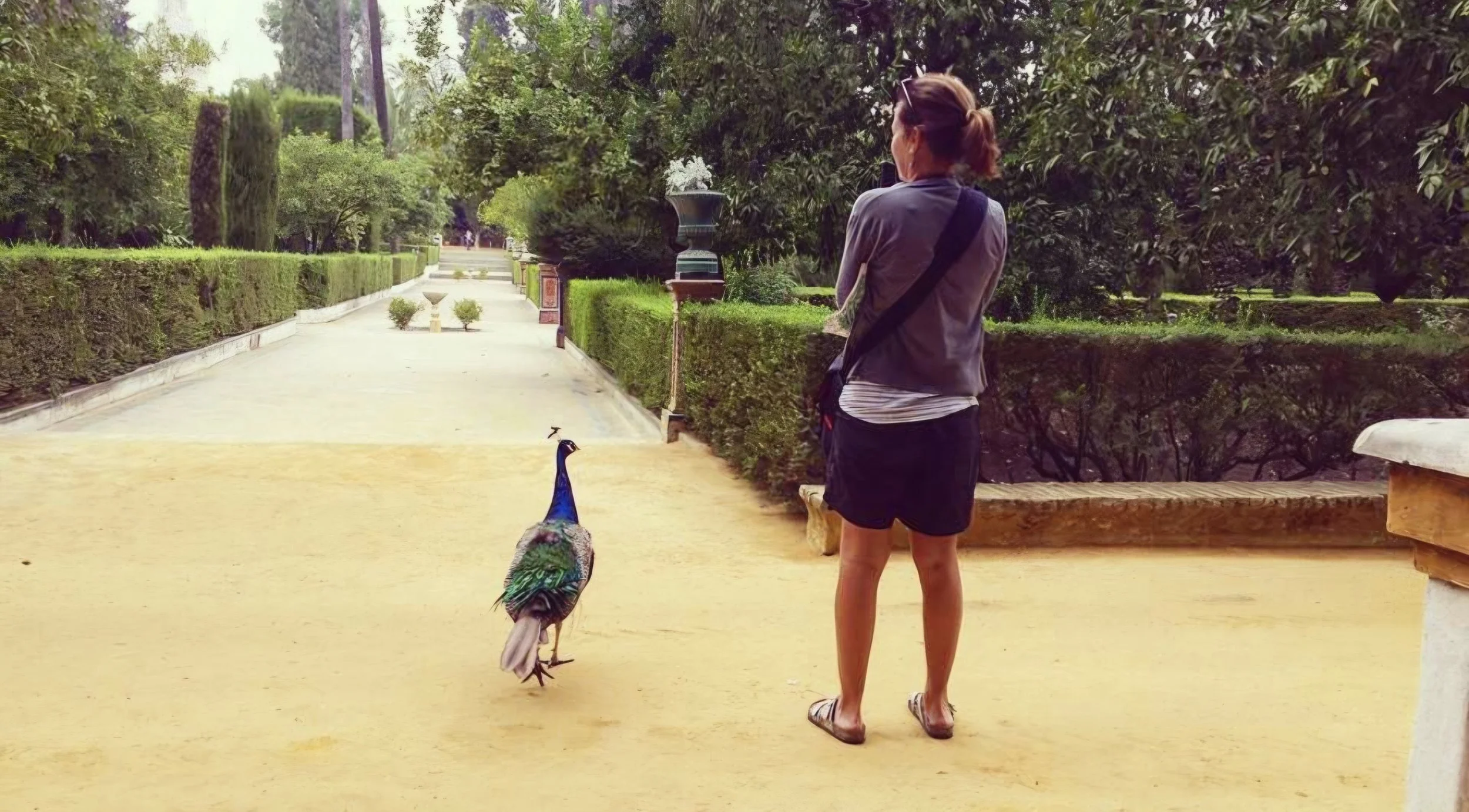
Image - Kellie enjoying the beautiful Alhambra Gardens, a few years ago. A quiet moment of feeling peace, awe and wonder, …….. with an unexpected new friend.

But culture is just the backdrop. The more intimate teaching happens closer to home.

In many families, emotions, particularly big, difficult ones, were not something that could safely exist in the shared space. Not because parents were cruel, but because they were human; carrying their own unprocessed histories, their own unmet needs, their own nervous systems doing the best they could.

Children are exquisitely attuned to the emotional climate of their home. They feel the tension before anyone speaks. They notice the shift in atmosphere when a particular topic is raised. They learn, with remarkable speed, which feelings are welcome and which ones make the air go strange.

So they adapt. They make themselves smaller. They learn to swallow the tears, contain the anger, perform the calm. Not because they were told to, though sometimes they were, but because they felt what happened in the room when they didn't. The withdrawal. The anxiety. The subtle but unmistakable signal that this was too much.

This is not a failure of the child. It is a profound act of adaptation. The child keeps the peace. The child holds the system together. The child learns that their inner world is less important than the emotional stability of the adults around them. The problem with this is it is not the child’s role in the family system to hold space. They don’t have the capacity in their own bodies to do this. Their nervous systems grow well when they have support and co-regulation for parents and caregivers.

That learning doesn't leave when we grow up. It becomes the architecture of how we relate to ourselves.

For some, this went even further. Perhaps there was a parent who struggled, with depression, with alcohol, with the weight of their own unresolved grief. Perhaps the emotional temperature of the household was genuinely unpredictable, and learning to monitor and manage it became a matter of felt safety.

These children became extraordinarily skilled at reading other people. They developed a finely calibrated sensitivity to mood, to need, to the earliest signs of distress in those around them. They learned to intervene before things escalated. To soothe, to deflect, to become whatever the moment required.

What they didn't learn was how to turn that same attention inward.

When your nervous system is organised around tracking others, when your survival, in some early and embodied sense, depended on getting that right , your own feelings become background noise at best. At worst, they feel like a liability. An indulgence. Something to be attended to only once everyone else is okay.

Which, of course, is never. Because these choices were intelligent strategies that our nervous system made, that helped us survive moments when protection, choice and support was missing. Over time they become habituated responses, very strong neural pathways that keep us alive. Those intelligent responses live in the nervous system and tissues; muscles stay contracted, breath stays shallow and the body stuck in a fight response, prepared for a fight that is no longer happening.

Culturally we started to notice in workplaces that we had a problem with poor emotional regulation and here's where it gets interesting.

Emotional disconnection, burnout, relational breakdown, it became impossible to ignore so we developed a response and we called it Emotional Intelligence.

We built frameworks. Competency models. Training programmes. We gave people a vocabulary for their inner world and a five-step process for navigating it. In many ways, it was very well-intentioned a genuine attempt to bring feeling back into professional and personal life. I want to say I think it is brilliant that organisations started to highlight this because left to their own devices, many people wound never come across this content. As I always say, you have to start somewhere.

But look at what we actually did. We took the most embodied, relational, lived thing there is and…. we put it in a PowerPoint. We made emotion into a skill to be optimised. Name the feeling, manage the feeling, deploy the feeling strategically. Which means it's still, fundamentally, a head operation. You're just thinking about feelings in a more sophisticated way. The body, where the feeling actually lives, barely gets a mention.

Emotions arise from the nervous system particularly the limbic system. This is a different part of the brain to the neo-cortex which is receiving this powerpoint information, which is all about logic and reason. If you want to build emotional capacity you have to work with those parts of the brain where implicit memory lives and you do it through the language of the nervous system, which we call ‘The felt sense’.

This, I think, tells you everything about how deep the conditioning runs. That even our solution to emotional disconnection had to be made safe by intellectualising it. We couldn't let it be messy and bodily and unquantifiable. It had to have a score. A framework. A return on investment.

We looked at the problem of not feeling and responded by finding a more sophisticated way to not feel. There is a huge cost of staying ‘just north of yourself’.

When we consistently move away from sensation, the feelings don't disappear. They go underground deep into our unconscious. They show up as anxiety without a clear source, as a vague flatness, as a body that's always tense for no reason you can name. They emerge sideways in sudden irritability, in chronic pain, in the persistent sense that something is off even when life looks fine on paper.

There's also a quieter cost. When we numb or bypass the difficult feelings, we inadvertently turn down the volume on the good ones too. Joy becomes harder to access. Aliveness feels further away. We go through the motions of a full life while feeling strangely absent from it.

Perhaps most poignantly, when we can't feel our own experience, we cannot feel others’ and we struggle to feel genuinely met by others. The connection we most want keeps glancing off a surface we've spent years polishing smooth. In relationships this is a major driver of loneliness because we cannot connect with our emotions let alone talk about them and share what is deep in our heart with another. That level of vulnerability is terrifying.

The body keeps the ledger, it waits, sometimes for decades, for the conditions to be safe enough to finally put some of it down.

We often talk about feeling feelings as though it's a matter of bravery of simply deciding to stop avoiding and diving in. But that framing misses something important.

Feeling, especially for those of us who learned early to move away from sensation, is a capacity that needs to be built. The nervous system needs to learn, slowly and with support, that it can be with experience without being overwhelmed by it. That sensation can be felt and survived. That there is enough space, enough ground, enough steadiness to actually let something land.

This is the heart of the somatic work I do with people. Not pushing into feeling, but gently expanding what can be experienced without the system needing to flee. It's slow work. It requires patience, curiosity, and a willingness to be a beginner in your own inner life.

It is some of the most important work I know.

Somatic work doesn’t force patterns to disappear it meets them with careful pacing and respect. Healing begins when we attend closely to the physiology and introduce layers of support that were not present in the original moment: co-regulation, steadiness, choice, support and the permission to be and move ever so slowly. Slow is more in somatic healing.

The nervous system begins to soften and loosen. It realises that it is no longer in a fight and the body learns that it does not have to hang on so tightly. The support that was missing is finally here.

If any of this resonates, here's a gentle place to start. The next time you notice an urge to reach for your phone, or to get suddenly very busy, or to launch into problem-solving mode, pause. Just for a moment.

Ask: what's happening in my body right now?

You don't need to feel everything. You don't need to go anywhere overwhelming. Just notice. A breath. A tightening. A warmth. A nothing.

That small, curious turn toward the body, that noticing, is the beginning of coming home to yourself.

This is unlike anything you'll find in a competency framework, nobody can teach it to you from the outside. It has to be lived, slowly, from within.

If you would like some support and learn how to build this capacity so that you have more energy to cope with what life throws your way, come talk to me.

The hidden cost of being the strong one

Did you grow up being the good child, the strong child or the one who kept it all together?

Some people learn very early in life how to carry more than others can see. On the outside, they look fine they are capable, reliable, calm under pressure. They are the ones everyone turns to.  They are often the strong one and the responsible one and the one who holds it all together.

But what most people don’t see is the cost because people who learned to over-give and over-function rarely fall apart in obvious ways. They just keep going, showing up, they keep caring for others and they keep managing what everyone else is feeling.

Who is looking out for this person?

Slowly and quietly, the cost accumulates.  It can look like exhaustion, burnout and loneliness.  Not because they don’t have people in their lives but because very few people actually see them.

People who carry this pattern often recognise themselves here:

• They overthink everything they say or do
• They feel responsible for other people’s emotions
• They struggle to ask for help
• They rarely talk about what’s really hurting inside
• They smile even when they feel overwhelmed
• They put everyone else’s needs before their own

From the outside, it looks like strength however on the inside, it often feels like survival. Over time, they may find themselves disconnected from their own needs, unsure who they are underneath the roles they’ve learned to carry.

Many of them quietly wonder when was the last time that they felt truly understood and seen for who they really are.

For most, this pattern didn’t begin in adulthood but rather in childhood. These children grew up in an environment where the adults around them did’t have the emotional capacity to hold their feelings. So they adapted and became the good child or the strong child. The responsible child, the one who had to maintain the energy in the family to keep the peace. They learned to read everyone in the room by developing a finely attuned radar and so now we might know them as an empath or call them hypervigilant.

Their nervous system learned that staying safe means managing the emotional environment around them. So they become quiet, easy, helpful. They learned how to keep themselves small and shapeshift into the environment around them so they never caused any trouble.

Their emotions weren’t mirrored back to them, so they become the child who understands everyone else but who isn’t truly understood themselves.

Another of their clever adaptive strategies was to learn never to rely on anyone else. They became magnificently independent to protect themselves. This is because when they asked for help in childhood that lead to being dismissed, misunderstood, or blamed. In time, the nervous system learns something important, that it’s safer to rely on yourself.

So these children grow up to become adults who are extraordinarily capable. They become their own parent, protector and stabiliser.

People admire them for their strength.

Underneath all that strength is often a quiet exhaustion, because no one was meant to carry everything on their own.

At its core, this pattern often carries a deep wound of abandonment. Of self-abandonment. They learned to stop listening to their own body, to their own needs, to put everyone else first to stay safe, to receive love and to feel a deep sense of belonging.

However they have a very deep sense of longing not to actually give less but to be seen, known and to be able to be themselves. To be able to receive all of this without having to earn love through caretaking, perfection, or responsibility.

All this requires them to be vulnerable however when someone gets close fear often appears because in the past being vulnerable has not been safe. So connection is longed for and at the same time it is also frightening.

We can heal this pattern when we start to include ourselves in our circle of care. When we find and reconnect with the protective part of ourselves that learned to over-function in order to survive, the wounded inner child who learned if you keep it all together you will be loved. You begin offering that part of yourself something new.

You might say to this child part of you, “I'm safe now. It's safe to rest. You don't have to carry everything anymore’.

Healing might also means choosing relationships that feel different. It might look like choosing people who can meet and hold all of your emotions and feelings. It might mean finding people who can actually see you.

When you focus on healing these wounded child parts, you will find that not everyone will respond the way people did in the past. As you learn that, slowly through experience, you will notice how trust begins to rebuild. One tiny step at a time.

Over time, the same things you once gave endlessly to others, begin to return to you. Care, kindness, patience, compassion and understanding will come your way.

This time it will be different because you have learned to give them to yourself too, not because you have stopped caring about others, but because you are no longer abandoning yourself in order to belong. Slowly, something new begins to grow. A sense of home inside yourself, a place deep in your heart where all your parts are allowed to exist, simply because you are here.

Functional Freeze: When you are coping but not living

For many of the people I work with, they don’t arrive saying, “I’m traumatised.”  They arrive saying things like:  “I’m exhausted, and I am not sure why and I am thinking it might be related to trauma.” or “I am functioning but I really feel flat”.  Others feel like they have lost their spark and zest for life.  Some people know that something is inherently not right, their life looks fine but they feel ‘out of whack’, or sometimes stuck, something about their life is off.

They are holding jobs, relationships, families, leadership roles and often they are capable, intelligent, emotionally aware. Yet, deep inside, something feels stalled or a bit disconnected.

This is what we call, functional freeze.

What is functional freeze?

Functional freeze is a nervous system state where you are operational but disconnected.  Many of us have this in our body. Remember, our nervous system responses are very natural because our Autonomic nervous system (ANS) is our body’s surveillance system.  With functional freeze the brake and the accelerator are both on at the same time.  However, unlike collapse, where everything stops, functional freeze allows you to: keep working, keep caring for others, keep meeting expectations, keep “showing up”.

We can do all this but it comes at a cost.

We often find that the body is braced, that our emotional range narrows. So, joy, desire, creativity, and spontaneity have maybe quietly drained away.  From the outside, life looks fine. On the inside, we can feel numb, effortful, or strangely empty.

Functional freeze serves as a type of camouflage so it can render us, (or a part of us) invisible.  It allows us to be hidden in plain sight, just going through the motions.  The authentic part of ourself, our core essence, is unavailable for participation.

Digital Art, Kellie Stirling

How does functional freeze develop?

Functional freeze often develops in people who had to adapt early.  People who learned, consciously or not, to not be a burden.  They were told to just get on with it, that their feelings had to wait or, if they just kept on going, they would be ok.  It develops in children who couldn’t protest or leave, in relational systems where anger or need was not safe.  So people learn that compliance is a survival strategy.

Metaphorically, we become like the owl, invisible in the tree, feathers blending into the background.  Quiet, but with those big eyes taking everything.  Our flight is quiet and stealthy.  Often when we see an owl in the natural environment we are delighted. They are quiet, wise and all knowing and there are so many we often don’t see because of their expert camouflage. These strategies are not flaws.  They are intelligent adaptations to environments that didn’t reliably support emotional expression, rest, or dependency.

Many high-functioning adults grew up in families or cultures that rewarded: Independence, self-reliance, achievement and emotional restraint.  The nervous system learned to override sensation and emotion in order to keep moving. For a long time, this works.

Until it doesn’t.

Why functional freeze often shows up in midlife?

Midlife is a threshold.  Biologically, emotionally, relationally, the body begins to renegotiate capacity.  So what you could once tolerate, override, or push through starts to feel harder because hormonal shifts change stress tolerance.  This means that  emotional labour accumulates and this happens all in a time in life where caregiving, leadership, or relational demands increase.  Our nervous system starts to have less appetite for suppression and the allostatic load in our body, which is the amount of stress we can tolerate, hits a high.  Our body says “I can't do this dance of squashing everything done anymore, I am exhausted”.  To suppress our emotions and sensations requires an enormous amount of energy from our body.

Those old strategies that once kept you successful now feel unsustainable.

This is why people often experience midlife as a loss of motivation or meaning and where they may experience increased conflict in relationships.  Maybe they find themselves being emotionally reactive or irritable or that they are tired and wired, they have an exhaustion that rest does not fix.  Often there is a sense of “I can’t do this the way I used to’ and also a despair at feeling anchorless and uncertain of where to orient from and to next.

This isn’t failure.

It’s the body asking for a reorganisation, not more effort.

What is important to know is that functional freeze is not laziness or burnout.  It is not a low energy state, it is a contained energy state.  Mobilising energy is present but it is being actively inhibited, our body is working hard to not move.  People in functional freeze are often deeply conscientious.  They care a lot, they try and they keep on going.  What’s happening isn’t a lack of motivation, it’s a protective nervous system state.

Freeze conserves energy when the system has learned that stopping isn’t an option or that help wasn’t available.  It is a very quiet version of survival.

What helps functional freeze begin to thaw?

Functional freeze doesn’t resolve through insight alone.

Understanding why you feel this way can be validating  but it’s not enough.  What helps is gentle, titrated reconnection with the body, often through, slowing down without forcing rest and noticing sensation rather than analysing emotion.  It is about small experiences of choice, agency, and pleasure being experienced interoceptively.  It is about experiencing embodied relational safety and not having to perform anything.

We know when we are ‘thawing’ a bit because we might notice a deeper breath or an emotion coming up spontaneously.  We also might notice a clearer ‘no’ or ‘yes’ in our body when it comes to making choices or that we are able to rest for a moment without feeling guilty. These are not dramatic breakthroughs, they are signs of life returning.

The invitation of functional freeze

Functional freeze is not something to purge or cathartically push out.  It takes slow and gentle work and it is an invitation to stop living from adaptation and start living from presence.  To shift from coping to inhabiting your life.  With the right therapeutic support it is a nervous system state that you can come out of.

So that you can let your body, not just your mind, lead the next chapter.  For many people, this is the initiation of midlife: not becoming better at surviving, but becoming more available to aliveness, truth, and an authentic way of being in the world.

When our inner child is leading the fight

Our relationships can be the most fantastic containers for healing our inner child wounding. When we argue with our partners it is not our wise adult self having the argument it is almost always one of our adaptive childhood parts. These are the parts of us that learned very early how to survive emotionally in our families of origin.

When I work with couples through a systemic lens, I can see the recurring patterns that keep looping and generating conflict, alongside each partner’s adaptive child strategies. Once these patterns become visible, they’re impossible to unsee.

We think our fights are about the dishes, about a shutdown after a small comment, about tension around sex. Or maybe it is someone always needing to be right, or to be in control. Maybe it about someone who withdraws in the middle of tension, they clam up and say nothing. There is always something deeper there.

Artist unknown, From Burning Man

Once you see it, it makes a different kind of sense. The fight isn’t about the housework or the small irritations, those are just the signs. What’s really happening is that an adaptive child has taken the lead. The adaptive children are in the house.

It is our adaptive child that runs the fight. The problem with this is our adaptive child has no place running our adult relationships. It doesn’t have the discernment or capacity to make adult decisions.

The adaptive child is the part of us that learned how to stay connected, safe, or invisible in childhood. This is a very intelligent survival strategy that helped us survive when we were a child to stay safe. The only problem is that when this part is running the show in adult relationships, we don’t respond we react.

So when two adaptive children collide, the relationship quickly becomes a battleground rather than a place of safety.

In Terry Real’s framework, there are three common adaptive child imprints that often show up in adult intimacy. These are:

The Hero Child. This is the person who '“holds it all together.” They learned early that love came through competence, responsibility, or emotional caretaking. They took up a particular role in their family system and it was often either, the good one, the achiever, the surrogate spouse, the family therapist or they calmed things down.

They are often very competent, loyal and responsible people in their adult life. They show up, do their job and they do it well. They are often seen by others as competent, logical and good people.

When they are not good, what does that look like?

Well they can be passive sometimes and they are not particuarly good at being vulnerable because they have had to be good and responsible for a very long time. This means surrender, being open and receiving can be really challenging for them.

In adult relationships, this can look like:

  • Over-functioning

  • Carrying the emotional load for both partners

  • Resentment building beneath “being fine”

  • Struggling to ask for help or show vulnerability

When the Hero Child is activated, they often feel: “If I don’t manage this, everything will fall apart.” When they do eventually explode or withdraw, it often shocks their partner because their exhaustion has been invisible for a long time. The Hero child has had to hold a lot in the family system; in fact, they have probably been given more power than a child should have but it has not been based on them as an individual. It has been based on what the parents needed them to do to regulate the family system.

The Scapegoat Child. The scapegoat is the classic rebel or problem child. They learned that conflict, intensity, or acting out was the only way to stay seen. They often have very big feelings and express all that is not being expressed in the family system. They might be the person who fights with one of the parents all the time. Maybe the overbearing parent. They are often overtly or covertly shamed, being seen as the source of all the problems in the family.

In adult relationships, this can show up as:

  • Anger that feels bigger and disproportionate to the moment

  • Defensiveness or blaming

  • A sense of being misunderstood or unfairly criticised

  • Feeling chronically “wrong” or rejected

Underneath the reactivity is often a deep fear; fear that they are going to be shamed again. Often the whole family system can be organised around keeping this child in line. So they seem to carry a lot of power because everyone is walking around on egg shells around them. In some ways, they are the truth teller of what is not being expressed.

This child fights not to win but to protect against collapse. They are very emotional and often have big hearts. They are the rebels and the creatives of the world. Sometimes the bad boys. Why do we love the bad boys; because they have big hearts.

The Lost Child. The lost child runs their own race. Behind it is the belief, “If I disappear, I’ll be safe.”

The Lost Child adapted by minimising needs, emotions, and presence. The core wound here is often abandonment and that was learned early when this child went to their parent for co-regulation and they learned quickly that that was not available so they become independent and walled off as they have had to regulate themselves. They went and hid in their bedroom.

In adult relationships, this often looks like:

  • Withdrawal or emotional shutdown

  • Avoidance of conflict

  • Difficulty expressing wants or desires

  • A partner feeling shut out or alone

The Lost Child’s strategy isn’t disinterest, it’s self-protection. Their nervous system learned very early that connection is overwhelming or unsafe. There are lots of repressed emotions here because growing up there was no one they felt safe enough to be with to express how they were feeling.

When we eventually find a partner, the person we want to commit to, we often pick a partner that enables us to predictably repeat our role. Hence they saying ‘we marry our unfinished business’. We pair off with people who mirror the experience we received from our parents/caregivers so we can finally heal that pattern.

Why do fights often escalate so fast?

Here’s the key piece, when we are fighting from our adaptive child, we cannot access our Wise Adult self because our pre-frontal cortex, the part of our brain responsible for logical and rational thought, goes offline. We go into a survival response, our limbic system comes online and all our early adaptive patterns are alive and ready to go.

When we can stay in the Wise Adult part of ourselves we;

  • Can stay present

  • Can hold complexity

  • Can self-soothe

  • Can take responsibility without collapsing or attacking

But the adaptive child doesn’t have that capacity. Instead, the nervous system is organised around threat, survival and attachment loss. So the fight isn’t about the content. It is about our old unmet needs colliding in the present.

Two children are trying to feel safe, using strategies that once worked, but now damage intimacy. Our adaptive child strategies rarely serve us well in our adult relationships.

From Fighting to Repair

The work of adult relationship healing isn’t about erasing these parts. It’s about learning to:

  • Recognise when your adaptive child is running the interaction

  • Learning how to self soothe so that you can pause before responding

  • Build the capacity to come back online as your Wise Adult

  • Speak from the present rather than the past

This is deep nervous-system work. Because you can’t “think” your way out of an adaptive state.
You have to feel your way back into safety first. Only then can true repair happen.

The Quiet Shift That Changes Everything

When couples can see that this isn’t you versus me, but younger parts trying to keep us safe, the nervous system settles. Defensiveness eases, blame falls away, and curiosity makes space for compassion, for ourselves and for one another.

Very slowly, the relationship becomes less about winning or withdrawing and more about learning how to stay connected, even when it’s hard.

Here are some reflection questions for you to sit with.

  • When conflict arises in my relationship, what do I notice happening in my body first?

  • Do I tend to move toward fixing, fighting, or disappearing when things feel tense?

  • Which adaptive child strategy do you recognise most easily in yourself; the Hero, the Scapegoat, or the Lost Child? Do you see see a combination of two or maybe that you as you have matured you have moved from one to another?

  • What familiar loop do my partner and I seem to fall into when we’re under stress?

  • If this pattern had a job, what might it be trying to protect?

  • What old story or fear might be getting activated beneath the surface of our current conflict?