Chronic Stress

The nervous system of the high achieving woman

What looks like ambition is often something older and the body always knows the difference.

High achievement is culturally celebrated as a character trait. We treat it as something a person simply is driven, ambitious, goal-oriented. But for many women, particularly those who have spent time in my practice or ones like it, achievement began as something more fundamental than ambition. It began as safety.

A child who learns that performance earns approval, that excellence keeps the peace, that being useful prevents abandonment, that staying busy stops the scary feelings, does not grow out of that lesson easily. She grows into it. She gets very, very good at it. So what happens is the nervous system, which learned early that output equals love, safety and the feeling of belonging, encodes that equation into its baseline operating state.

What you experience and see, when you interact with her is an organised, capable, often extraordinary human. She shows up early, follows through, holds a lot. She is the one people call when things need doing. She probably has a full calendar, willpower in spades, and a level of follow-through that others genuinely admire.

She may also be exhausted in a way that rest isn't fixing. Because somewhere underneath the doing, there is a restlessness she can't quite name a low hum telling her she should always be working on something. She may also find that she has an anxiety that surfaces the moment she tries to stop.

I am not writing this blog about burnout in the conventional sense. It is about what lives underneath the high-achieving pattern in the nervous system, in the body and why the solution is rarely what it appears to be. Whilst I am focusing this on women, I have many men that I work with who have a similar patterns. I also had this pattern myself, so I know it intimately and I know what helped me let go of it.

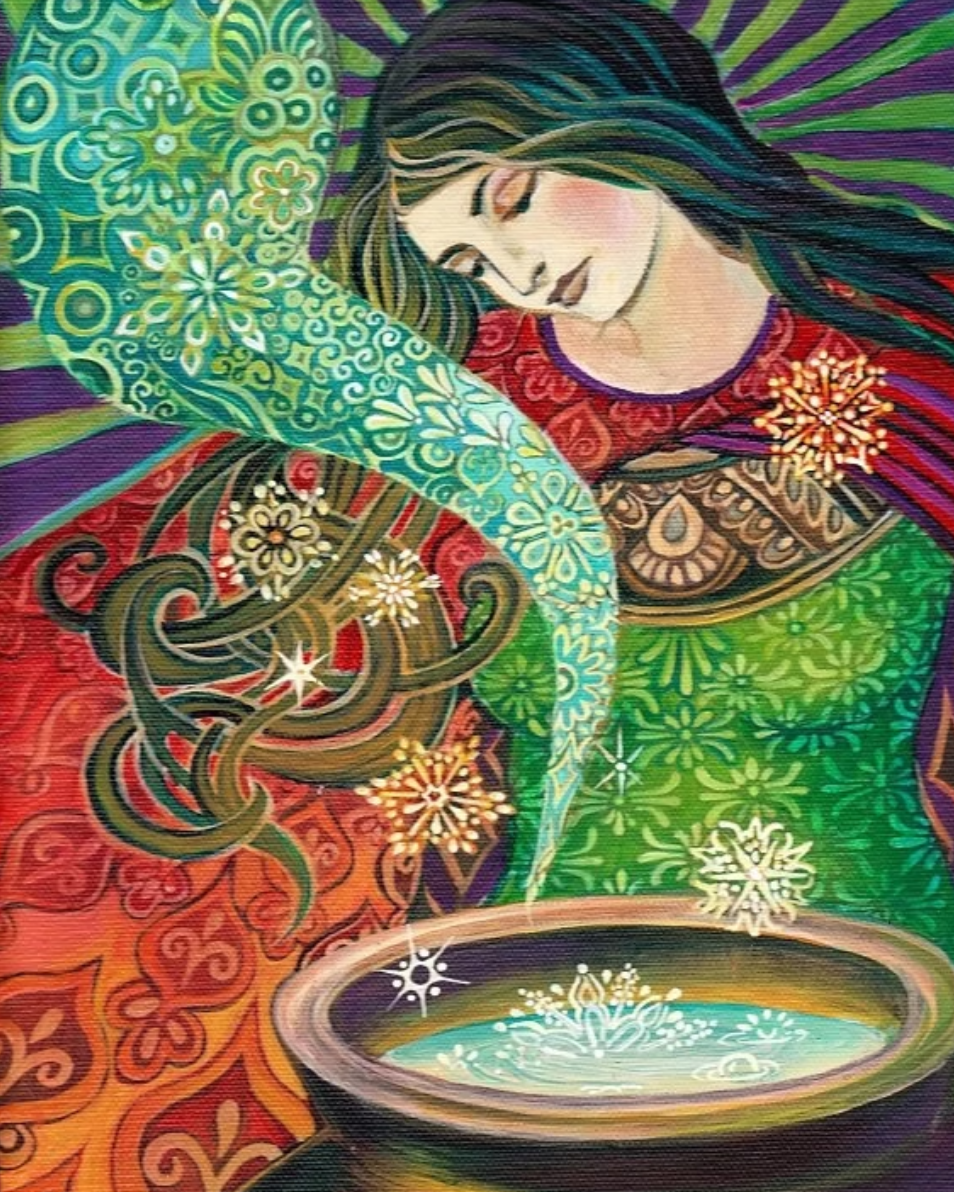
Digital art - Kellie Stirling

So, where does this begin?


Many high-achieving women were children who were praised for being capable. For excelling. For being responsible beyond their years. In that early environment, a lesson got encoded not as a conscious belief, but as something more fundamental; output brings attunement and performance earns love. Being ‘able’ even when deep inside you were anything but, is what gets you chosen.

So the child learns to produce and she is rewarded for it everywhere she goes. She gets seen when she achieves, supported when she delivers, admired when she holds it together. Over time, the lines blur between what she truly wants and what she chases in order to feel okay.

By adulthood, this has become identity. This is not a strategy that was chosen but an identity that she grew into. Her nervous system, which learned early that output equals safety, encodes that equation into its baseline state. The inner voice never fully quiets. There is always something she should be working on, something that needs to be done, the list is never ending, the brain spins with ideas. Any time she tries to slow down there is a level of anxiety that appears. So busyness keeps that anxiety at bay.

What that busyness is doing though is keeping her nervous system in a constant state of urgency. The body is operating off adrenaline as opposed to genuine life force energy. Deep inside she is desperately craving a break but she has no idea how to physically do that and still feel okay.

Here is a distinction I find myself returning to again and again in my work; there is a profound difference between a system running on urgency and a system running on genuine energy.

From the outside, they can look identical. Both produce. Both deliver. Both show up. But inside, the experience is entirely different. A system running on genuine energy has access to a real sense of aliveness, a felt connection to what matters, to pleasure, to choice and it feels safe to rest when it needs to. A system running on urgency is fuelled by adrenaline and cortisol, your stress hormones. It is staying ahead of something. The busyness is not an expression of vitality, it is a way of managing a low-level dread.

So back to this point of needing, no, craving a break but not knowing how to do that and feel safe. This is not because she lacks self-awareness, but because stopping doesn't feel like relief. It feels like exposure. The nervous system that is organised around doing as safety, experiences stillness as a threat signal. Rest is not neutral. It is where the thing she unconsciously has been outrunning, might catch up her.

So when I work with women like this, there is a real skill I need to deploy about the pace at which we slow down her nervous system. Because if we slow down too fast, her nervous system will contract because it feels unsafe.

The high-achieving pattern is not a personality type. It is a survival strategy that became an identity. if she is not achieving who is she really? The tricky thing about a survival strategy becoming identity is it is very hard to untangle, but not impossible, because doesn’t it feel like you are losing a behaviour it feels like you are losing yourself.

So the inner work isn’t just about doing less or achieving less, it is about connecting with the part of yourself that is still running, still proving and bracing. Waiting in fear that someone realises that you actually have limits. The reality is when you are in this place, you have lost connection with what your limits actually are. You have lost connection with the feeling of when the body says no.

The nervous system is not infinitely elastic. Allostatic load, which is the cumulative cost of sustained stress responses, of chronic activation, of never quite returning to baseline, builds slowly and announces itself late. For years, willpower compensates. Most of the women that come into my practice have willpower in spades and they use it as the dominant strategy to keep working. Until they don't because their body stops and refuses to do anything. All the strategies that worked in the past don’t work anymore; the scaffolding that has held it all together often collapses.

I find that this threshold often arrives at midlife, sometimes with perimenopause, sometimes with a loss or a transition, sometimes with no obvious trigger at all. The burnout that arrives doesn't resolve the way burnout used to. The anxiety seems to come from nowhere and there is a particular hollowness and sense of emptiness that begins to surface after achievements. She reaches the goal, and finds nothing there. Just the question: what's next? Until she gets to the point where she thinks, what actually is the point of all of this doing?

She may think her body is breaking down. But what it might actually be doing is asking a question it has held for a long time: ‘what are we running from?’

The body has been sending signals for years and she learned, somewhere along the way, not to hear them. The accumulation is what finally makes them impossible to ignore.

Back to identity again. The deep existential question comes up ‘who am I?’ or sometimes I hear in my practice ‘I don’t know who I am anymore?’.

For those of us whose self-worth was built on output, this is not a philosophical question. It is a genuinely destabilising one. Slowing down doesn't just feel uncomfortable. It can feel like disappearing. This is why the conventional advice like, do less, set better limits, take a holiday really misses the point, or is too big of an ask for the nervous system. It needs to be titrated. You cannot manage your way out of a survival strategy. You cannot override a nervous system that genuinely believes stillness is dangerous. The work has to go somewhere deeper.


In my experience, the women who move through this most meaningfully are not the ones who learn to slow down for the sake of it. They are the ones who build a real relationship with the part of themselves that is still running still proving, still bracing, still waiting to be found out.

That part was not wrong to develop, it was a survival strategy created by your adaptive child. It was often exactly what was needed but now it deserves to be met, not managed. Turned toward, not overridden. Given the same quality of attention, attunement and care that she has spent her whole life giving to everything else.

As she learns to connect with a sense of safety in her body and connect with this part of herself that does not feel safe to stop, the nervous system begins to find a different kind of ground. One that doesn't have to be earned. It was always there to begin with.

We are not learning to stop achieving. We are learning to attune to the parts of ourselves that were never allowed to rest, and to that deep sense of self that was always more multi-dimensional and complex than what we produced.


Trauma, Joy and the Space between

I was reading the newspaper on the weekend and I saw an interview with Bessel van der Kolk.  It was one of those Q and A style interviews and he was talking about MDMA therapy which is very interesting but he was asked a few general questions about trauma.  In one of his responses he said ‘I don’t know a single person who doesn't have trauma’.  This stopped me and it got me thinking about our definitions of trauma, the clinical definitions and then what we understand about it in popular culture.

We've inherited a story about trauma that is too narrow, too dramatic. We imagine it belongs to people who've survived catastrophe, war, abuse, disasters, big accidents.  Yes it is associated with those things but there are many more categories that we work with in somatic experiencing practice.  What I have noticed with many clients is that we place it at a safe distance from ourselves and from our ordinary yet very complex lives.  The reality is most of us carry something we don't have a name for. A tightness that arrives without warning. A habit of bracing. A way of going quiet in rooms where we used to feel at home.

Trauma isn't the story of what happened to us. It's what happened inside of us in response to what happened or a series of things happening.   It is the imprint it left on your nervous system, the way your body learned to brace, to shut down, to stay small, to stay safe. It doesn't care how big or small the event looks from the outside. It only knows what it felt like to be you, in that moment, without enough support or safety to absorb what was happening.

That's a very different thing and when you understand that it changes your meaning making around the topic of trauma.

Because if trauma is that ordinary, that universal, it means we are all, to varying degrees, navigating life with some part of us still keeping watch, still waiting for something or maybe still braced for what might come next.

Sometimes it is also about things that didn’t happen.  Not being attuned to, not feeling like we are being seen or heard.  Not receiving physical touch.  Not feeling like we belong and having to disconnect from what we feel in our body to survive the environment we are in.  

It widens the lens on it a bit doesn’t it?

There is a huge cost to all of this.  It costs us presence. It costs us the easy pleasure of being in our own bodies. It costs us spontaneity, delight, the capacity to be genuinely moved by something beautiful. Not because we don't want those things but because a nervous system that has learned to protect you from pain will, inevitably, protect you from the full depth of joy as well.

Let me tell you what I know about healing.  If trauma lives in the nervous system, so does healing. Healing doesn’t only happen through processing pain, it lives and grows through joy, connection, pleasure and co-regulation.

We seem to have created this story that healing trauma means processing pain and diving into it which is not strictly correct.  In my somatic world it definitely isn’t.  We’ve over-associated healing with pain processing and under-recognised the role of pleasure and connection. I understand why because trauma often narrows interoception; we feel less, or only certain ranges. But did you know that pleasure expands interoception? We begin to feel more safe and co-regulation gives the nervous system a lived experience of safety in relationships.

So joy isn’t superficial, it is regulating, organising and restorative.

Another really inspiring thing happened last week that motivated me to write this blog.  I was watching the Artemis landing and I had been following the astronauts a little when they were in space.  Jeremy Hansen the Canadian astronaut made a comment:

"Our purpose on the planet as humans is to find joy, to find the joy in lifting each other up, by creating solutions together instead of destroying."

He said seeing the Earth from space helped them all realise this.  This brought tears to my eyes, especially with all the crazy shit going on in the world at the moment.

We are not here to be unaffected. We are not here to have gotten it all sorted. We are here, nervous systems and all, to feel as much as we can bear to feel and to help each other bear a little more.  We are here not just to heal ourselves, but to help each other feel safe enough to come back to experience and feel the fullness of life.

This is what helps us metabolise and integrate the overwhelm that we all experience often each day.

This is what I mean when I talk about integration.  It is not fixing, not erasing, not arriving somewhere unblemished. Integration is the slow, patient process of your nervous system finding enough safety to loosen its grip. To let a little more life in. To discover that aliveness is available to you again.

The signs of that are most often quieter than you might expect. A moment when you actually taste your food. A laugh that surprises you from somewhere low in your belly. The ability to receive kindness or a compliment without immediately deflecting it. A morning when your body doesn't feel like something to manage, but something to inhabit.  A changed reaction to regular dysfunctional behaviour you experience from another on the regular.

Coming full circle on my thoughts at the start of the blog, when you understand all of this it really changes how you view all the people that come into your life each day.  I think it brings us more compassion toward each other and it makes us reflect on what we can do to support each other.

When we understand that everyone is carrying something; that the person who cut you off in traffic, the colleague who snapped at you, the friend who disappeared when you needed them, the parent who couldn't quite get it right.  When we understand that all of them are navigating some version of a nervous system that learned to cope, we start to see and feel our world a little differently.  

I am not talking about excusing what isn't okay. I am talking about a kind of tenderness that makes more room for yourself and others. For the whole complicated, tender mess of being human together.


You can't think your way into feeling

Feeling your feelings is harder than it sounds.

We have increasingly found sophisticated ways not to feel. We've all heard it. Just feel your feelings. It sounds so simple , almost obvious. Yet, for most of us, it's one of the hardest things we'll ever do.

Not because we're weak, or broken, or doing something wrong. But because somewhere along the way, we learned that feelings weren't entirely safe. Then, quietly and collectively, we built an entire world that confirmed it.

The interesting thing about feelings is that they show us one simple truth, the body knows first. You know when you walk into the room and sense the emotional climate? That is what I am talking about, the nervous system reads the room first and we feel it.

Feelings aren't thoughts about emotions. They are physical events.

A tightening in the chest. A hollow opening in the stomach. Heat rising in the face. Heaviness settling in the shoulders like something invisible just landed there. The body receives experience first, before the mind has a chance to name it, frame it, or find somewhere useful to put it. Feelings don't live in your head. They live in tissue, in breath, in the subtle language of your nervous system.

So when we talk about avoiding feelings, what we're really talking about is learning to move away from sensation. From the body's own signal system and most of us have been doing it for so long, we don't even notice we're doing it.

The avoidance rarely starts as a choice. For most of us, it began as an inheritance.

We absorbed it from the culture we were born into, a culture that prizes productivity over presence, resilience over vulnerability, and forward motion over the messy, necessary work of actually processing what's happening inside us. “Push through. Stay positive. Don't dwell”. We've dressed emotional suppression up in the language of strength for so long that many people genuinely can't tell the difference between regulation and repression.

The "good vibes only" movement, for all its cheerful intentions, is perhaps the most recent iteration of a very old story; that difficult feelings are a problem to be solved rather than a signal to be heard.

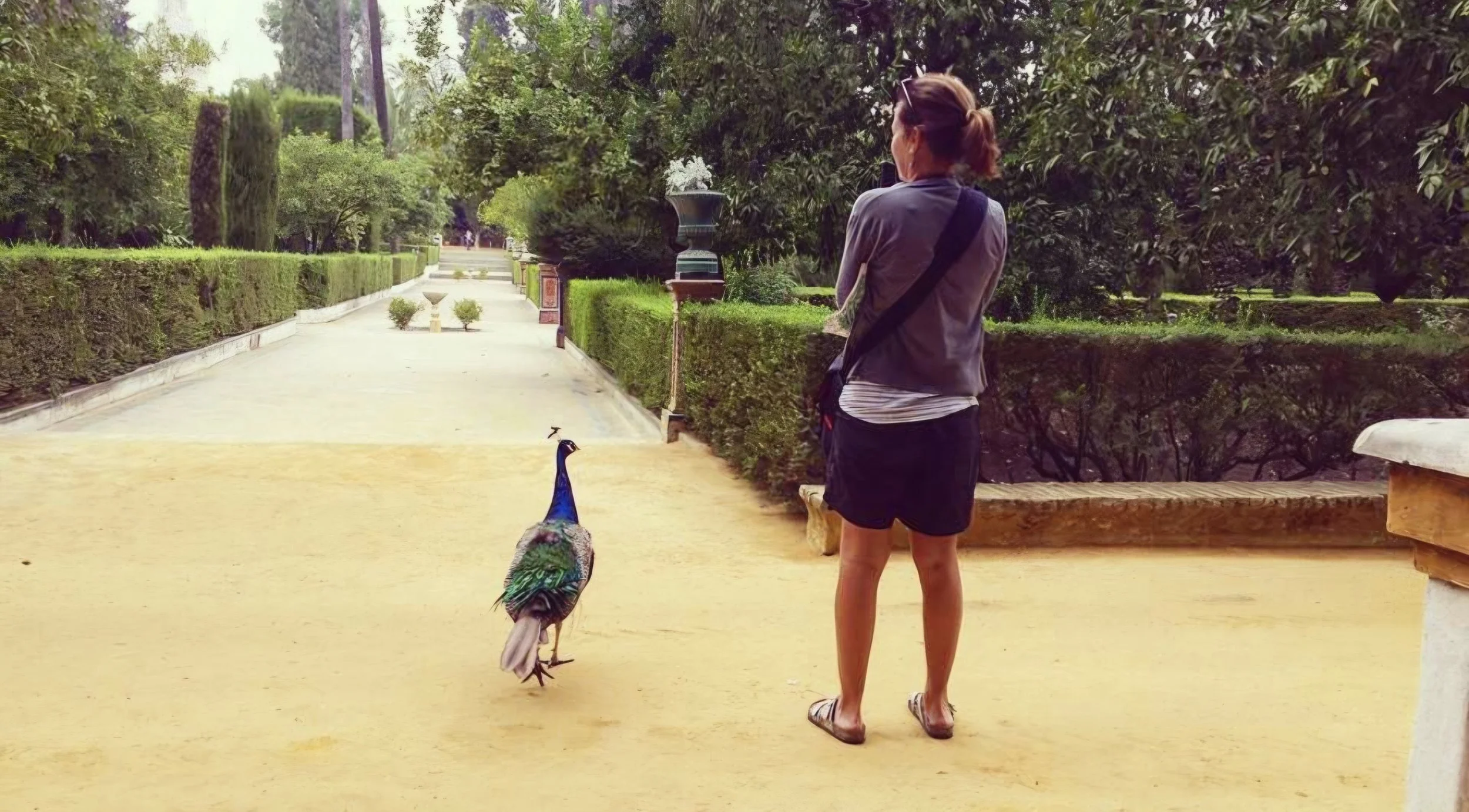
Image - Kellie enjoying the beautiful Alhambra Gardens, a few years ago. A quiet moment of feeling peace, awe and wonder, …….. with an unexpected new friend.

But culture is just the backdrop. The more intimate teaching happens closer to home.

In many families, emotions, particularly big, difficult ones, were not something that could safely exist in the shared space. Not because parents were cruel, but because they were human; carrying their own unprocessed histories, their own unmet needs, their own nervous systems doing the best they could.

Children are exquisitely attuned to the emotional climate of their home. They feel the tension before anyone speaks. They notice the shift in atmosphere when a particular topic is raised. They learn, with remarkable speed, which feelings are welcome and which ones make the air go strange.

So they adapt. They make themselves smaller. They learn to swallow the tears, contain the anger, perform the calm. Not because they were told to, though sometimes they were, but because they felt what happened in the room when they didn't. The withdrawal. The anxiety. The subtle but unmistakable signal that this was too much.

This is not a failure of the child. It is a profound act of adaptation. The child keeps the peace. The child holds the system together. The child learns that their inner world is less important than the emotional stability of the adults around them. The problem with this is it is not the child’s role in the family system to hold space. They don’t have the capacity in their own bodies to do this. Their nervous systems grow well when they have support and co-regulation for parents and caregivers.

That learning doesn't leave when we grow up. It becomes the architecture of how we relate to ourselves.

For some, this went even further. Perhaps there was a parent who struggled, with depression, with alcohol, with the weight of their own unresolved grief. Perhaps the emotional temperature of the household was genuinely unpredictable, and learning to monitor and manage it became a matter of felt safety.

These children became extraordinarily skilled at reading other people. They developed a finely calibrated sensitivity to mood, to need, to the earliest signs of distress in those around them. They learned to intervene before things escalated. To soothe, to deflect, to become whatever the moment required.

What they didn't learn was how to turn that same attention inward.

When your nervous system is organised around tracking others, when your survival, in some early and embodied sense, depended on getting that right , your own feelings become background noise at best. At worst, they feel like a liability. An indulgence. Something to be attended to only once everyone else is okay.

Which, of course, is never. Because these choices were intelligent strategies that our nervous system made, that helped us survive moments when protection, choice and support was missing. Over time they become habituated responses, very strong neural pathways that keep us alive. Those intelligent responses live in the nervous system and tissues; muscles stay contracted, breath stays shallow and the body stuck in a fight response, prepared for a fight that is no longer happening.

Culturally we started to notice in workplaces that we had a problem with poor emotional regulation and here's where it gets interesting.

Emotional disconnection, burnout, relational breakdown, it became impossible to ignore so we developed a response and we called it Emotional Intelligence.

We built frameworks. Competency models. Training programmes. We gave people a vocabulary for their inner world and a five-step process for navigating it. In many ways, it was very well-intentioned a genuine attempt to bring feeling back into professional and personal life. I want to say I think it is brilliant that organisations started to highlight this because left to their own devices, many people wound never come across this content. As I always say, you have to start somewhere.

But look at what we actually did. We took the most embodied, relational, lived thing there is and…. we put it in a PowerPoint. We made emotion into a skill to be optimised. Name the feeling, manage the feeling, deploy the feeling strategically. Which means it's still, fundamentally, a head operation. You're just thinking about feelings in a more sophisticated way. The body, where the feeling actually lives, barely gets a mention.

Emotions arise from the nervous system particularly the limbic system. This is a different part of the brain to the neo-cortex which is receiving this powerpoint information, which is all about logic and reason. If you want to build emotional capacity you have to work with those parts of the brain where implicit memory lives and you do it through the language of the nervous system, which we call ‘The felt sense’.

This, I think, tells you everything about how deep the conditioning runs. That even our solution to emotional disconnection had to be made safe by intellectualising it. We couldn't let it be messy and bodily and unquantifiable. It had to have a score. A framework. A return on investment.

We looked at the problem of not feeling and responded by finding a more sophisticated way to not feel. There is a huge cost of staying ‘just north of yourself’.

When we consistently move away from sensation, the feelings don't disappear. They go underground deep into our unconscious. They show up as anxiety without a clear source, as a vague flatness, as a body that's always tense for no reason you can name. They emerge sideways in sudden irritability, in chronic pain, in the persistent sense that something is off even when life looks fine on paper.

There's also a quieter cost. When we numb or bypass the difficult feelings, we inadvertently turn down the volume on the good ones too. Joy becomes harder to access. Aliveness feels further away. We go through the motions of a full life while feeling strangely absent from it.

Perhaps most poignantly, when we can't feel our own experience, we cannot feel others’ and we struggle to feel genuinely met by others. The connection we most want keeps glancing off a surface we've spent years polishing smooth. In relationships this is a major driver of loneliness because we cannot connect with our emotions let alone talk about them and share what is deep in our heart with another. That level of vulnerability is terrifying.

The body keeps the ledger, it waits, sometimes for decades, for the conditions to be safe enough to finally put some of it down.

We often talk about feeling feelings as though it's a matter of bravery of simply deciding to stop avoiding and diving in. But that framing misses something important.

Feeling, especially for those of us who learned early to move away from sensation, is a capacity that needs to be built. The nervous system needs to learn, slowly and with support, that it can be with experience without being overwhelmed by it. That sensation can be felt and survived. That there is enough space, enough ground, enough steadiness to actually let something land.

This is the heart of the somatic work I do with people. Not pushing into feeling, but gently expanding what can be experienced without the system needing to flee. It's slow work. It requires patience, curiosity, and a willingness to be a beginner in your own inner life.

It is some of the most important work I know.

Somatic work doesn’t force patterns to disappear it meets them with careful pacing and respect. Healing begins when we attend closely to the physiology and introduce layers of support that were not present in the original moment: co-regulation, steadiness, choice, support and the permission to be and move ever so slowly. Slow is more in somatic healing.

The nervous system begins to soften and loosen. It realises that it is no longer in a fight and the body learns that it does not have to hang on so tightly. The support that was missing is finally here.

If any of this resonates, here's a gentle place to start. The next time you notice an urge to reach for your phone, or to get suddenly very busy, or to launch into problem-solving mode, pause. Just for a moment.

Ask: what's happening in my body right now?

You don't need to feel everything. You don't need to go anywhere overwhelming. Just notice. A breath. A tightening. A warmth. A nothing.

That small, curious turn toward the body, that noticing, is the beginning of coming home to yourself.

This is unlike anything you'll find in a competency framework, nobody can teach it to you from the outside. It has to be lived, slowly, from within.

If you would like some support and learn how to build this capacity so that you have more energy to cope with what life throws your way, come talk to me.

Some reflections on Nostalgia and Collective Grief

There’s a trend circulating at the moment on social media. “Mum and Dad… what were you like in the 90s?” People are posting old photos, grainy images, oversized denim, sun-faded afternoons. There’s something almost tender about it. A collective wistfulness and I’ve noticed it in myself too.

Recently, I’ve been watching Ryan Murphy’s series on John F. Kennedy Jr. and Carolyn Bessette Kennedy. There’s something about it, the aesthetic, the pace, the feeling that evokes a different era. A quieter one. It stirs something. Not just memory but something deeper. The visuals evoke memories of my twenties living in London in the UK and times I visited New York in that time period.

Nostalgia is a slow form of grief where time shifts without our awareness. Chapters of our life end really quietly without much self awareness whilst we are living them. There are people, places and versions of ourselves that we never really got to say goodbye to, because we didn’t realise that we were at the end of something, until it was over.

We don’t really think of nostalgia as grief. Many of us learned that nostalgia was fondness or sentimentality. The yearning for the good old days. It is a felt sense, it’s very somatic; our senses are the gateway to our memories. A song comes on and reminds you of a time and place. You smell something and a whole era of your life comes flooding back. You might come across an old photo and as you look at it you remember the version of yourself that you see in your hand. How it felt to be that version of you. Sometimes you miss that version of yourself and sometimes you smile and think I am glad I am past all of that.

A few mornings ago, I was walking with my 17-year-old son. He’s been feeling the weight of the world lately like many young people are. The complexity of it. The uncertainty. The constant stream of information that never really lets the nervous system settle.

And he asked me: What was life like when you were 17, Mum?” So I told him about 1989. There were no mobile phones or internet. You rang your friends on the house phone and hoped they were home. People turned up when they said they would and most of the time you waited. We used to spend a lot of time waiting around for each other. Shops were closed on Saturday afternoons and Sundays. Nights were quieter. Life moved more slowly. As I spoke, I could feel something in my body soften. What was strengthened in our nervous system when we waited around was a greater capacity for uncertainty and a quiet trust that connection would come.

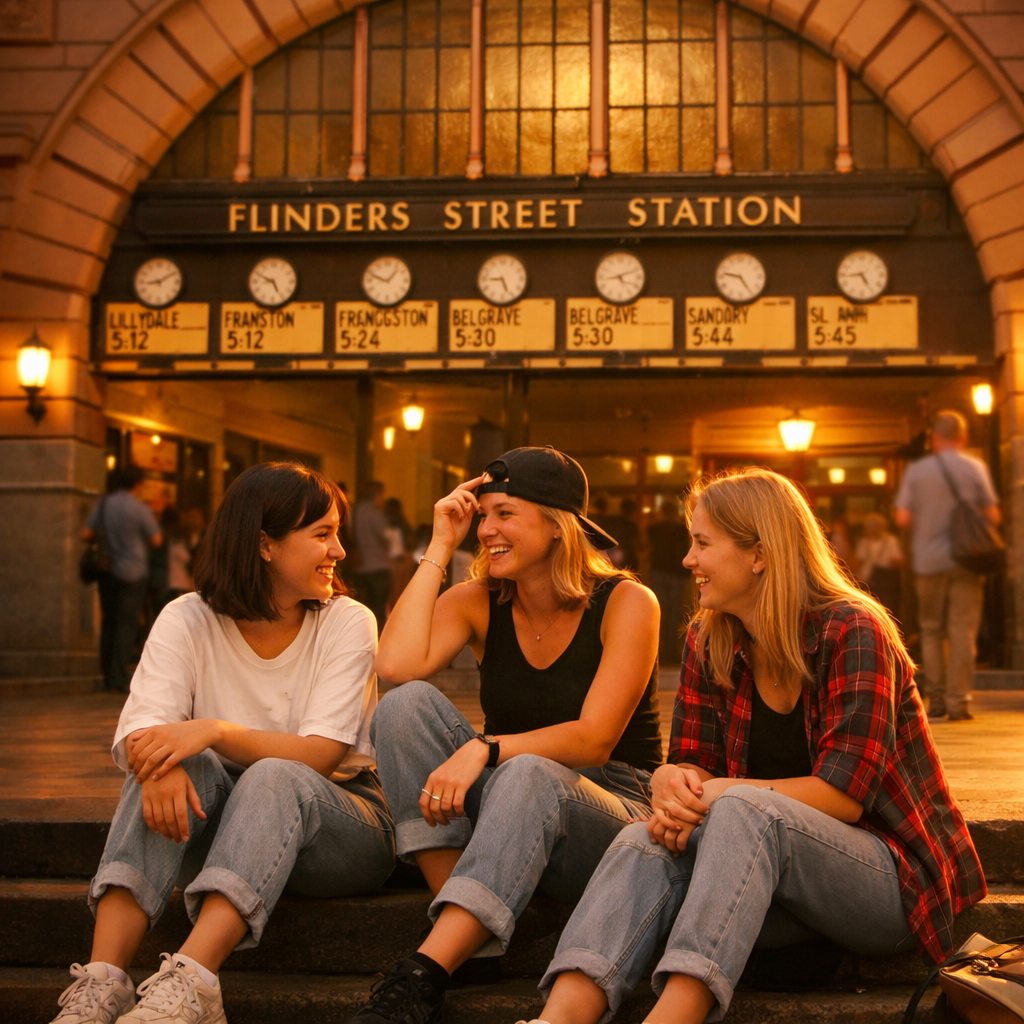
Digital image, Kellie Stirling. Waiting for our friends by the clocks.

Not because everything was better, it wasn’t. But because something about the pace of life was different. It was a little more contained, less exposed and relentless. I think that’s part of what we’re feeling when we experience nostalgia at the moment.

It’s often described as longing for the past but I don’t think we’re really longing for a decade. I think we’re longing for that felt sense. A way of being in ourselves when the world moved differently.

Later that day, I was in the car with my sons. My eldest, who’s nearly 20 and an engineering student at University, was driving. We were talking about fuel shortages and what might change in the future, electric cars, shifting systems, renewable energy options, the way the world is having to adapt.

I found myself asking: “What do you think we’ll learn from this?” He said, quite simply: “I think people have to realise that the only way we’re going to get through this is together. We have to collaborate. We have to support each other. We’ve got to change.”

I felt it land in my body as he spoke because in that moment, something shifted. Nostalgia looks back. But what he named looks forward. We can’t recreate the conditions of the 90s. The world is more interconnected now. It is more complex and demanding on our attention, our nervous systems, our capacity to process.

The slower pace we remember wasn’t just a lifestyle it was an environment that offered a kind of built-in regulation. There was less information, stimulation. and there were more natural boundaries between “on” and “off.”

That world doesn’t exist in the same way anymore. So the question isn’t, how do we go back? It’s: ‘How do we live well here? Perhaps this is where nostalgia becomes something more than wistfulness. Maybe it becomes a kind of remembering. Remembering not of a time but of what mattered and what was valued.

There was connection, presence and rhythm. It felt a little more spacious for our nervous systems and there was more connection and time spent in different types of community.

We are being asked to express those things differently now, not through simplicity, fewer inputs or retreating from the world, but through conscious collaboration with greater discernment. By learning how to stay connected within it.

What my son named, in that simple sentence, is something I see in my work every day. Whether I’m working with leaders, couples, or individuals navigating change the same truth emerges: we regulate in relationship and we find our way through complexity together.

So maybe the nostalgia many of us experiencing at the moment isn’t asking us to return to the past.

Maybe it’s helping us feel what we’re missing, so we can choose how to bring it forward. We may not get the slower world back, but we can create moments of slowness. We may not escape the complexity but we can learn to meet it with others, rather than alone.

I think perhaps that is the quiet invitation underneath all of this; not to go back but to become more intentional about how we live now.

Together.

When the Roots are revealed

A nervous system reflection on collective disgust, power, and disillusionment

There are moments when the collective emotional field shifts.  You can feel it, not just in headlines or conversations, but in the body. A heaviness. A tightening. A quiet sense of repulsion that sits somewhere in the triad of disgust, anger and grief.  Lately there has been a lot of upheaval in our lives and lots of information revealed that has frankly, shocked many of us to our core.

It is not just the big stuff.  I feel like every day I read the newspaper or look online and something about the abuse of power is there.

So it is not surprising that many people have been describing feelings of disgust, disbelief, and despair as more information circulates about powerful people, networks, and systems that appear far more complex and paradoxically far more human than we once imagined.

The reactions are strong and they make sense because this isn’t just an intellectual response.

It is a nervous system response and we notice that the body knows before the mind can explain.

When people feel disgust, the body is doing something very specific.

Disgust is a boundary emotion.  It is the nervous system saying, this is not safe, it has crossed a line and I need distance.  Disgust is an interesting emotion because it doesn’t say fight, it says move away.  Our visceral reactions with disgust are often really strong; recoiling, nausea, tightening in the throat and gut, facial expressions that close down intake.  It is like our body is saying, ‘do not ingest this’.  Which makes sense when you think that disgust evolved evolutionarily to protect us from contamination, like rotten food or toxins.  When you explore it psychologically that same neural circuitry extends to moral violations, ethical breaches, abuses of power and relational betrayal.  So when people feel disgust at certain events or revelations, the nervous system is experiencing something more than ‘this is wrong’.  It is experiencing a very different message.  The message is more ‘this feels contaminating to my sense of safety or moral order’.

It is a little bit different to anger.  Which we then might experience closely after it.  Anger is a mobilising energy that wants to restore integrity or fairness.  After that, for many if anger offers us no respite, then comes something heavier.  A flattening, fatigue and often a sense of despair. The moment when the body recognises that the systems involved feel too large to influence.

Now lets think about disillusionment for a minute. At a nervous system level, disillusionment isn’t just disappointment. It’s the moment when something we were orienting toward; a person, system, belief, or story, no longer provides stability. The illusion wasn’t just an idea, It was an organising principle that helped shape our mental models of how things are, how we perceive everything works together.

So when it falls away, the body momentarily loses its map. You might feel a drop in energy, a slowing or flattening, maybe heaviness in the chest or a kind of internal ‘oh…’ that comes with a sinking feeling in your belly. It is almost like our body is saying ‘I don’t know where to place my trust now’. With disillusionment, it is like relational disappointment and so we might be feeling something like a micro grief because we are carrying sadness rather than outrage (or maybe outrage too!). It might feel like we are grieving the certainty, innocence and simplicity we once knew.

In the context of what we are experiencing with information revealing abuse of power, these responses are not signs that something is wrong with us. They are signs that our bodies are orienting to what feels morally and relationally unsafe.

When trust and power collide

Human beings are wired to seek safety through connection.  Connection with trusted structures like families, communities, organisations, leaders, institutions.  When those structures feel compromised, the impact is deeper than opinion or politics.

It can feel like an attachment rupture at a collective level.

Deep inside of us we ask, Who can we trust now?  What is actually true?  How do we orient in the world?

In my work with teams and leadership systems, I often see a similar dynamic. When trust breaks in a leadership group, the entire nervous system of the team shifts. People become hypervigilant, cynical, or withdrawn. Energy that once went toward creativity or collaboration turns toward self-protection.

In society, the collective field behaves much the same way.

Digital art, Kellie Stirling

Another way we can look at it is by using a metaphor; The forest and the storm.

Sometimes a forest looks healthy from a distance.  The canopy is full and the trees stand tall. When we zoom up above and look down, everything appears stable.

But a storm arrives, and suddenly weak branches fall. Rot hidden deep within the roots is exposed. What seemed solid reveals its fragility.  The storm did not create the decay, it simply revealed what was already there.

This is often how systemic realities come into awareness not all at once, but through moments that expose the invisible networks of power, proximity, and influence that shape human systems.  The discomfort people feel is partly the shock of seeing complexity where we once wanted simplicity.

Living with complexity without collapsing

Our nervous systems like clear categories: good or bad, safe or unsafe, hero or villain.

Complexity asks more of us.  It asks us to hold multiple truths at once that people can be influential and flawed, connected and compromised, admired and deeply human.  It is asking us to hold the tension of polarity, of competing priorities.

When this ambiguity becomes too much, we tend to move toward extremes.  It can look like outrage that burns hot and fast or sometimes numbness that shuts us down.  Often we protect ourselves by demonstrating cynicism that protects us from disappointment.

But there is another possibility, a slower and more embodied stance.  That is Witnessing.

Not bypassing what we feel. Not rushing to certainty. Simply allowing the body to register what is present while staying connected to our capacity for discernment.

Staying human in a dysregulated world

When collective stories stir strong emotional responses, it helps to come back to what our nervous systems can actually hold. To orient to the present moment and to notice where we still have agency.  Can we find where we have choice in how we speak, how we relate, how we show up in our own circles of influence?

Systems change slowly and nervous systems change slowly too.  Often the most grounded response is not to harden, but to stay soft enough to feel, while strong enough to hold boundaries.

How can we rejuvenate and grow in the face of decay, how can we hold space for it?

In nature, decay is not the end of the story.  When something breaks down, it creates space for renewal. Nutrients return to the soil. New growth becomes possible.  Perhaps this is also true in human systems.  Moments that expose cracks in our collective structures can feel deeply uncomfortable, even destabilising, but they also invite reflection.

We can ask ourselves what kind of leadership we want to grow now within ourselves and what values we choose to root into, even when trust feels fragile.  The work is not only to witness what has been revealed.  It is to stay human, grounded, discerning, and connected as the system reorganises around us. The more we can stay in peace and calm and maintain a clear focus, the more easily we can navigate this time.  Can we stay connected to a vision of a much more compassionate and loving world for all of us as familiar systems shift and reshape around us?

If you are struggling at the moment with the chaos of the world, here are some reflection questions for you.

What sensations arise in your body when something feels morally confronting?

What helps you stay grounded and discerning when trust feels fragile?

What kind of leadership are you choosing to embody in your own sphere right now?


Functional Freeze: When you are coping but not living

For many of the people I work with, they don’t arrive saying, “I’m traumatised.”  They arrive saying things like:  “I’m exhausted, and I am not sure why and I am thinking it might be related to trauma.” or “I am functioning but I really feel flat”.  Others feel like they have lost their spark and zest for life.  Some people know that something is inherently not right, their life looks fine but they feel ‘out of whack’, or sometimes stuck, something about their life is off.

They are holding jobs, relationships, families, leadership roles and often they are capable, intelligent, emotionally aware. Yet, deep inside, something feels stalled or a bit disconnected.

This is what we call, functional freeze.

What is functional freeze?

Functional freeze is a nervous system state where you are operational but disconnected.  Many of us have this in our body. Remember, our nervous system responses are very natural because our Autonomic nervous system (ANS) is our body’s surveillance system.  With functional freeze the brake and the accelerator are both on at the same time.  However, unlike collapse, where everything stops, functional freeze allows you to: keep working, keep caring for others, keep meeting expectations, keep “showing up”.

We can do all this but it comes at a cost.

We often find that the body is braced, that our emotional range narrows. So, joy, desire, creativity, and spontaneity have maybe quietly drained away.  From the outside, life looks fine. On the inside, we can feel numb, effortful, or strangely empty.

Functional freeze serves as a type of camouflage so it can render us, (or a part of us) invisible.  It allows us to be hidden in plain sight, just going through the motions.  The authentic part of ourself, our core essence, is unavailable for participation.

Digital Art, Kellie Stirling

How does functional freeze develop?

Functional freeze often develops in people who had to adapt early.  People who learned, consciously or not, to not be a burden.  They were told to just get on with it, that their feelings had to wait or, if they just kept on going, they would be ok.  It develops in children who couldn’t protest or leave, in relational systems where anger or need was not safe.  So people learn that compliance is a survival strategy.

Metaphorically, we become like the owl, invisible in the tree, feathers blending into the background.  Quiet, but with those big eyes taking everything.  Our flight is quiet and stealthy.  Often when we see an owl in the natural environment we are delighted. They are quiet, wise and all knowing and there are so many we often don’t see because of their expert camouflage. These strategies are not flaws.  They are intelligent adaptations to environments that didn’t reliably support emotional expression, rest, or dependency.

Many high-functioning adults grew up in families or cultures that rewarded: Independence, self-reliance, achievement and emotional restraint.  The nervous system learned to override sensation and emotion in order to keep moving. For a long time, this works.

Until it doesn’t.

Why functional freeze often shows up in midlife?

Midlife is a threshold.  Biologically, emotionally, relationally, the body begins to renegotiate capacity.  So what you could once tolerate, override, or push through starts to feel harder because hormonal shifts change stress tolerance.  This means that  emotional labour accumulates and this happens all in a time in life where caregiving, leadership, or relational demands increase.  Our nervous system starts to have less appetite for suppression and the allostatic load in our body, which is the amount of stress we can tolerate, hits a high.  Our body says “I can't do this dance of squashing everything done anymore, I am exhausted”.  To suppress our emotions and sensations requires an enormous amount of energy from our body.

Those old strategies that once kept you successful now feel unsustainable.

This is why people often experience midlife as a loss of motivation or meaning and where they may experience increased conflict in relationships.  Maybe they find themselves being emotionally reactive or irritable or that they are tired and wired, they have an exhaustion that rest does not fix.  Often there is a sense of “I can’t do this the way I used to’ and also a despair at feeling anchorless and uncertain of where to orient from and to next.

This isn’t failure.

It’s the body asking for a reorganisation, not more effort.

What is important to know is that functional freeze is not laziness or burnout.  It is not a low energy state, it is a contained energy state.  Mobilising energy is present but it is being actively inhibited, our body is working hard to not move.  People in functional freeze are often deeply conscientious.  They care a lot, they try and they keep on going.  What’s happening isn’t a lack of motivation, it’s a protective nervous system state.

Freeze conserves energy when the system has learned that stopping isn’t an option or that help wasn’t available.  It is a very quiet version of survival.

What helps functional freeze begin to thaw?

Functional freeze doesn’t resolve through insight alone.

Understanding why you feel this way can be validating  but it’s not enough.  What helps is gentle, titrated reconnection with the body, often through, slowing down without forcing rest and noticing sensation rather than analysing emotion.  It is about small experiences of choice, agency, and pleasure being experienced interoceptively.  It is about experiencing embodied relational safety and not having to perform anything.

We know when we are ‘thawing’ a bit because we might notice a deeper breath or an emotion coming up spontaneously.  We also might notice a clearer ‘no’ or ‘yes’ in our body when it comes to making choices or that we are able to rest for a moment without feeling guilty. These are not dramatic breakthroughs, they are signs of life returning.

The invitation of functional freeze

Functional freeze is not something to purge or cathartically push out.  It takes slow and gentle work and it is an invitation to stop living from adaptation and start living from presence.  To shift from coping to inhabiting your life.  With the right therapeutic support it is a nervous system state that you can come out of.

So that you can let your body, not just your mind, lead the next chapter.  For many people, this is the initiation of midlife: not becoming better at surviving, but becoming more available to aliveness, truth, and an authentic way of being in the world.

The kings and queens of the push through

I tend to work with a lot of high achievers who come to me in midlife in a quandary. They are either burned out, they have lost their motivation or they have lost their inner compass. They are incredibly capable people. Brilliant creatives, leaders and thinkers, the people everyone relies on to get the job done or come up with the solution.

When they come to me there is something fundamental happening underneath, deep in their system, that they can’t solve or workout. They have lost connection with their deepest needs and desires. Their emotions, what they value, what is important to them has become fuzzy. Something is wrong in their world and they cannot put their finger on it. They are overly tired or have lost their zest. This drives them crazy, they feel like a failure because they are so used to solving all the problems. They love solving problems and creating value.

It is a body in freeze.

For many of us, we are still functioning and functional freeze is the nervous system’s quiet survival strategy: a blend of dorsal vagal shutdown with just enough sympathetic activation to keep you moving, performing, achieving.

You look “fine,” you produce, you deliver, you impress people but you have lost connection with your internal world. You’re upright, responsive, competent but you feel dead on the inside. No real vitality, internal pulse or felt sense of self.

Digital Art - Kellie Stirling, People thawing their freeze

For many overachievers, this becomes the air they breathe until their body says No, not any more. Often it happens at midlife.

So how does this overachieving freeze pattern start?

Well most overachievers learned early in their life that there needs were either: inconvenient, ignored, criticised, overwhelming to caregivers, unsafe to express or simply too much.

So they adapted in the only way their system knew how, they turned down the volume on their body and turned up the volume on their mind. They became brilliant, fast processors, high-capacity thinkers. They became the problem-solvers, the responsible ones, the reliable ones.

But brilliance built on freeze has a cost. We stop listening to the signals from our body. We stop listening to the signs of tiredness, of what a NO feels like in our body. We learn to override our basic impulses. It is not coincidence. Is is a pattern.

Productivity culture is built on functional freeze.

We applaud over-functioning and self-sacrifice. We reward output and speed and we celebrate people who “just keep pushing through”. I think a lot of Gen X’ers learned to do this early, because in their teenage years they spent a lot of time on their own and just had to get on with life.

We call this excellent work ethic, resilience or commitment. But what if much of what we call “productivity” is actually a socially-validated freeze response?

I have had so many clients, mid forties to late fifties, post-menopausal, who make a big career change and then come to me saying, I don’t know what is wrong with me, I just feel out of sorts. I get stuff done, I am a doer. Nothing is wrong with any of them. Their body has just simply stopped cooperating with the override. Or guys who come to me and say they know their life has to change, they are on the precipice of existential change but they don’t know where to start.

When you have spent decades powering through the classic, go, go go. Your body has a way of bringing you back into right relationship with it. As we age, our hormonal cocktail starts to change and menopause has a way of stripping down and highlighting our compensatory strategies. The freeze structure that held everything together began to collapse. Remember the developmental challenge of midlife is radical honesty, come back to the truth of who you really are.

Gently and slowly we work together to slow down. My client's nervous system immediately start to show what they have been trying to outrun. The survival strategies that were created as children to stay safe aren’t working anymore. Their body is setting a boundary. The freeze is ready to be thawed.

This is why burnout in midlife spikes.

Women lose hormonal scaffolding that kept them overriding their body. and men hit existential thresholds where achievement can’t fill the inner void. Our careers peak while capacity starts to decline. Many parents carry the emotional and logistical load for teens and ageing parents. and many of us find the nervous system can’t run the childhood strategy anymore.

People think they’re falling apart. But what’s falling apart is the freeze, not the person. Burnout is both exhaustion and it’s the breakdown of the freeze scaffold. Burnout is the point where the body says, “I’m not going to keep doing this.”

Overachievers don’t lose their motivation they lose their override strategy. When the freeze starts to thaw, we start to feel all the things we have been pushing down for years. The anger, fatigue, hunger, sadness, longing, boundaries, desire and our No.

For many overachievers learning what a No feels like in their body can be a big revelation.

Many overachievers are very creative. They have lots of ideas. They get excited by their ideas, creatively, strategically, intellectually their mind is alive. They can get flooded by them too and want to put them all into action. Not doing so feels like a failure. Something I have learned personally that I help my clients with is our freeze makes us believe these ideas have to be acted on.

Every impulse becomes pressure, every spark becomes a project, every inspiration becomes responsibility something we feel we absolutely must do. This is where burnout can accelerate.

One of the most powerful shifts in my own midlife has been learning that you don’t have to act on every idea. You can feel it, sit with it and let it breathe.

Sometimes an idea is complete simply by being witnessed. Sometimes it is enough to journal it, or talk it through with a colleague or friend. Sometimes you just have to write it down and let it sit for a few months.

This is how you slowly retrain your system, that not every idea has to be acted on. You start to rewire your nervous system and you will notice that the compulsion to act will turn into more capacity. The pressure to act can turn into being present, and the need for action will become digestion.

To come out of functional freeze we work slowly, relationally and somatically. We learn to track micro-sensations and small pulses of movement. We learn how to set tiny boundaries, small steps at a time. We learn how to titrate our life. Small changes 1% more each day. We learn to enjoy receiving the co-regulation from our somatic therapists and/or coaches. We start to notice we are slowing down, 1% more each day and then we can recognise that rest isn’t a weakness it is a signal. We start to notice, that we are noticing how we feel and we let our ideas sit and percolate rather than having to act on them.

Most importantly we learn that our value isn’t earned by producing. Value is inherent because you are here, you are alive. Your body is your home, your garden, your temple. It is not a machine.

Your needs matter.


Fawning: why we mirror, merge and self-abandon

Seven years ago, I read Pete Walker’s book on complex PTSD, and it was the first time I truly understood the nervous system response of Fawning. I had known the behaviour as “people pleasing,” but I hadn’t realised until then that fawning was a protective response our body utilises. As I explored it more deeply, I realised it was everywhere and that it was not a personality trait, but a strategy our system uses to keep us safe, particularly in the face of a power-over dynamic.

How many times had I sat in conversations in the workplace where a person was labelled a people pleaser as it if was a personality flaw with no true understanding or curiousity of what was driving it. Let alone acknowledgement that this person does not feel safe. I realised right then that fawning shows up in so many ways. I see it in people who over-function, some organisations are run off the back of employing a workforce who constantly does this. Entire customer service cultures are built on fawning.

Fawning is a nervous system strategy that supports us to stay in connection when we feel unsafe and we are in a double bind; where there are real consequences for us not to fawn. We all do it. Women are a little more predisposed to it because we have lots of estrogen and oxytocin is the neuromodulator of our body. What that means is that bonding and connection helps us regulate and process our lives. It can come up at anytime because it is a strategy your autonomic nervous system uses to keep you safe. If it doesn’t work you go to fight and flight, then freeze. It is a cascade.

Men fawn too, not to soothe, but to belong. Male fawning often looks like “fitting in,” but underneath is the same physiology. In very masculine coded work cultures you see this all the time. Men fawn to avoid being the odd one out. They mute their sensitivity or complexity, mimic bravado or certainty, abandon their authentic relational needs and shape-shift to avoid being shamed.

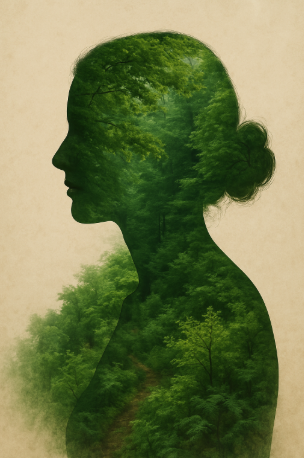
Digital Art, Kellie Stirling. Woman merged with nature

When we fawn we shapeshift, so we morph into a version of ourselves that feels the most likely to keep us safe. For some people, fawning looks like becoming more of who they are; more charming, smart, generous, funny or adored. For other people it is about being less of who you are; less vocal, creative, smart, self-assured or even able to set boundaries. Fawning shows up sexually, in money situations or, in the constant emotional regulation of other people.

We all know about fight, flight and freeze. The fawning response is different because it is a hybrid of these. The hyperarousal part of fawning encourages us to lean into relationships that are causing us harm so we to appease the person. The flight response, self-abandoning to stay safe. The hypoarousal part, or freeze part, numbs our connection to our needs and desires, so we don’t feel the effects of the harm we are experiencing.

When we fawn, we mirror or merge with someone else’s desires or expectations of us to stay safe. We do this to defuse potential conflict because that is our best chance of maintaining safety. In most of these situations there is a power over relationship. Someone has power over us. When we merge or mirror, whilst it keeps us safe, we forgo our own desires and agency and become overly accommodating of others. We become shapeshifters moulding ourselves to each scenario and person. We abandon ourselves, what we care about, our opinions, desires and what we value.

Fawning is so culturally imbued in our society that we are conditioned from a young age to do it. Think of these statements: “give your uncle a kiss”, “be the better person”, “take the high road’, “be a team player’, “you have to learn to compartmentalise it'‘, “just go with it”. We say these every day and they normalise fawning.

Fawning is a common coping system for people dealing with ongoing relational trauma. It also occurs in larger systems of oppression or marginalisation where we must let go of aspects of ourselves to secure membership or a sense of belonging. Over time fawning becomes a systemic pattern.

Individuals don’t just fawn, systems induce fawning. Some examples I see frequently include: A leader who is dysregulated will have a whole team fawning to avoid triggering them. A family with a narcissistic parent creates children who become emotional caregivers or family systems with rigid hierarchy. Workplaces where vulnerability is punished. Relationships where one partner regulates through dominance.

Fawning is not a personal pathology; it’s a predictable adaptation to power-over cultures. So you can see it is not about being nice, it is a nervous system adaptation to relational power dynamics.

One of the deepest wounds of fawning I have observed is the disconnection from anger. Many fawners cannot feel their anger; not because it isn't there, but because it has been repressed for survival. Anger felt too dangerous, too destabilising, too likely to provoke retaliation or abandonment.

So internally, they learned that their anger was not safe and put them at risk. The thing is their anger doesn’t disappear, it goes underground. Into the unconscious.

Over time, this suppressed anger can turn into resentment, chronic tension because you are constantly bracing, exhaustion or collapse, health issues particularly autoimmune issues and a fierce inner critic who constantly self blames.

Restoring healthy aggression, the energy of our boundaries, clarity, and self-protection is essential. But it must be done slowly. Really slowly. Because letting that much anger thaw all at once can overwhelm the system that originally buried it to stay safe.

How do we stop Fawning?

Well it starts with finding safety in the body. You can’t talk yourself out of a fawn response nor can you mindset your way through it. Your nervous system needs to feel safe in the body to try anything new.

The work looks like being able to notice the early cues the anticipatory smile, the shallow breath, the scanning of the other person’s mood and gently interrupting the impulse to fix or appease. Learning to feel tiny drops of healthy anger in an incredibly titrated, slow and digestible way. Allowing the internal critic to soften, which often happens naturally when anger can finally move outward instead of being turned inward

Learning to stop the fawn process from being pervasive is the process of reclaiming power-within, instead of surviving through power-over dynamics. Our fawning response is wisdom it is not a flaw. It has kept us safe and will continue to do so, when we need it in the moment. Our fawn has kept the peace and helped us to function in environments that could not hold our full aliveness.

It is profoundly healing for us to notice our fawn patterns (and to continue to be able to notice them in the moment) and gently let them loosen their grip. Over time it becomes a survival strategy we have access to, not our default mode of functioning. When you start to let go of it you are not losing the nice aspect of yourself, you are becoming more You.

Lying in the Dark

One of the things I find most interesting is that we are all, on some level, afraid of the dark. I don’t mean the literal dark, like the night. I mean we are afraid of dark emotionality, dark times, dark moods, that dark place we go when we our life is changing dramatically, death. We are afraid of all that dark.

What I find so striking is that the dark isn’t foreign to us. It’s the first home we ever had. Before we had language, consciousness and identity, we were held in a warm, fluid, completely dark womb.

For nine months, the dark was our sanctuary. We were nourished, protected, and completely connected without ever seeing a thing. We didn’t need sight to feel safe, or light to orient. Our bodies knew how to rest and grow in the dark.

Isn’t it ironic that we spend the rest of our lives fearing the very place we began?

Popular culture treats the dark as something dangerous or disorienting, a space where we lose ourselves. But from a somatic perspective, the dark is often where we find ourselves again. Because the dark asks nothing of us. It doesn’t demand performance, productivity, clarity, or answers.

The dark invites us to rest, to slow into ourselves and just be.

The dark womb is an archetype of profound safety, not because it is soft and easy, but because it strips away everything that is unnecessary. In the dark, we are not seen for what we do. We are held for who we are.

Maybe that’s the deeper truth; the dark isn’t here to frighten us, it’s here to return us to ourselves.

There are seasons in life when everything familiar falls away. Not by choice or spiritual aspiration but because life itself becomes a burning ground. My cancer journey was one of those seasons.

I remember feeling stripped bare, not just physically, but emotionally and existentially. It wasn’t simply the fear or the medical complexity. It was the sense of being dismantled at every layer. The parts of me that used to hold me together stopped working. My usual ways of coping fell away. There was nowhere to run, nowhere to hide inside myself. In fact, I found the best place to be was in the present. I must admit that it felt like being dropped into the dark womb of the world and strangely, or maybe not that strangely at all, that’s exactly where the healing began.

We all have experiences in life where we feel like everything is being burned down and we are going to fall into our own dark hole. You don’t need to have cancer to experience this. Midlife, menopause, divorce, grief, trauma healing, big career transitions, or sometimes all the above at the same time. The thing is they all bring us to the same threshold.

That threshold is a place where you realise you can no longer be who you were, you feel rudderless, but if you can stick with it you have this deep sense of knowing that you are being carved into who you truly are. You are becoming yourself.

While this process can feel brutal, it’s also profoundly sacred.

Sometimes life breaks us open so the truth can finally be felt. Sometimes life drags us into the dark so we can be remade. Sometimes life strips us bare so we can emerge more honest, more embodied, and more deeply alive.

When we come through the other side of these big life transitions, we often notice that yes we are still here, but we are not the same person we were before. We will never be that person again.

There will be parts of you that survive and are the same, there are parts that are gone and there are new parts of you that are being birthed.

During my treatment I spent my days resting and I read a lot. I came across Meggan Watterson’s Divine Feminine Cards (which are great by the way) and within them I found the archetype of the Black Madonna. I would shuffle the cards and many times she would just drop out.

The Black Madonna, archetypally, represents the power we all have to emerge from dark times transformed. Jungian Analyst, Marion Woodman believes that the Black Madonna represents a new awareness or consciousness toward out bodies. She represents the wisdom we can only gain when we go through the painful fires of transformation.

The Black Madonna is not the soft, glowing mother of the light. She is the fierce mother of the dark.

She is the one who meets us in our descent, not to pull us out, but to sit with us in the shadow until something true emerges. She is the archetype of the underworld, the womb, the ashes, the grief that breaks us open.

By connecting with this energy I can tell you that I felt spiritually held; not by something that promised rescue, but by something that promised presence.

The Black Madonna taught me that the dark is not a punishment. It’s a crucible. A crucible is what alchemists used to melt down metals to turn them into gold. The dark and our grief that often comes with it, are a crucible, a container that holds us.

So what burned away for me? Well a few things, a compulsion to hold everything together and the pressure I put upon myself to be endlessly available, a need to make other people comfortable and identity shaped by survival rather than by my soul. What emerged and was born was a quieter and steadier self with clarity about what actually matters, a deeper respect for the wisdom of my body and its profound capacity to heal, an acceptance in the fragility of life whilst at the same time being able to hold a deep trust in life.

The darkness, the feeling of burning down or being stripped bare, it wasn’t destruction it was actually refinement.

If you are in your own dark season right now, feeling like you are burning down, or you are lying down in a hole and can’t move, I want you to know this. What is burning down or being stripped away was never meant to be there.

Like the Black Madonna, the dark can hold you whilst you let go of whatever you need to. It is not to rush you or rescue you, but to support you and witness your becoming.

Because sometimes the most loving thing life can do to us is strip us bare so we can finally see ourselves clearly.


Things I have learned about meeting my edges

Edges we all have them. Some whisper slowly and some flatten us in a moment. A few years ago, a friend said to me, you meet your edges with grace. At the time I must admit I was perplexed by the comment. Mainly because like many people, when I hit my limits and edges I struggle. Edges arrive in many forms, a conversation that stirs something deeply uncomfortable, a season of uncertainty, a devastating illness or a body that whispers enough. So I have been reflecting on this comment this year and I thought I would write about it.

I used to think edges were something to overcome. Now I see them as initiations, thresholds where life invites me to grow a new layer of being. I view them as portals not problems. I have come to understand that every edge , whether burnout, grief, conflict, or uncertainty, is a threshold moment. I don’t try to cross it quickly. I tend the threshold until my whole being is ready to step through. I take my time (where I can), and on the other side, I always emerge with a new layer of wisdom that I quietly weave back into my life, my relationships and my work.

I have always viewed my edges and limits from a perspective of curiousity not control. When something feels uncomfortable, in my body, a relationship, or a system, my first instinct isn’t to fix it. I listen to it with my five senses. I try and get close enough to sense what wisdom it’s carrying. Through years of embodiment and somatic practice, I have trained my nervous system to stay present with discomfort until it reveals the deeper pattern beneath it. This has not been easy, it is very hard work.

Connecting with my body has taught me when to rest, when to deepen and when to let go and shed. There is regenerative intelligence in going slower, what looks like retreat can often be fertile integration. My Winter season has taught me to trust the stillness. Spring, to let new growth emerge without forcing it. The tides, always the tides, to remind me that contraction and expansion belong to the same dance.

I’ve discovered that when I meet an edge, the first thing that matters is slowing down. My mind wants to sprint ahead, but my body asks for stillness. If I can pause long enough to feel what’s happening underneath the surface, the contraction, the ache, the flicker of fear, something shifts. The edge becomes less like a wall, and more like a doorway.

Meeting my edges has taught me that they reveal what’s ready to be integrated. They show me the places I’ve outgrown my old ways of being. They ask for tenderness, not toughness. Sometimes the most courageous act is to soften, to stay present, to breathe until my system remembers that it’s safe to expand again. I don’t do this on my own, I ask for help to hold the container so my body can do what it needs to do.

I have come to understand that meeting your edges in relationship is so much easier than doing it on your own. Healing and growth happen in relationship. I don’t isolate when I reach a threshold, I lean into a trusted circle, my friends, my health providers, my husband, or nature itself as co-regulators. I have learned that building a circle of support around you is one of the most constructive things you can do to live well. I allow others to witness me in the process, those people I have secure connection with are the most supportive to my nervous system. There is something about being seen that can turn fear into belonging.

I definitely meet my edges somatically, not conceptually. Well to be fair, I might start reading about something that is coming up just to get more context and understanding, but I know that path through, is through the body. I’ve come to learn how to locate tension, grief, or fear in my body and to feel it as sensation rather than make it a story. Because our body records every experience of our lives and that tension or emotion is my body’s story. I let my body lead the dialogue: sometimes through stillness, sometimes through tears, sometimes through movement or sometimes just be being in nature. Those edges of mine then becomes a living conversation between my nervous system and my consciousness.

I try to meet my edges in rhythm with nature. There is something incredibly healing about learning about our inner seasons, that brings us back into right relationship with our internal rhythms. I don’t push for transformation, I let it compost. I have noticed both within myself and with my clients, that going slow is more effective, nuanced and has more depth than pushing fast.

Connecting with my body has taught me when to rest, when to deepen and when to let go and shed. There is regenerative intelligence in going slower, what looks like retreat can often be fertile integration. My Winter season has taught me to trust the stillness. Spring, to let new growth emerge without forcing it. The tides, always the tides, to remind me that contraction and expansion belong to the same dance.

Perhaps most of all, I’ve learned that every edge is a form of love, life calling me deeper into myself,
asking if I’m willing to be even more fully alive.

What edge is alive for you right now? Take a moment to feel it in your body.
What might it be inviting you to see, soften, or grow into?

Edges are not walls, they are doorways. Today, notice one edge you’re facing.
Slow down, breathe, and feel what wisdom it might hold if you pause long enough to meet it.

Burnout, chronic stress and boundaries

Every week, I meet people who are utterly exhausted, not because they or aren’t capable, but because they’re working inside systems with no boundaries left. Restructures, shifting roles, endless “transformations”, it’s like the organisation itself is in permanent fight-or-flight, constantly reacting to the next thing.

Many people finding it almost impossible to get into the ‘meaty’ parts of their role, they are simply skirting along the top, doing the things they have to do to keep functioning. Inside that chaos, people are expected to just keep pushing and pushing until their bodies finally say, no more.

They lose touch with the ability to listen to their body’s boundaries or they notice them and ignore them. When you are bored, exhausted, shutdown or unmotivated, that is a boundary. The body is saying no, not for me.

Chronic stress traps the body in survival states, fight, flight, freeze or eventually collapse. Over time, we lose connection with our most basic autonomic cues, those subtle sensations that tell us when to rest, pause, or say no.

We override those messages so often that “pushing through” becomes who we are. The nervous system becomes so used to being “on” that stillness feels unsafe.

Many of my clients tell me they don’t even know what rested feels like anymore, they only know the space between deadlines. When they start slowing down in our sessions, they’re often deeply moved by the experience. It’s as if their body finally exhales. They realise they haven’t felt that kind of slowness, safety, and presence for years.

The Myth of Resilience

In my experience, most organisations completely misunderstand resilience. They talk about “building resilience” as if it’s about pushing through, grinding harder, or coping better with dysfunction.

But nervous system resilience isn’t about endurance, it’s about return. It’s the capacity to come back into your window of tolerance, that place where you feel calm, connected, and curious, after you experienced hyper or hypoarousal in your autonomic nervous system. That’s where perspective returns, creativity awakens, and we can actually relate to others instead of reacting from stress.

Pushing through isn’t resilience. It’s disconnection disguised as dedication.

Systemic Boundaries and the Body

When an organisation has poor systemic boundaries, no clear priorities, constant change, or unrealistic expectations, people end up carrying the system’s chaos in their own bodies. The organisation offloads its dysregulation onto its people.

A nervous system can’t heal without stabilisation, neither can a culture. We need workplaces that honour pause, stabilisation, containment, and rhythm, the same sequence that helps a nervous system recover from chronic stress. Stabilisation creates the ground. Containment provides safety. Rhythm restores flow.
Without that, burnout isn’t a personal failure, it’s a systemic inevitability.

When Agility becomes agitation

Many workplaces today pride themselves on being “agile”; always pivoting, always moving. But without true systems thinking capability, agility easily turns into agitation. Instead of responding intelligently to what’s happening, organisations start grinding, pushing, and reacting. People carry the cost, through exhaustion, disconnection, and burnout.

So instead of becoming more fluid and responsive, organisations become hyper-reactive. They confuse activity with progress, speed with strategy, and flexibility with chaos. When leaders can’t see the system as a living organism, with cycles, rhythms, and interdependencies, they unconsciously perpetuate stress throughout the whole structure.

Without true systems thinking capability, “agility” gets flattened into constant motion, change for change’s sake, rather than mindful adaptation. When we don’t understand the organisational system as a living system, we keep driving it past its own capacity. The solution isn’t to become more efficient; it’s to become more attuned.

Healing from burnout and chronic stress isn’t about bouncing back; it’s about coming home. It is remembering what it feels like to inhabit your own body again, to breathe, to rest, to notice. It is about understanding what a Yes and a No feels like in your body. It is feeling safe to be slow.

True resilience begins when we stop pushing through and start listening, to ourselves, to each other, and to the quiet wisdom of our own biology.

If you are feeling overworked, overwhelmed or burned out, it is a reminder to take time out for yourself. Take a mini break. Notice your breath. Notice when your body tightens, braces, speeds up, or checks out. That’s your nervous system whispering that you’re at the edge of your window of tolerance.

For leaders and organisations, it’s time to redefine resilience, not as pushing through, but as coming back home to ourselves. Back to stabilisation. Back to rhythm. Back to the wisdom of the body, individual and collective.

Because when the system learns to breathe again, everyone within it can too.