There is a question that sits quietly beneath many of life's biggest transitions. Most of us never say it out loud. Instead, we ask questions about careers, relationships, ageing, health, identity, purpose, or the future. But underneath those questions is often another one: Will I still belong if I become who I am becoming? With that there is often fear and also a quiet awareness that life as we know it cannot continue in the same way. Sometimes it is a whisper and sometimes it is a crisis. Either way we become aware that change is asking something of us.
That question lives somewhere below the throat. You might not have words for it yet. You might not even know you're asking it. But if you're in the middle of a significant life transition, becoming a new parent, a relationship ending, a career dissolving, a sudden life threatening illness, a version of yourself becoming suddenly ill-fitting, your nervous system is asking it on your behalf, constantly, in the background of everything.
It's not really a question about the future. It's a question about whether you are fundamentally safe to change.
What I have discovered is that thinking your way to the answer doesn't work. Not because you're not intelligent enough, but because the question isn't being asked by your intellect. It's being asked by something much older and much more fundamental, the part of you that is wired, before anything else, for connection and survival.
Last Saturday I sat in a room with a group of somatic experiencing and TCM practitioners and learned something that my body already knew.
We were working with the Five Elements of Chinese Medicine, an ancient framework that maps all of life onto a seasonal cycle. Being taught by the incredible Alaine Duncan (TaoTrauma). Metal, Water, Wood, Fire, Earth. Autumn, Winter, Spring, Summer, Late Summer. Each element with its own quality, its own organ system, its own emotional signature, its own role in the great turning of things.
What stopped me, what caused a kind of internal earthquake I'm not sure anyone else in the room noticed, was the moment I understood that these five elements describe not just the seasons of the natural world, but the seasons of every significant transition a human being moves through. More than that actually. Each element carries precisely the quality of support a nervous system needs at that particular moment in the cycle.
I've been working with people in life transitions for nearly ten years. I thought I was learning something new about somatic touch work and I want to reaffirm to you that I absolutely did. But I was also actually finding the map for territory I'd been navigating and creating by felt sense all along. Every transition we go through has a cycle within a cycle. These big transitions are not linear, they are fractals within a fractal. Spirals that move in, out and around.
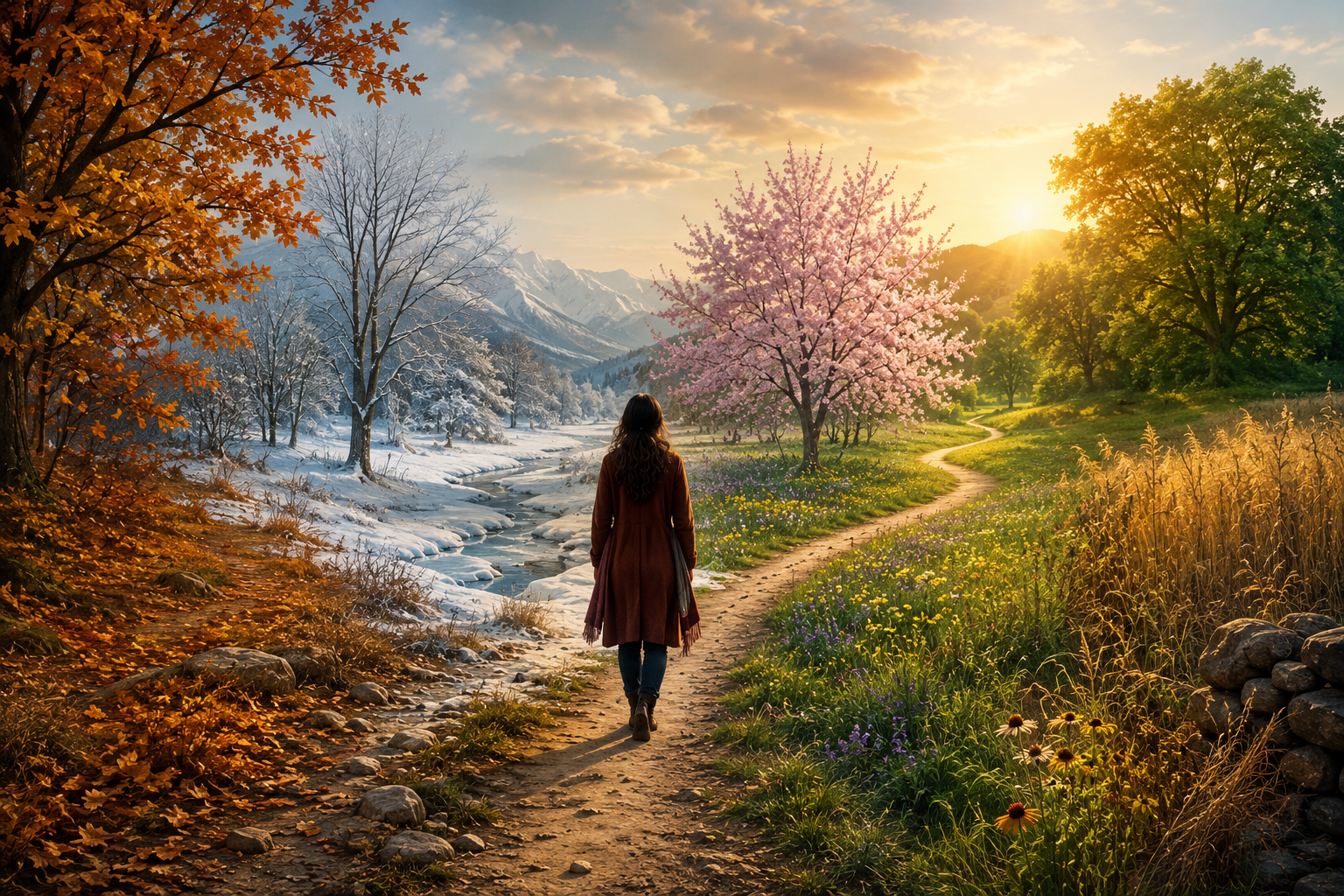
Digital Art, Kellie Stirling
Here's what I mean.
Every transition begins in Metal that sits with the season of Autumn. Something ends. Something is released, or taken, or outgrown. The Metal element governs our capacity for sensate awareness, the skin that registers the first chill, the gut that knows before the mind does that something has shifted, that sense we have when we experience slight arousal because our gut knows something is not quite right. The resource energy of Metal is respect. Respect for what is ending. Respect for the fragility of the threshold. Precision in how we hold what is being lost. How might perimenopause be experienced if culturally we had more respect for what women experience at this time. If we could offer that in a large container for them. If getting older was not denigrated but rather respected.
In transition, Metal asks: can you let this be what it actually is?
Then comes Water, the element associated with Winter. The not-knowing. The fallow. The period that our culture is most brutal about rushing, most intolerant of sitting inside. Water is where fear lives, but also where wisdom gestates. You cannot see the shape of what's coming yet. The resource energy here is protection, to anchor, to contain, to hold someone steady while they cannot yet hold themselves. This is often where we reach out to others for help, trying to regulate through connection. Our tribal need to connect to help us regulate ourselves through the fear that is rising up. This is where providing a container of support is really useful. In Australia, new mothers are connected with other new mothers in a mothers groups so they can have connection during this time.
Water asks: can you bear not knowing what comes next?
Wood is Spring. Spring cannot be manufactured. But when the conditions are right, when there has been enough winter, something moves. Wood governs the mobilisation of life force, the capacity for healthy anger and also hope. It is directed forward movement. Life wants you to move, something new is trying to emerge. A dream that was never pursued, or a truth that was never acknowledged. A boundary that was never spoken. The resource required here is encouragement. Encouragement is not pushing, it is standing alongside someone and quietly saying: "I think you can trust this next step."
In our training room last Saturday, a colleague placed her supportive hands under my ankles. The intention with the somatic touch was encouragement and support in the spirit of a coach. As I was lying there I felt a moving forward energy in my body. Then an image arrived in my mind, unbidden, I was running through a field of flowers in pure delight. That's Wood. That's what an unimpeded mobilisation response actually feels like in a body that has been through enough winter. Whilst the resource energy for wood is encouragement, the felt sense is of something or someone believing in your capacity to move, even when you cannot yet believe it yourself.
Wood asks: what wants to emerge through you now?
Fire is Summer, coherence restored. This is the moment in a transition when you suddenly start to know yourself again, when the scattered pieces find their arrangement and come together in a new constellation, when connection becomes possible again. Fire governs the heart, and the heart's capacity to communicate both danger and equanimity to the whole system. The resource energy is love, not sentiment, but the agape quality of full, unconditional presence. Being truly met.
Fire asks: can you let yourself be known again?
Finally Earth, the arrival of late summer, the harvest. This is where the gristle gets digested. Where the lessons move from being things that happened to you into being part of who you are. Where the gut microbiome, the immune system, the capacity for giving and receiving, all of it comes back online. This is the time in a life transition where we have enough distance from the challenge that we can harvest the lessons we have learned along the way. In menopause in TCM this time is known as the second spring. The resource energy is support coming from underneath, nurturing, a trust and knowing that the ground is holding you rather than you holding yourself up.
Earth asks: what has this made you?
Then we move back to Metal again. Metal is both the beginning and ending of a cycle. Life is nothing but a series of transitions, beginnings, middles and endings that keep on happening.
Respect. Protection. Encouragement. Love. Support.
Five different answers to the same question. Will I still belong if I become who I am becoming?
Yes. When we are in transition we feel like we have lost our inner compass because our nervous system is often rewiring and this affects other systems in our body. When we experience all of this it offers a sense of what it feels like to belong within a transition. Within each season of our life.
The reason transitions are so hard in our culture is not that we lack resilience. It's that we treat them as problems to be solved rather than seasons to be moved through. We try to think our way to summer while our bodies are standing in the frost. We pathologise winter and try to get out of it as soon as we can, often without support. We rush spring. We skip the harvest because we're already anxious about the next thing ending.
But the body knows. The body has always known. What it needs, what it has always needed is not a solution. It is the right quality of presence for the season it is actually in.
When you help someone belong to themselves through a winter they didn't choose, you are doing something that ripples far beyond the room. A nervous system that has been met in its fear, encouraged in its spring, and supported in its harvest doesn't mobilise that unresolved energy outward. It completes the cycle. It becomes available for connection, for contribution, for the next season, whatever it brings.
You don't learn this with your mind first. You learn it the way I did last Saturday through highly attuned presence of another person, sitting with you and holding space for you through it. With that your body suddenly remembers what moving forward safely feels like.
That's where we start. Not with the answer to the belonging question. With the conditions that make the question safe enough to ask.
Here are some reflection questions for you if this resonates with you.
Can I respect what is ending in my life? How can I protect myself in uncertainty? What do I need to be able to encourage what is emerging? Can I meet myself with love? What support do I need to foster time and space for the integration of my experience?