traumahealing

The Gates of Grief

Last week a friend of mine passed away. I got the news early in the morning when I was at the gym.  This is unusual because I never take my phone with me when I am working out but for some reason this particular morning, I slid it unconsciously into the side pocket of my tights, put my headphones on and off I went.  I love listening to music when I exercise, I find it motivating and uplifting.  Normally I turn on my playlist on my phone and leave the phone in the locker; the bluetooth in my headphones is great and picks up the signal from quite a distance.  On this day I did not, I put my phone in my pocket.  

I have known this friend for twenty five years, I met him through my husband.  He was 90 years old, there is no tragedy in the death of a ninety year old but it is sad. He was our friend, we met him in Italy and got married in his town, which is a very beautiful place.  We were looking forward to seeing him next year.  Just a week ago, whilst out for a walk we were talking about him and we admitted to each other that there was a chance he might not be there next year and we talked about our feelings about that, should it eventuate.  Needless to say both of us were very sad when we found out.  I had a few tears at the gym, when I read it, walked home and hugged my husband for an hour.  He was very upset.

It got me thinking about the gates of grief that I learned off Francis Weller who is a psychotherapist who does a lot of work in the grief space.  If you google him you will find many conversations and interviews with him.  I did 12 months of training with him about 5 years ago, more for myself, when I noticed about 6 months out of chemotherapy treatment, I had a lot of grief about my medical experience.

Weller completely reframed the meaning of grief for me in this program.  What he has done is  create a profound contribution to soul-centered psychotherapy because he helps us shift the Western cultural narrative of grief, which often treats grief as private, pathological, and linear, toward one that is relational, ancestral, and integrated.  His map of the five gates of grief help us understand that we can experience grief for many different reasons in our life, beyond the experience of losing someone we love.

So I thought I would take you through them and add my thoughts on it.  I have found in my own experience and in working with clients that there are often many other emotions that get wrapped up with grief, and how it shows up in our lives changes all the time.  There is no unique experience of grief, it changes every time within us and it is different for every individual.

I often talk about grief as a crucible.  A container that can withstand great heat and stress to create something new.  We could see that Weller’s gates create that container by naming different types of loss, we allow others to stop bottling up their grief and sorrow and allow it to flow.  This is what helps us process transitions.

The first gate is, Everything we love we will lose.  Grief is an essential part of being a human.  Weller says one of grief’s most important teachings is everything is a gift, nothing lasts.  To accept this is to live on life’s terms.  This is what the Buddhists called impermanence.  There are no exceptions.  When we acknowledge grief we acknowledge that everything we love we will lose.

I notice lots of people are sad about things that did not happen in their lives or if they didn’t get what they think they deserve.  I think there is a difference here, this is more disappointment and it is totally ok to be disappointed with what has or has not happened in your life and you might experience great sadness with this.  There is a distinction for me between the two, it is nuanced for sure.

People do experience grief in big life transitions like parenthood and menopause and events like a chronic or acute illness like cancer.  These are all very big initiations and initiations take us into places that are unknown.  We wonder will we ever be the same again, who will we be on the other side?  We are not meant to be the same person on the other side, these are times of sheddings and endings and often we are brought face to face with our own mortality.  Often these experiences strip away all our defence strategies we created to adapt as children and we are forced to face our adult world that is much sweeter, riper and vivid.  Many people discover they can actually be with all the emotions we experience as humans and we will not only be okay, we can thrive.

The second gate is; The places that have not known love. This gate is about the parts of ourselves that we have separated from that are untouched by love.  These are the parts of ourselves that have been banished to the basement of our psyche because they are surrounded in shame.  They haven’t experienced kindness, compassion, warmth or a welcoming smile.  What we think or experience as a part of ourselves being defective or wrong is often what we experience grief for.  Weller explains that it is hard to grieve for parts of ourselves that we have banished because we feel they are unworthy of our grief.  Some of you might be familiar with IFS as a therapeutic modality.  It is very helpful to many people to help them bring these banished parts back on line.  When we bring them back it makes sense that we would experience grief having disconnected from them.  Shame separates us from our soul. It is an insidious emotion and I understand why academics like Brene Brown have spent their professional lives trying to understand it.

The third gate is, The sorrows of the world.  We experience this most days just looking at the TV and watching the news.  The grief we experience at lives lost to war, around climate change and natural life being destroyed, cultures being destroyed, people living without a home.  It takes everything that we have within us to walk down a street and not be affected by the sorrows of our world.  This is where being in community, ritual and grieving together is a very powerful process for people to process grief.  Often we do this through art, music, and dance.  Ancient cultures have been doing this for years.  We live in relational fields, in fields of consciousness, indigenous cultures have known this for years.  

The fourth gate is, What we expected we did not receive. This one is a little trickier to explain but I believe it links to belonging.  We are born into families, into communities.  There are certain things we are born to expect.  Weller says we are designed to hear (as babies) soothing sounds, to be comforted, and hear soothing sounds and noises to soothe and comfort us.  Yet some of us don’t experience that.  We are wired to want to belong, it is a very primal need of humans, we are not wired to do life on our own.  Our nervous systems are wired for connection.  Our feelings of not being enough, of feeling like we are lacking are most often not a sign of personal failure but of a community or a society that has failed to offer us what we are designed to expect.  I believe this is where marginalisation and discrimination deeply wounds us.  One of the rituals of Italian life I love is the passigiata.  This is where Italians go out at night before dinner and take a walk with family and friends. There is both communion and spectacle in this event, often dressed in their very best, the passigiata gives rise to a bit of theatre as well as connection with others. As the Italians meet in the community and talk about their day, maybe have a cafe or gelato or aperitivo.  It is a beautiful ritual where people come together at the end of our day.  

The fifth gate is Ancestral Grief.  This is the grief that we carry in our bodies that is handed down by our ancestors.  This can be held for generations and often creates secondary coping strategies of addiction, rage or silence in families.  Things that are never spoken of for generations until they turn up generations later in unexplained maladies like illness or chronic health conditions repeated throughout families. Or ways of being and showing up in the world that we think is personality but actually trauma.  People who lost touch with their cultural  rituals of dance, art, song and moved into survival strategy which is often silence.  I have a few Mexican friends and they all say borrow our Day of the Dead.  This is the 1st of November and it’s the day they all honour and remember their deceased ancestors.  I have started doing this, it's so lovely.

To help grief flow it must be witnessed by another.  Like trauma, grief requires a witness who can acknowledge and witness our experience.  That is why ritual and grieving in community are so important.  This allows us to live more fully as we are opening our heart to our emotions and not repressing them.  We learn to hold what is both bitter and sweet at the same time, what is painful and pleasurable.

I could write pages about grief. I feel like I have barely touched the surface here.  It is such an essential human experience that helps us let go, to keep growing as humans.  I often say to clients, the tears of our grief are like windscreen wipers for our heart.  They help us process our experience of being a human.  

I will finish with a quote from Martin Prechtel, a Mayan Shaman who is also a grief specialist.  “Grieving should never be avoided or postponed; griefing is absolutely necessary.  Without grief the world would never renew itself; the world would cease to exist”.

If you want to read more I highly recommend Francis Weller’s, The Wild Edge of Sorrow and Martin Prechtel’s, The Smell of Rain on Dust.
Permission to be slow

There is a rhythm in the body that most of us have never been taught to feel.  It is actually really hard to feel or listen to.

It is not the rhythm of the heart, though that too. Nor is it the rhythm of the breath, though that is closer. It is actually deeper than both of those and also slower than both.  It is a deep rhythm that feels a bit like it is a tidal movement in the body that pulses beneath everything else. It is two deep rhythms, like a deep tide and a middle tide. Or as my teacher described it is like the ocean, which holds both a surface current and a deep undercurrent. The body carries its own layered rhythms. Both are real. Both carry information.They are deep and they require something most of us have forgotten how to do.

It requires us to slow down enough to feel it.

This year I have been completing training in biodynamic craniosacral therapy, a modality that works with exactly this. What struck me most, is how radically unhurried it is. The touch is extraordinarily light, almost weightless actually. The practitioner's hands don't press or manipulate or fix. They listen. They receive. They create enough stillness that the body's own intelligence can begin to express itself.

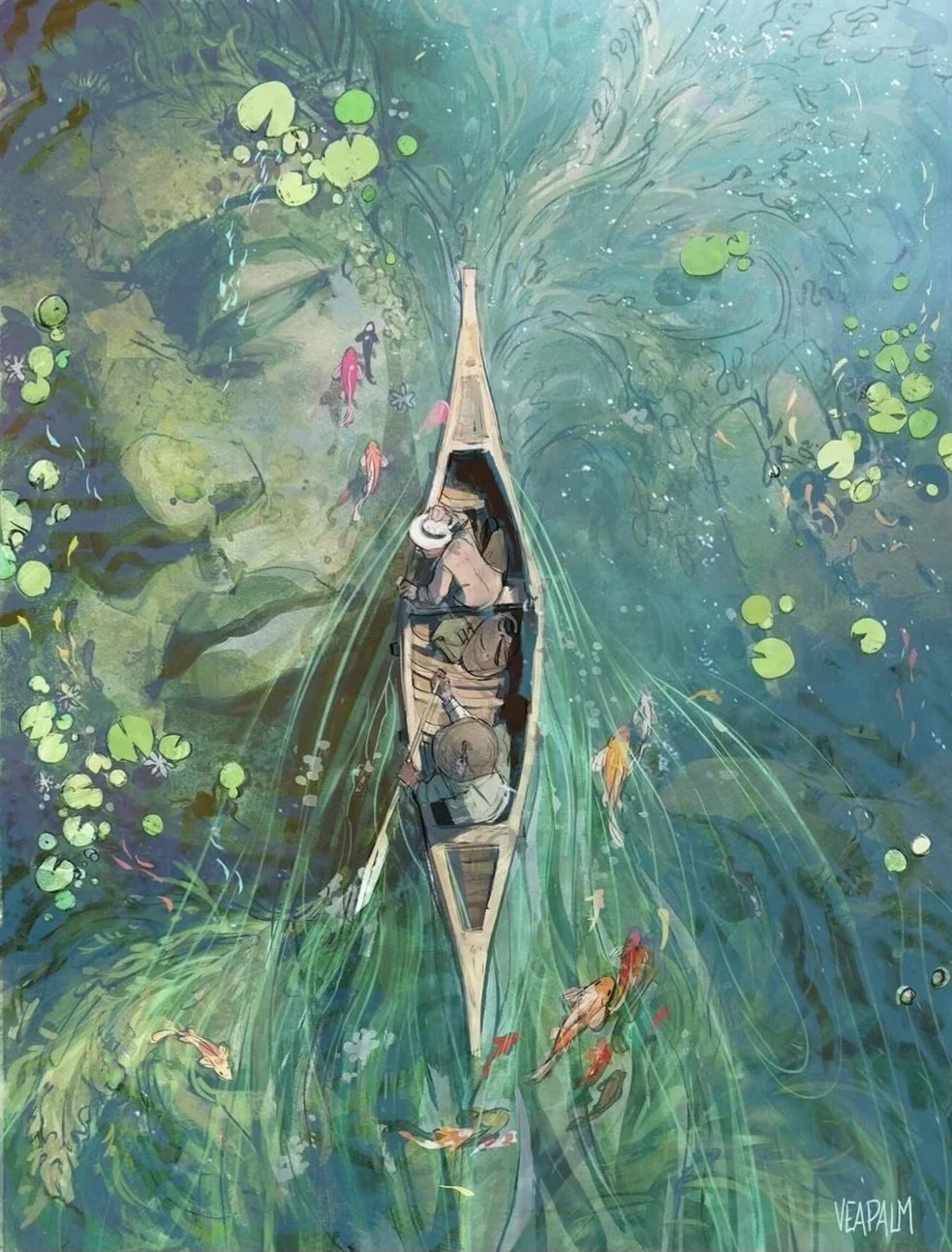
Art, Vanessa Palmer, Beneath the Lillies 2019

This is a different kind of healing to the one most of us have been taught to expect.

We come to healing whether it be to therapy, to coaching, to body work, often looking for something to happen. We want the insight, the release, the shift we can point to. We have been trained, particularly those of us who live from our minds, to measure progress by what we can articulate and what we can feel ourselves changing. We are used to effort. We are used to working hard, even at our healing.  I would say that many of my clients work incredibly hard.  They show up, they invest in themselves.  I do this too.  I always have, even with my own healing work.

Craniosacral therapy quietly dismantles all of that. Before the body can heal, it needs to feel safe enough to be itself.

This is not a metaphor. It is a biological reality. The nervous system, particularly one shaped by years of high-functioning stress or early relational difficulty, is not simply waiting to be fixed. It is waiting to be met. It is scanning, constantly, for whether the environment, including the practitioner, is trustworthy enough to soften into.  I talked about this last week in my blog when I was discussing how the nervous system is always scanning for safety in belonging and trying to work out what role it can take up in the social system.  It's the same theme.

Attunement is what creates that safety. Not technique. Not expertise, though expertise matters. But the quality of presence that says, “I am not here to rush you. I am not here to interpret or analyse or pull anything from you. I am here to be with what is”.

There are things the body carries that have no words.

Not because they are mysterious or unknowable but because they arrived before language did, or at a moment when language shut down. Shock held in the diaphragm. Grief folded into the chest. A startle response stuck in the body. The memory of a moment when the body braced and never quite let go.

Talk therapy doesn’t reach this because it deals with what is in the rational and logical part of the brain, not the limbic system and primal brain, where the nervous system lives, that holds all the patterns of bracing, tension or stress we may not be fully aware of. The body stores experience in tissue, in posture, in the patterned way the breath moves or doesn't move. Sometimes what a body most needs is not to be spoken to, but to be touched, with such fine attunement, such precision of presence, that the tissue begins to trust it is safe to release what it has been holding.

This is what the lightness of biodynamic craniosacral touch makes possible. It is not passive. It is listening at a cellular level. It is a hand that says, ‘I can feel you. I am not frightened of what I find. You don't have to do anything’.

That kind of touch is a language. One the body recognises before the mind has time to evaluate it. The body is the most incredible self healer.

What continues to move me, both as a practitioner and as a person who has spent years working with what the body holds. It is not the practitioner doing the healing, it is the person on the table receiving the gentle touch.

The body already knows. It has always known. The intelligence that knows how to close a wound, regulate temperature, move food through the gut without a single conscious instruction from us; that same intelligence knows how to process and integrate experience, when it is given enough safety and enough time.

My job as a somatic practitioner is not to fix. It is to create conditions. To hold space that is regulated, attuned, and unhurried enough that the body's own healing capacity can come online.

Slow is not passive. Slow is the speed at which the nervous system's deepest layers operate. Slow is the speed at which the tidal rhythms of the body move, carrying their information. Slow, it turns out, is where the most profound healing lives.  I have constantly been surprised by how much depth and nuance can be achieved when we slow things down. It allows stress cycles that have been stuck for years to be completed.  It creates a level of unwinding in the body that can only happen when the body is not rushed.  Slow is more. 

If you are someone who has worked hard at your healing; and I suspect many of you reading this are, I want to offer you this.

You are allowed to receive.

Not just information. Not just insight. Not just techniques to practise between sessions. But the quiet, almost-nothing of being held in a regulated, attuned presence and allowed to simply be. The body does not need to be pushed into healing. It needs to be trusted to know the way.

Permission to be slow is not a luxury. For a nervous system that has been organised around effort and vigilance and productivity, it may be the most therapeutic thing on offer.

The tide is always moving. We simply need to learn to feel it.

You can't think your way into feeling

Feeling your feelings is harder than it sounds.

We have increasingly found sophisticated ways not to feel. We've all heard it. Just feel your feelings. It sounds so simple , almost obvious. Yet, for most of us, it's one of the hardest things we'll ever do.

Not because we're weak, or broken, or doing something wrong. But because somewhere along the way, we learned that feelings weren't entirely safe. Then, quietly and collectively, we built an entire world that confirmed it.

The interesting thing about feelings is that they show us one simple truth, the body knows first. You know when you walk into the room and sense the emotional climate? That is what I am talking about, the nervous system reads the room first and we feel it.

Feelings aren't thoughts about emotions. They are physical events.

A tightening in the chest. A hollow opening in the stomach. Heat rising in the face. Heaviness settling in the shoulders like something invisible just landed there. The body receives experience first, before the mind has a chance to name it, frame it, or find somewhere useful to put it. Feelings don't live in your head. They live in tissue, in breath, in the subtle language of your nervous system.

So when we talk about avoiding feelings, what we're really talking about is learning to move away from sensation. From the body's own signal system and most of us have been doing it for so long, we don't even notice we're doing it.

The avoidance rarely starts as a choice. For most of us, it began as an inheritance.

We absorbed it from the culture we were born into, a culture that prizes productivity over presence, resilience over vulnerability, and forward motion over the messy, necessary work of actually processing what's happening inside us. “Push through. Stay positive. Don't dwell”. We've dressed emotional suppression up in the language of strength for so long that many people genuinely can't tell the difference between regulation and repression.

The "good vibes only" movement, for all its cheerful intentions, is perhaps the most recent iteration of a very old story; that difficult feelings are a problem to be solved rather than a signal to be heard.

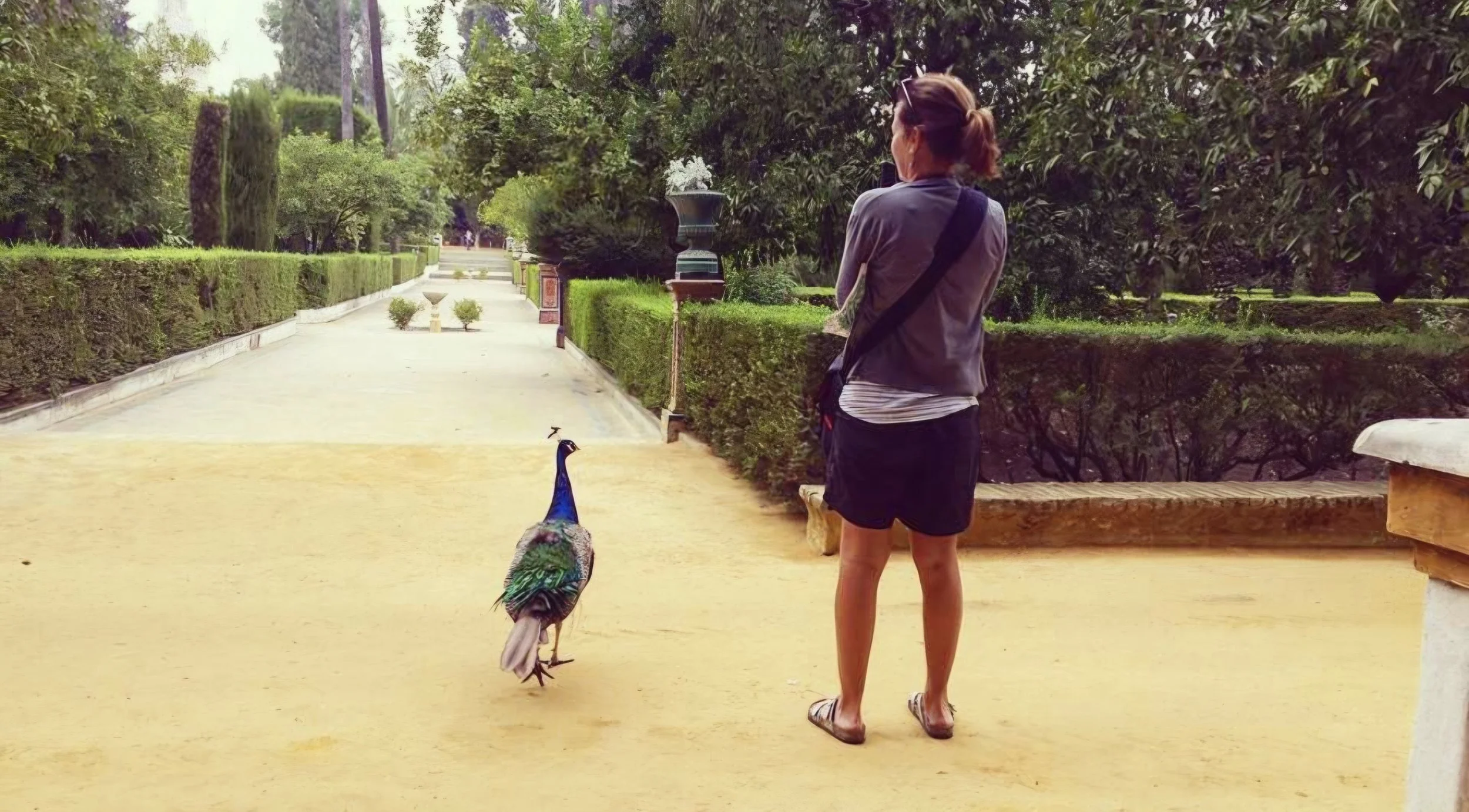
Image - Kellie enjoying the beautiful Alhambra Gardens, a few years ago. A quiet moment of feeling peace, awe and wonder, …….. with an unexpected new friend.

But culture is just the backdrop. The more intimate teaching happens closer to home.

In many families, emotions, particularly big, difficult ones, were not something that could safely exist in the shared space. Not because parents were cruel, but because they were human; carrying their own unprocessed histories, their own unmet needs, their own nervous systems doing the best they could.

Children are exquisitely attuned to the emotional climate of their home. They feel the tension before anyone speaks. They notice the shift in atmosphere when a particular topic is raised. They learn, with remarkable speed, which feelings are welcome and which ones make the air go strange.

So they adapt. They make themselves smaller. They learn to swallow the tears, contain the anger, perform the calm. Not because they were told to, though sometimes they were, but because they felt what happened in the room when they didn't. The withdrawal. The anxiety. The subtle but unmistakable signal that this was too much.

This is not a failure of the child. It is a profound act of adaptation. The child keeps the peace. The child holds the system together. The child learns that their inner world is less important than the emotional stability of the adults around them. The problem with this is it is not the child’s role in the family system to hold space. They don’t have the capacity in their own bodies to do this. Their nervous systems grow well when they have support and co-regulation for parents and caregivers.

That learning doesn't leave when we grow up. It becomes the architecture of how we relate to ourselves.

For some, this went even further. Perhaps there was a parent who struggled, with depression, with alcohol, with the weight of their own unresolved grief. Perhaps the emotional temperature of the household was genuinely unpredictable, and learning to monitor and manage it became a matter of felt safety.

These children became extraordinarily skilled at reading other people. They developed a finely calibrated sensitivity to mood, to need, to the earliest signs of distress in those around them. They learned to intervene before things escalated. To soothe, to deflect, to become whatever the moment required.

What they didn't learn was how to turn that same attention inward.

When your nervous system is organised around tracking others, when your survival, in some early and embodied sense, depended on getting that right , your own feelings become background noise at best. At worst, they feel like a liability. An indulgence. Something to be attended to only once everyone else is okay.

Which, of course, is never. Because these choices were intelligent strategies that our nervous system made, that helped us survive moments when protection, choice and support was missing. Over time they become habituated responses, very strong neural pathways that keep us alive. Those intelligent responses live in the nervous system and tissues; muscles stay contracted, breath stays shallow and the body stuck in a fight response, prepared for a fight that is no longer happening.

Culturally we started to notice in workplaces that we had a problem with poor emotional regulation and here's where it gets interesting.

Emotional disconnection, burnout, relational breakdown, it became impossible to ignore so we developed a response and we called it Emotional Intelligence.

We built frameworks. Competency models. Training programmes. We gave people a vocabulary for their inner world and a five-step process for navigating it. In many ways, it was very well-intentioned a genuine attempt to bring feeling back into professional and personal life. I want to say I think it is brilliant that organisations started to highlight this because left to their own devices, many people wound never come across this content. As I always say, you have to start somewhere.

But look at what we actually did. We took the most embodied, relational, lived thing there is and…. we put it in a PowerPoint. We made emotion into a skill to be optimised. Name the feeling, manage the feeling, deploy the feeling strategically. Which means it's still, fundamentally, a head operation. You're just thinking about feelings in a more sophisticated way. The body, where the feeling actually lives, barely gets a mention.

Emotions arise from the nervous system particularly the limbic system. This is a different part of the brain to the neo-cortex which is receiving this powerpoint information, which is all about logic and reason. If you want to build emotional capacity you have to work with those parts of the brain where implicit memory lives and you do it through the language of the nervous system, which we call ‘The felt sense’.

This, I think, tells you everything about how deep the conditioning runs. That even our solution to emotional disconnection had to be made safe by intellectualising it. We couldn't let it be messy and bodily and unquantifiable. It had to have a score. A framework. A return on investment.

We looked at the problem of not feeling and responded by finding a more sophisticated way to not feel. There is a huge cost of staying ‘just north of yourself’.

When we consistently move away from sensation, the feelings don't disappear. They go underground deep into our unconscious. They show up as anxiety without a clear source, as a vague flatness, as a body that's always tense for no reason you can name. They emerge sideways in sudden irritability, in chronic pain, in the persistent sense that something is off even when life looks fine on paper.

There's also a quieter cost. When we numb or bypass the difficult feelings, we inadvertently turn down the volume on the good ones too. Joy becomes harder to access. Aliveness feels further away. We go through the motions of a full life while feeling strangely absent from it.

Perhaps most poignantly, when we can't feel our own experience, we cannot feel others’ and we struggle to feel genuinely met by others. The connection we most want keeps glancing off a surface we've spent years polishing smooth. In relationships this is a major driver of loneliness because we cannot connect with our emotions let alone talk about them and share what is deep in our heart with another. That level of vulnerability is terrifying.

The body keeps the ledger, it waits, sometimes for decades, for the conditions to be safe enough to finally put some of it down.

We often talk about feeling feelings as though it's a matter of bravery of simply deciding to stop avoiding and diving in. But that framing misses something important.

Feeling, especially for those of us who learned early to move away from sensation, is a capacity that needs to be built. The nervous system needs to learn, slowly and with support, that it can be with experience without being overwhelmed by it. That sensation can be felt and survived. That there is enough space, enough ground, enough steadiness to actually let something land.

This is the heart of the somatic work I do with people. Not pushing into feeling, but gently expanding what can be experienced without the system needing to flee. It's slow work. It requires patience, curiosity, and a willingness to be a beginner in your own inner life.

It is some of the most important work I know.

Somatic work doesn’t force patterns to disappear it meets them with careful pacing and respect. Healing begins when we attend closely to the physiology and introduce layers of support that were not present in the original moment: co-regulation, steadiness, choice, support and the permission to be and move ever so slowly. Slow is more in somatic healing.

The nervous system begins to soften and loosen. It realises that it is no longer in a fight and the body learns that it does not have to hang on so tightly. The support that was missing is finally here.

If any of this resonates, here's a gentle place to start. The next time you notice an urge to reach for your phone, or to get suddenly very busy, or to launch into problem-solving mode, pause. Just for a moment.

Ask: what's happening in my body right now?

You don't need to feel everything. You don't need to go anywhere overwhelming. Just notice. A breath. A tightening. A warmth. A nothing.

That small, curious turn toward the body, that noticing, is the beginning of coming home to yourself.

This is unlike anything you'll find in a competency framework, nobody can teach it to you from the outside. It has to be lived, slowly, from within.

If you would like some support and learn how to build this capacity so that you have more energy to cope with what life throws your way, come talk to me.