midlife coach

Some reflections on Nostalgia and Collective Grief

There’s a trend circulating at the moment on social media. “Mum and Dad… what were you like in the 90s?” People are posting old photos, grainy images, oversized denim, sun-faded afternoons. There’s something almost tender about it. A collective wistfulness and I’ve noticed it in myself too.

Recently, I’ve been watching Ryan Murphy’s series on John F. Kennedy Jr. and Carolyn Bessette Kennedy. There’s something about it, the aesthetic, the pace, the feeling that evokes a different era. A quieter one. It stirs something. Not just memory but something deeper. The visuals evoke memories of my twenties living in London in the UK and times I visited New York in that time period.

Nostalgia is a slow form of grief where time shifts without our awareness. Chapters of our life end really quietly without much self awareness whilst we are living them. There are people, places and versions of ourselves that we never really got to say goodbye to, because we didn’t realise that we were at the end of something, until it was over.

We don’t really think of nostalgia as grief. Many of us learned that nostalgia was fondness or sentimentality. The yearning for the good old days. It is a felt sense, it’s very somatic; our senses are the gateway to our memories. A song comes on and reminds you of a time and place. You smell something and a whole era of your life comes flooding back. You might come across an old photo and as you look at it you remember the version of yourself that you see in your hand. How it felt to be that version of you. Sometimes you miss that version of yourself and sometimes you smile and think I am glad I am past all of that.

A few mornings ago, I was walking with my 17-year-old son. He’s been feeling the weight of the world lately like many young people are. The complexity of it. The uncertainty. The constant stream of information that never really lets the nervous system settle.

And he asked me: What was life like when you were 17, Mum?” So I told him about 1989. There were no mobile phones or internet. You rang your friends on the house phone and hoped they were home. People turned up when they said they would and most of the time you waited. We used to spend a lot of time waiting around for each other. Shops were closed on Saturday afternoons and Sundays. Nights were quieter. Life moved more slowly. As I spoke, I could feel something in my body soften. What was strengthened in our nervous system when we waited around was a greater capacity for uncertainty and a quiet trust that connection would come.
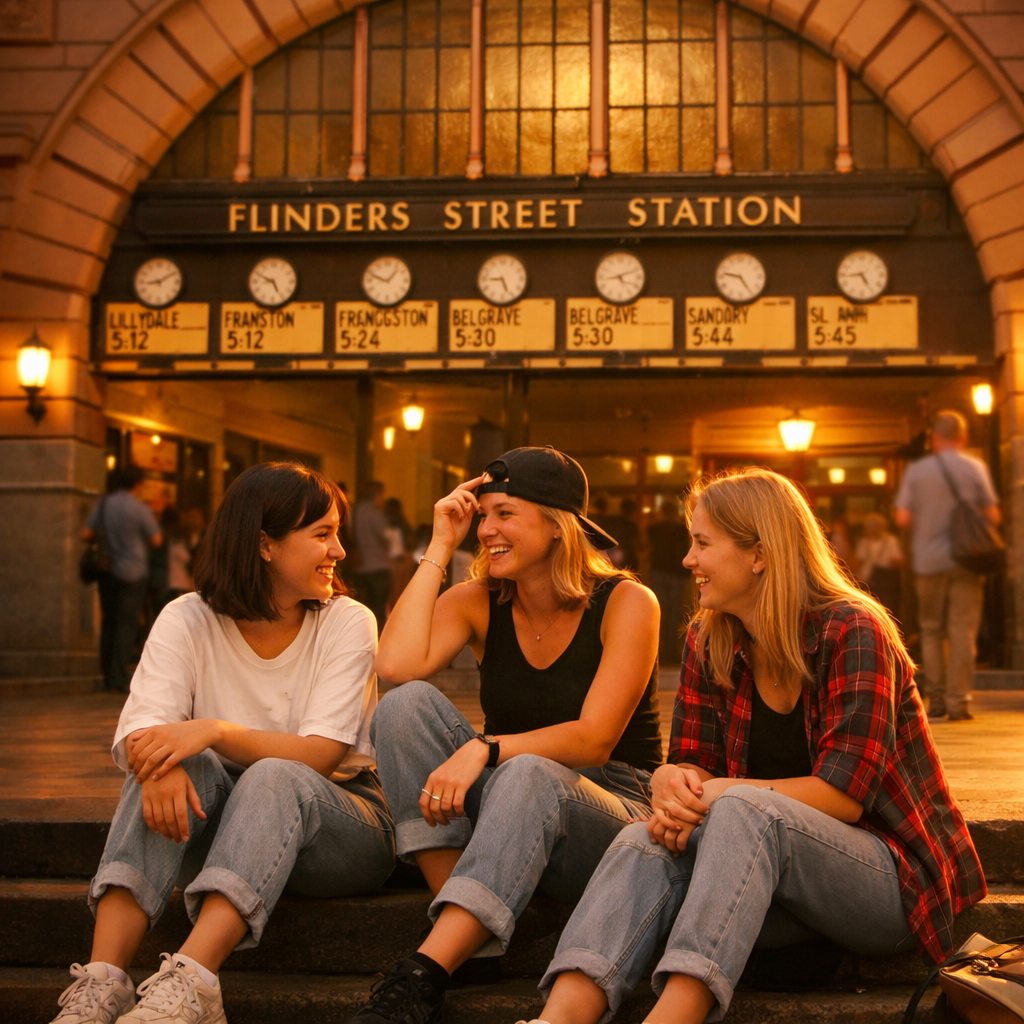
Digital image, Kellie Stirling. Waiting for our friends by the clocks.

Not because everything was better, it wasn’t. But because something about the pace of life was different. It was a little more contained, less exposed and relentless. I think that’s part of what we’re feeling when we experience nostalgia at the moment.

It’s often described as longing for the past but I don’t think we’re really longing for a decade. I think we’re longing for that felt sense. A way of being in ourselves when the world moved differently.

Later that day, I was in the car with my sons. My eldest, who’s nearly 20 and an engineering student at University, was driving. We were talking about fuel shortages and what might change in the future, electric cars, shifting systems, renewable energy options, the way the world is having to adapt.

I found myself asking: “What do you think we’ll learn from this?” He said, quite simply: “I think people have to realise that the only way we’re going to get through this is together. We have to collaborate. We have to support each other. We’ve got to change.”

I felt it land in my body as he spoke because in that moment, something shifted. Nostalgia looks back. But what he named looks forward. We can’t recreate the conditions of the 90s. The world is more interconnected now. It is more complex and demanding on our attention, our nervous systems, our capacity to process.

The slower pace we remember wasn’t just a lifestyle it was an environment that offered a kind of built-in regulation. There was less information, stimulation. and there were more natural boundaries between “on” and “off.”

That world doesn’t exist in the same way anymore. So the question isn’t, how do we go back? It’s: ‘How do we live well here? Perhaps this is where nostalgia becomes something more than wistfulness. Maybe it becomes a kind of remembering. Remembering not of a time but of what mattered and what was valued.

There was connection, presence and rhythm. It felt a little more spacious for our nervous systems and there was more connection and time spent in different types of community.

We are being asked to express those things differently now, not through simplicity, fewer inputs or retreating from the world, but through conscious collaboration with greater discernment. By learning how to stay connected within it.

What my son named, in that simple sentence, is something I see in my work every day. Whether I’m working with leaders, couples, or individuals navigating change the same truth emerges: we regulate in relationship and we find our way through complexity together.

So maybe the nostalgia many of us experiencing at the moment isn’t asking us to return to the past.

Maybe it’s helping us feel what we’re missing, so we can choose how to bring it forward. We may not get the slower world back, but we can create moments of slowness. We may not escape the complexity but we can learn to meet it with others, rather than alone.

I think perhaps that is the quiet invitation underneath all of this; not to go back but to become more intentional about how we live now.

Together.

The kings and queens of the push through

I tend to work with a lot of high achievers who come to me in midlife in a quandary. They are either burned out, they have lost their motivation or they have lost their inner compass. They are incredibly capable people. Brilliant creatives, leaders and thinkers, the people everyone relies on to get the job done or come up with the solution.

When they come to me there is something fundamental happening underneath, deep in their system, that they can’t solve or workout. They have lost connection with their deepest needs and desires. Their emotions, what they value, what is important to them has become fuzzy. Something is wrong in their world and they cannot put their finger on it. They are overly tired or have lost their zest. This drives them crazy, they feel like a failure because they are so used to solving all the problems. They love solving problems and creating value.

It is a body in freeze.

For many of us, we are still functioning and functional freeze is the nervous system’s quiet survival strategy: a blend of dorsal vagal shutdown with just enough sympathetic activation to keep you moving, performing, achieving.

You look “fine,” you produce, you deliver, you impress people but you have lost connection with your internal world. You’re upright, responsive, competent but you feel dead on the inside. No real vitality, internal pulse or felt sense of self.

Digital Art - Kellie Stirling, People thawing their freeze

For many overachievers, this becomes the air they breathe until their body says No, not any more. Often it happens at midlife.

So how does this overachieving freeze pattern start?

Well most overachievers learned early in their life that there needs were either: inconvenient, ignored, criticised, overwhelming to caregivers, unsafe to express or simply too much.

So they adapted in the only way their system knew how, they turned down the volume on their body and turned up the volume on their mind. They became brilliant, fast processors, high-capacity thinkers. They became the problem-solvers, the responsible ones, the reliable ones.

But brilliance built on freeze has a cost. We stop listening to the signals from our body. We stop listening to the signs of tiredness, of what a NO feels like in our body. We learn to override our basic impulses. It is not coincidence. Is is a pattern.

Productivity culture is built on functional freeze.

We applaud over-functioning and self-sacrifice. We reward output and speed and we celebrate people who “just keep pushing through”. I think a lot of Gen X’ers learned to do this early, because in their teenage years they spent a lot of time on their own and just had to get on with life.

We call this excellent work ethic, resilience or commitment. But what if much of what we call “productivity” is actually a socially-validated freeze response?

I have had so many clients, mid forties to late fifties, post-menopausal, who make a big career change and then come to me saying, I don’t know what is wrong with me, I just feel out of sorts. I get stuff done, I am a doer. Nothing is wrong with any of them. Their body has just simply stopped cooperating with the override. Or guys who come to me and say they know their life has to change, they are on the precipice of existential change but they don’t know where to start.

When you have spent decades powering through the classic, go, go go. Your body has a way of bringing you back into right relationship with it. As we age, our hormonal cocktail starts to change and menopause has a way of stripping down and highlighting our compensatory strategies. The freeze structure that held everything together began to collapse. Remember the developmental challenge of midlife is radical honesty, come back to the truth of who you really are.

Gently and slowly we work together to slow down. My client's nervous system immediately start to show what they have been trying to outrun. The survival strategies that were created as children to stay safe aren’t working anymore. Their body is setting a boundary. The freeze is ready to be thawed.

This is why burnout in midlife spikes.

Women lose hormonal scaffolding that kept them overriding their body. and men hit existential thresholds where achievement can’t fill the inner void. Our careers peak while capacity starts to decline. Many parents carry the emotional and logistical load for teens and ageing parents. and many of us find the nervous system can’t run the childhood strategy anymore.

People think they’re falling apart. But what’s falling apart is the freeze, not the person. Burnout is both exhaustion and it’s the breakdown of the freeze scaffold. Burnout is the point where the body says, “I’m not going to keep doing this.”

Overachievers don’t lose their motivation they lose their override strategy. When the freeze starts to thaw, we start to feel all the things we have been pushing down for years. The anger, fatigue, hunger, sadness, longing, boundaries, desire and our No.

For many overachievers learning what a No feels like in their body can be a big revelation.

Many overachievers are very creative. They have lots of ideas. They get excited by their ideas, creatively, strategically, intellectually their mind is alive. They can get flooded by them too and want to put them all into action. Not doing so feels like a failure. Something I have learned personally that I help my clients with is our freeze makes us believe these ideas have to be acted on.

Every impulse becomes pressure, every spark becomes a project, every inspiration becomes responsibility something we feel we absolutely must do. This is where burnout can accelerate.

One of the most powerful shifts in my own midlife has been learning that you don’t have to act on every idea. You can feel it, sit with it and let it breathe.

Sometimes an idea is complete simply by being witnessed. Sometimes it is enough to journal it, or talk it through with a colleague or friend. Sometimes you just have to write it down and let it sit for a few months.

This is how you slowly retrain your system, that not every idea has to be acted on. You start to rewire your nervous system and you will notice that the compulsion to act will turn into more capacity. The pressure to act can turn into being present, and the need for action will become digestion.

To come out of functional freeze we work slowly, relationally and somatically. We learn to track micro-sensations and small pulses of movement. We learn how to set tiny boundaries, small steps at a time. We learn how to titrate our life. Small changes 1% more each day. We learn to enjoy receiving the co-regulation from our somatic therapists and/or coaches. We start to notice we are slowing down, 1% more each day and then we can recognise that rest isn’t a weakness it is a signal. We start to notice, that we are noticing how we feel and we let our ideas sit and percolate rather than having to act on them.

Most importantly we learn that our value isn’t earned by producing. Value is inherent because you are here, you are alive. Your body is your home, your garden, your temple. It is not a machine.

Your needs matter.