It is menopause awareness month and actually on October 18th, World Menopause day. This is an area I do a lot of work in - supporting women in their midlife transition. To be honest I am sick of the messaging around HRT being the silver bullet. It is not, not even close. It is helpful for some people, medical care matters and symptoms deserve attention. You don’t have to suffer. If you need it and it helps, go for it. But it will not fix everything, only a couple of things. So today I wanted to demystify the broader transition to help you make sense of what you might be seeing, hearing, thinking or feeling. Because there is a whole lot of conversation around the enormity of this transition that is not being spoken about and it is making people’s lives harder than they should be.
Menopause is a reckoning with how we have been living.
We are going through a re-wiring of our brain and nervous system. All our body systems are interconnected so when our hormone levels start to change, all hormones are impacted, not just your sex hormones. Your stomach hormones leptin and ghrelin, insulin, all of them. Of course our hormones interact with our nervous system all the time so it will be impacted to. Our brain is rewiring for this new hormonal cocktail just like it did when we were in adolescence and after giving birth. We will be tired and have brain fog, just like we did in earlier transitions. Our body needs time out and support.
For many of us the body changes alone don’t cause the exhaustion, over functioning and disconnection or loss of self. It can make the strategies we have relied upon for decades much harder to sustain. The scaffolding of our coping strategies becomes highly visible and the body has much less tolerance for the old deal most of us made with ourselves that sounds something like this. “I will keep giving, pushing, over-achieving, caring, anticipating, juggling all the balls, holding everything together and then eventually I will get to myself”.
Suddenly our body says, No, I am not doing that anymore.
Fatigue, insomnia, anxiety, hot flushes and the loss of resilience can become not simply problems to get rid of but information. Not information to not treat but information that invites you to ask yourself, How am I actually living? What is my body carrying? What am I no longer willing to carry?
Your body is asking you for a different economy, a different way of using your energy.
In Traditional Chinese Medicine (TCM) Menopause is known as the second spring. Our first spring in the five elements model is adolescence. TCM works with women’s bodies in a seven year cycle. It is around the age of 42 years that our perimenopause often starts in TCM terms, the next seven year cycle starts at 49. Most women in the western world go through menopause at the average age of 51. It differs across cultures. In the Indian subcontinent, the average age is 49.
TCM sees menopause as a life preserving action. Every month when we bleed we use up a lot of energy, both in creating the lining of the womb and then in shedding it. Once we enter second spring all that energy moves from the womb to the heart. It nourishes the heart as we age. I really like this explanation.
When we are depleting our reserves all the time, our yin starts to diminish. We start to really feel it in this 42-49 year cycle. The old ways of endlessly drawing on our reserves, without attending to ourselves become increasingly untenable.
In this time period our body starts to insist on reciprocity. That is, not so much How much more can I give? The questions become what nourishes me? What replenishes me? What is enough?
It really is a reckoning for us to look at our own limits and boundaries - or lack thereof.
There is a lot of messaging out there that says, your body is changing, here are all the things that can go wrong, here is how we can keep your functioning.
I feel this misses the point. What if you actually are not meant to return to who you were? Menopause can mark a threshold between one way of being a woman and another way that might be possible for you.
It is not a decline or an oestrogen deficiency. It is the Autumn season of our life where we get to review and decide what we don’t need anymore in our life and what we need to keep and what we need to birth. It is an initiation into the next phase of our life - to our wise woman power.
When the cloud of estrogen lifts I find many people remembering all their aspirations and goals they had when they were a young girl. They might find their inner activist who somewhere along the way got lost. Many women find that they care less what other people think. I think this is a good thing because what they are coming back to is their own internal compass and what they care about passionately, what lights them up and gives them meaning and purpose. Living life on their own terms, rather than looking after everyone else and sinking in the process.
The young girl isn’t necessarily the person you want to become again, but rather she may carry qualities that the adult woman within you finally feels free to claim. Curiosity, creativity, sensuality, adventure, fierceness, imagination. A particular fascination with something?
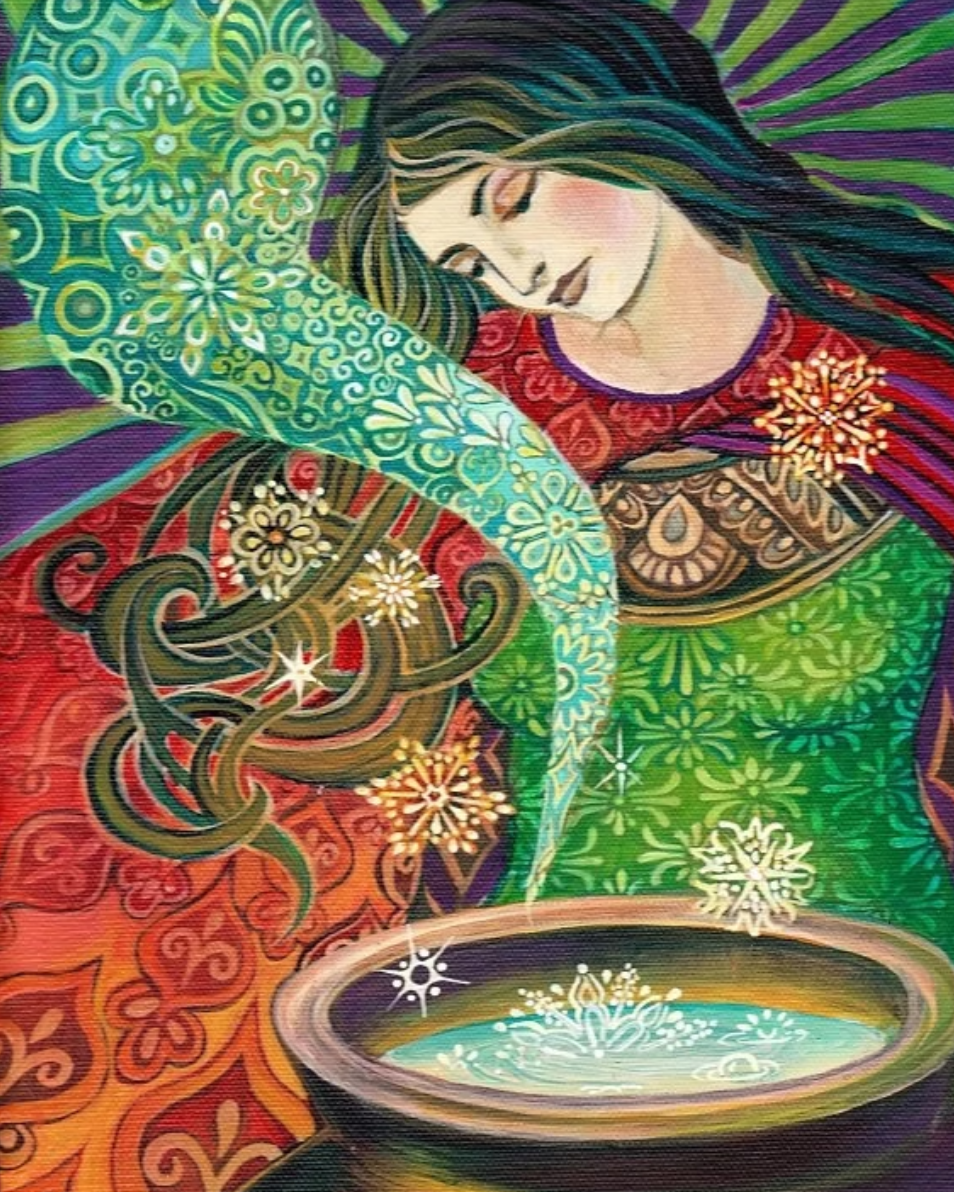
Digital Image, Kellie Stirling - A woman connecting with her Maga archetype.
Menopause connects us with our desire. It can be a profound connection for many women with what they really want. Like really actually want. Not what they should want, what their husband wants, what their family needs. Not what would make them a good partner, wife, employee or mother. But what does my body want now?
That can be very confronting. If you have spent thirty to forty years being highly functional, connecting with your desire can feel very strange and unfamiliar. I believe this is one of most powerful aspects of menopause. The possibility that you are connecting with your own inner compass and becoming more internally referenced. It is not becoming self-centred, it is having a centre within yourself from which to meet the world. When you connect with that, that is why you start to care less. That is why you find yourself speaking out more
Menopause is not asking you to become the woman you were again. It is asking you to become more fully the woman you actually are.
We are living longer these days and Archetypically this has brought a new archetype to our understanding of women’s transitions and modern feminist spirituality. We now have Maiden, Mother, Maga and Crone.
So who is the Maga? In the TCM model she is late summer and early autumn. The word Maga is Portuguese for magician, sorceress or wise woman, she is an enchantress and wild woman. In this transition time we are moving from being outward focused coming back to inner sovereignty. The Maga represents the reclamation of personal power, clear boundaries and creative alchemy. Our sexual and spiritual potency is no longer tied to our fertility. As I say to many clients we are becoming the sorceress and it is time to put our magic out into the world.
So you can see the conversation is much bigger than HRT. It is a conversation about how we have lived, about depletion, about what our bodies are trying to tell us. It is a conversation about our boundaries and limits, desire, identity, sexuality, ageing and about our power. It is a conversation about the parts of ourselves we have put aside or banished into the basement of our psyche and they are now screaming hard to come back. It is a conversation about what we are no longer willing to do and ultimately, it is a conversation about who we are becoming.
This is a profound initiation and a threshold, and thresholds always ask something of us.