sisterhood wounding

The wisdom women carry

Reflections on International Women’s Day.

I am a bit late to international women’s day this year. It happened on the weekend, we had a long weekend where I live and my week last week was really hectic. It arrived before I realised what date it actually was. Sometimes I get a bit ‘meh..’ about it too.

International Women’s Day often celebrates women for their achievements. The roles we hold, the barriers we break, the leadership we demonstrate. All of these things are very important. But I wanted to bring to your attention the deeper truth I witness in my work with women is something quieter, older, and far more powerful. It is the wisdom women carry in their bodies.

The wisdom forged through cycles of life. Through life’s transitions, challenges and the roles we take up in our lives. This wisdom that is forged through birth and loss, relationships that begin and end, careers that are built then changed, and identities that reshaped. All of this through the long and often invisible work of healing.

Women’s bodies are cyclical by nature. We are designed for seasons; for expansion, contraction, renewal and rest. Yet many of us have spent decades living inside systems that expect us to operate like machines: linear, productive, always moving forward.

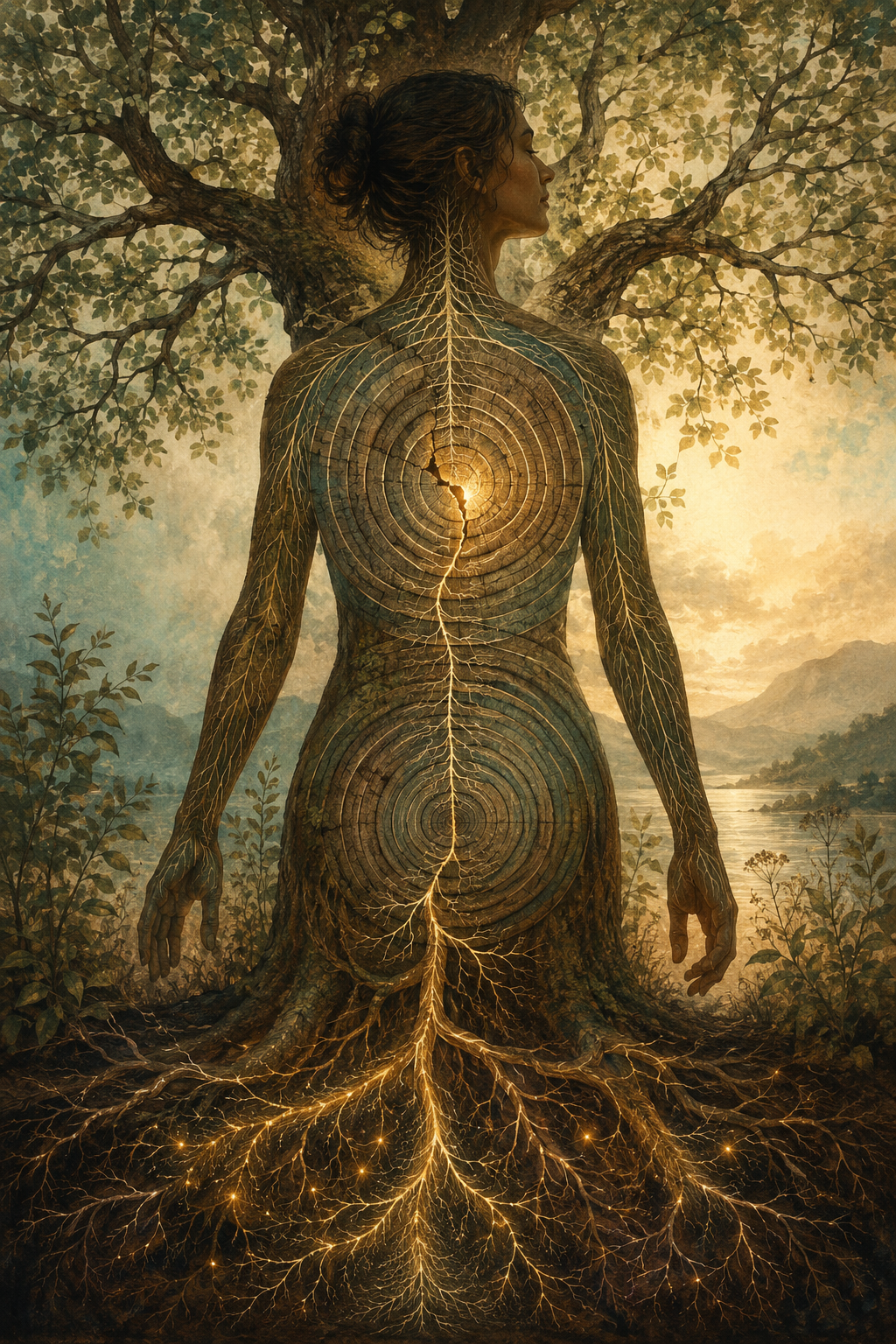
Digital Art, Kellie Stirling

However, a woman’s body never forgets its inherent nature. Eventually it calls us back and there are many different ways it speaks to us to do that. Often this call becomes louder during or after the big life transitions of becoming a mother and in our midlife when perimenopause arrives.

In midlife in particular, things really start to get shaken up. The old identities that once held us together begin to loosen. The roles that defined us, mother, partner, professional, caretaker often no longer fit in the same way they once did. What can start to feel like we have lost our inner compass a little at this point. What can feel like disorientation is actually something else entirely.

A threshold.

In my work as a somatic experiencing practitioner and somatic coach, I often see women arrive at this threshold carrying years of invisible labour, emotional labour, relational labour and generational patterns they have carried quietly for their families and communities.

When we slow down enough to listen to the body, something remarkable happens. The nervous system begins to soften and the old protective patterns that once helped us survive can gently loosen their grip.

Beneath those protective patterns something else emerges. It is not weakness or fragility. It is profound strength and a deep sense of knowing. This sense of knowing, this strength, comes from women who have lived.

What does it mean to have lived? It comes from our lived experience where we have have felt deeply, lost deeply, loved deeply. It looks like women who have learned that true power does not come from pushing harder, but from becoming more deeply connected to themselves, to their bodies, and to the web of life around them.

International Women’s Day, for me, is not only about celebrating what women achieve in the world. It is about honouring the depth of women’s inner worlds. Women who try so very hard to keep healing and growing as human beings. It comes from honouring the quiet courage it takes to heal and the wisdom that emerges when we listen to the body.

I notice the profound capacity women have to transform pain into compassion, for themselves, for others, and for future generations. When a woman heals, the ripple effect of it travels far beyond her. There is a saying that the mother is the anchor in the family system and constellation; when mum is okay, the family is okay. So when a woman works on her own healing the ripple effect is to all the social system she exists within. To her family, her intimate and platonic relationships and to her leadership.

The impact is far reaching.

So today I honour the women who are doing the deep work, the women who are reclaiming their bodies. The women questioning the systems they were taught to live inside and learning to reconnect with their deep knowing and learning to trust it again.

This kind of change rarely makes headlines but it is the kind of change that has a huge impact, one tiny step at a time.


When the Roots are revealed

A nervous system reflection on collective disgust, power, and disillusionment

There are moments when the collective emotional field shifts.  You can feel it, not just in headlines or conversations, but in the body. A heaviness. A tightening. A quiet sense of repulsion that sits somewhere in the triad of disgust, anger and grief.  Lately there has been a lot of upheaval in our lives and lots of information revealed that has frankly, shocked many of us to our core.

It is not just the big stuff.  I feel like every day I read the newspaper or look online and something about the abuse of power is there.

So it is not surprising that many people have been describing feelings of disgust, disbelief, and despair as more information circulates about powerful people, networks, and systems that appear far more complex and paradoxically far more human than we once imagined.

The reactions are strong and they make sense because this isn’t just an intellectual response.

It is a nervous system response and we notice that the body knows before the mind can explain.

When people feel disgust, the body is doing something very specific.

Disgust is a boundary emotion.  It is the nervous system saying, this is not safe, it has crossed a line and I need distance.  Disgust is an interesting emotion because it doesn’t say fight, it says move away.  Our visceral reactions with disgust are often really strong; recoiling, nausea, tightening in the throat and gut, facial expressions that close down intake.  It is like our body is saying, ‘do not ingest this’.  Which makes sense when you think that disgust evolved evolutionarily to protect us from contamination, like rotten food or toxins.  When you explore it psychologically that same neural circuitry extends to moral violations, ethical breaches, abuses of power and relational betrayal.  So when people feel disgust at certain events or revelations, the nervous system is experiencing something more than ‘this is wrong’.  It is experiencing a very different message.  The message is more ‘this feels contaminating to my sense of safety or moral order’.

It is a little bit different to anger.  Which we then might experience closely after it.  Anger is a mobilising energy that wants to restore integrity or fairness.  After that, for many if anger offers us no respite, then comes something heavier.  A flattening, fatigue and often a sense of despair. The moment when the body recognises that the systems involved feel too large to influence.

Now lets think about disillusionment for a minute. At a nervous system level, disillusionment isn’t just disappointment. It’s the moment when something we were orienting toward; a person, system, belief, or story, no longer provides stability. The illusion wasn’t just an idea, It was an organising principle that helped shape our mental models of how things are, how we perceive everything works together.

So when it falls away, the body momentarily loses its map. You might feel a drop in energy, a slowing or flattening, maybe heaviness in the chest or a kind of internal ‘oh…’ that comes with a sinking feeling in your belly. It is almost like our body is saying ‘I don’t know where to place my trust now’. With disillusionment, it is like relational disappointment and so we might be feeling something like a micro grief because we are carrying sadness rather than outrage (or maybe outrage too!). It might feel like we are grieving the certainty, innocence and simplicity we once knew.

In the context of what we are experiencing with information revealing abuse of power, these responses are not signs that something is wrong with us. They are signs that our bodies are orienting to what feels morally and relationally unsafe.

When trust and power collide

Human beings are wired to seek safety through connection.  Connection with trusted structures like families, communities, organisations, leaders, institutions.  When those structures feel compromised, the impact is deeper than opinion or politics.

It can feel like an attachment rupture at a collective level.

Deep inside of us we ask, Who can we trust now?  What is actually true?  How do we orient in the world?

In my work with teams and leadership systems, I often see a similar dynamic. When trust breaks in a leadership group, the entire nervous system of the team shifts. People become hypervigilant, cynical, or withdrawn. Energy that once went toward creativity or collaboration turns toward self-protection.

In society, the collective field behaves much the same way.

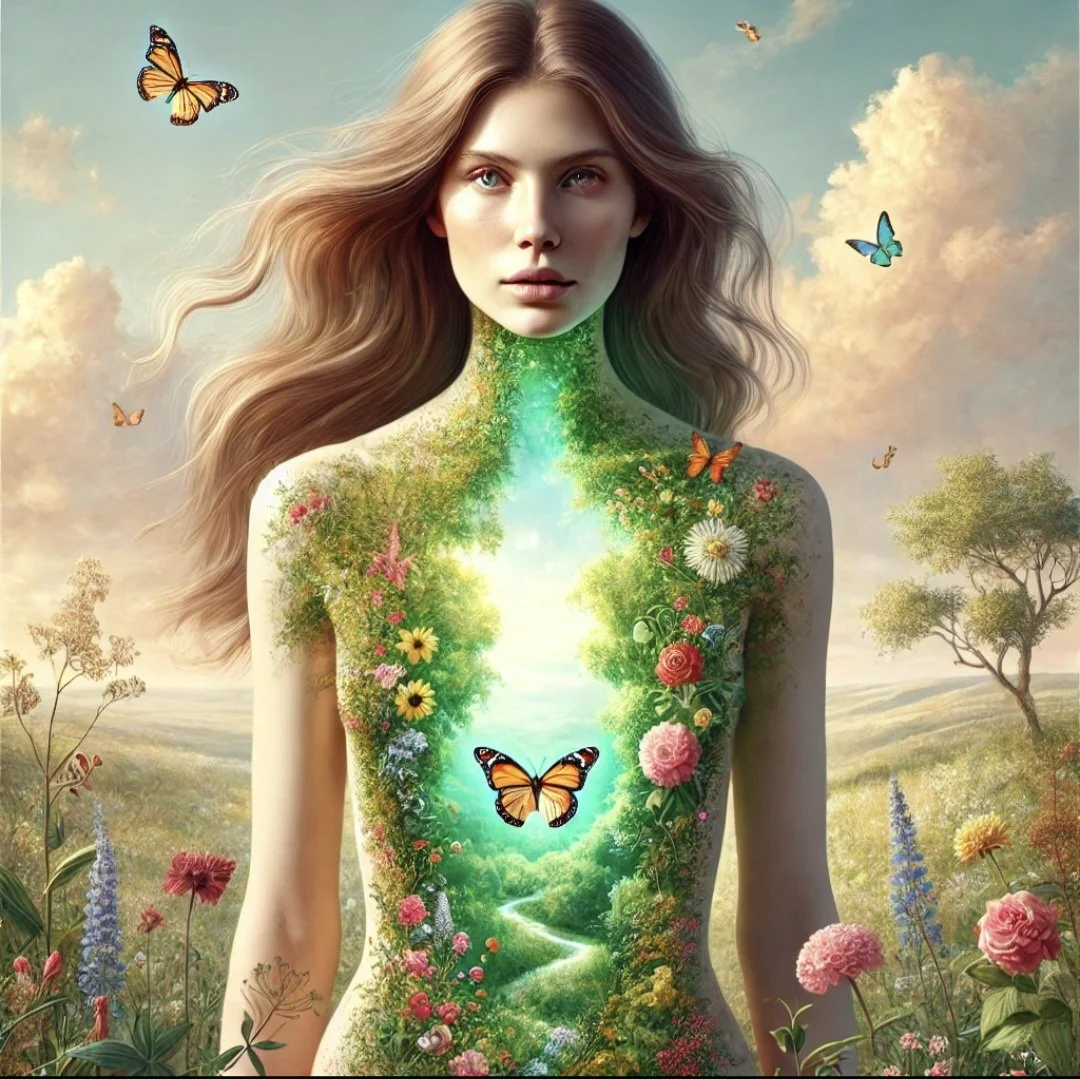
Digital art, Kellie Stirling

Another way we can look at it is by using a metaphor; The forest and the storm.

Sometimes a forest looks healthy from a distance.  The canopy is full and the trees stand tall. When we zoom up above and look down, everything appears stable.

But a storm arrives, and suddenly weak branches fall. Rot hidden deep within the roots is exposed. What seemed solid reveals its fragility.  The storm did not create the decay, it simply revealed what was already there.

This is often how systemic realities come into awareness not all at once, but through moments that expose the invisible networks of power, proximity, and influence that shape human systems.  The discomfort people feel is partly the shock of seeing complexity where we once wanted simplicity.

Living with complexity without collapsing

Our nervous systems like clear categories: good or bad, safe or unsafe, hero or villain.

Complexity asks more of us.  It asks us to hold multiple truths at once that people can be influential and flawed, connected and compromised, admired and deeply human.  It is asking us to hold the tension of polarity, of competing priorities.

When this ambiguity becomes too much, we tend to move toward extremes.  It can look like outrage that burns hot and fast or sometimes numbness that shuts us down.  Often we protect ourselves by demonstrating cynicism that protects us from disappointment.

But there is another possibility, a slower and more embodied stance.  That is Witnessing.

Not bypassing what we feel. Not rushing to certainty. Simply allowing the body to register what is present while staying connected to our capacity for discernment.

Staying human in a dysregulated world

When collective stories stir strong emotional responses, it helps to come back to what our nervous systems can actually hold. To orient to the present moment and to notice where we still have agency.  Can we find where we have choice in how we speak, how we relate, how we show up in our own circles of influence?

Systems change slowly and nervous systems change slowly too.  Often the most grounded response is not to harden, but to stay soft enough to feel, while strong enough to hold boundaries.

How can we rejuvenate and grow in the face of decay, how can we hold space for it?

In nature, decay is not the end of the story.  When something breaks down, it creates space for renewal. Nutrients return to the soil. New growth becomes possible.  Perhaps this is also true in human systems.  Moments that expose cracks in our collective structures can feel deeply uncomfortable, even destabilising, but they also invite reflection.

We can ask ourselves what kind of leadership we want to grow now within ourselves and what values we choose to root into, even when trust feels fragile.  The work is not only to witness what has been revealed.  It is to stay human, grounded, discerning, and connected as the system reorganises around us. The more we can stay in peace and calm and maintain a clear focus, the more easily we can navigate this time.  Can we stay connected to a vision of a much more compassionate and loving world for all of us as familiar systems shift and reshape around us?

If you are struggling at the moment with the chaos of the world, here are some reflection questions for you.

What sensations arise in your body when something feels morally confronting?

What helps you stay grounded and discerning when trust feels fragile?

What kind of leadership are you choosing to embody in your own sphere right now?


Lying in the Dark

One of the things I find most interesting is that we are all, on some level, afraid of the dark. I don’t mean the literal dark, like the night. I mean we are afraid of dark emotionality, dark times, dark moods, that dark place we go when we our life is changing dramatically, death. We are afraid of all that dark.

What I find so striking is that the dark isn’t foreign to us. It’s the first home we ever had. Before we had language, consciousness and identity, we were held in a warm, fluid, completely dark womb.

For nine months, the dark was our sanctuary. We were nourished, protected, and completely connected without ever seeing a thing. We didn’t need sight to feel safe, or light to orient. Our bodies knew how to rest and grow in the dark.

Isn’t it ironic that we spend the rest of our lives fearing the very place we began?

Popular culture treats the dark as something dangerous or disorienting, a space where we lose ourselves. But from a somatic perspective, the dark is often where we find ourselves again. Because the dark asks nothing of us. It doesn’t demand performance, productivity, clarity, or answers.

The dark invites us to rest, to slow into ourselves and just be.

The dark womb is an archetype of profound safety, not because it is soft and easy, but because it strips away everything that is unnecessary. In the dark, we are not seen for what we do. We are held for who we are.

Maybe that’s the deeper truth; the dark isn’t here to frighten us, it’s here to return us to ourselves.

There are seasons in life when everything familiar falls away. Not by choice or spiritual aspiration but because life itself becomes a burning ground. My cancer journey was one of those seasons.

I remember feeling stripped bare, not just physically, but emotionally and existentially. It wasn’t simply the fear or the medical complexity. It was the sense of being dismantled at every layer. The parts of me that used to hold me together stopped working. My usual ways of coping fell away. There was nowhere to run, nowhere to hide inside myself. In fact, I found the best place to be was in the present. I must admit that it felt like being dropped into the dark womb of the world and strangely, or maybe not that strangely at all, that’s exactly where the healing began.

We all have experiences in life where we feel like everything is being burned down and we are going to fall into our own dark hole. You don’t need to have cancer to experience this. Midlife, menopause, divorce, grief, trauma healing, big career transitions, or sometimes all the above at the same time. The thing is they all bring us to the same threshold.

That threshold is a place where you realise you can no longer be who you were, you feel rudderless, but if you can stick with it you have this deep sense of knowing that you are being carved into who you truly are. You are becoming yourself.

While this process can feel brutal, it’s also profoundly sacred.

Sometimes life breaks us open so the truth can finally be felt. Sometimes life drags us into the dark so we can be remade. Sometimes life strips us bare so we can emerge more honest, more embodied, and more deeply alive.

When we come through the other side of these big life transitions, we often notice that yes we are still here, but we are not the same person we were before. We will never be that person again.

There will be parts of you that survive and are the same, there are parts that are gone and there are new parts of you that are being birthed.

During my treatment I spent my days resting and I read a lot. I came across Meggan Watterson’s Divine Feminine Cards (which are great by the way) and within them I found the archetype of the Black Madonna. I would shuffle the cards and many times she would just drop out.

The Black Madonna, archetypally, represents the power we all have to emerge from dark times transformed. Jungian Analyst, Marion Woodman believes that the Black Madonna represents a new awareness or consciousness toward out bodies. She represents the wisdom we can only gain when we go through the painful fires of transformation.

The Black Madonna is not the soft, glowing mother of the light. She is the fierce mother of the dark.

She is the one who meets us in our descent, not to pull us out, but to sit with us in the shadow until something true emerges. She is the archetype of the underworld, the womb, the ashes, the grief that breaks us open.

By connecting with this energy I can tell you that I felt spiritually held; not by something that promised rescue, but by something that promised presence.

The Black Madonna taught me that the dark is not a punishment. It’s a crucible. A crucible is what alchemists used to melt down metals to turn them into gold. The dark and our grief that often comes with it, are a crucible, a container that holds us.

So what burned away for me? Well a few things, a compulsion to hold everything together and the pressure I put upon myself to be endlessly available, a need to make other people comfortable and identity shaped by survival rather than by my soul. What emerged and was born was a quieter and steadier self with clarity about what actually matters, a deeper respect for the wisdom of my body and its profound capacity to heal, an acceptance in the fragility of life whilst at the same time being able to hold a deep trust in life.

The darkness, the feeling of burning down or being stripped bare, it wasn’t destruction it was actually refinement.

If you are in your own dark season right now, feeling like you are burning down, or you are lying down in a hole and can’t move, I want you to know this. What is burning down or being stripped away was never meant to be there.

Like the Black Madonna, the dark can hold you whilst you let go of whatever you need to. It is not to rush you or rescue you, but to support you and witness your becoming.

Because sometimes the most loving thing life can do to us is strip us bare so we can finally see ourselves clearly.