feminine leadership

Belonging everywhere, nowhere and to ourselves

If you have ever wondered ‘where do I belong?’, you are not alone. I see it come up in coaching work all the time. Every big transition in life stirs that questions within us. It is our body and our psyches way of recalibrating. Making space for the next version of you to emerge.

The tender questioning of where we belong isn’t a flaw, it is part of being a human. Each transition asks us to find a new version of ourselves. It is a basic survival needs of humans to feel that we belong. We humans are mammals and we are wired for connection.

We spend so much of our lives searching for belonging; in relationships in communities and at work. Sometimes we find it. There are moments when belonging wraps itself around us so softly we barely notice it. Sometimes it slips through our fingers. The truest home we will ever know is the one we carry with us: our body. My body is the house that I live in. The place I return to when everything else feels uncertain, the memory and echo of every place I have ever been and seen, live within it.

Every version of me that once searched for home lives in my body.

There are moments when the world opens to us, when we feel connected to a person, a landscape, a shared purpose. These moments are luminous. We feel the pulse of life running through us, the sense that we’re part of something greater.
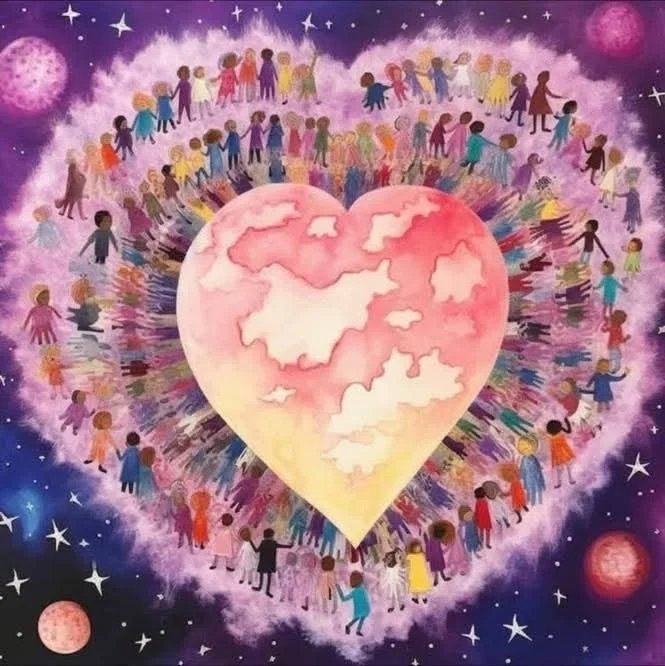
It’s easy to think, this is belonging. It is, for a time. But belonging to the world is fluid, it changes, shifts, and evolves as we do.

Then there are the seasons when we don’t fit anywhere. We grow and we change constantly. The old roles don’t suit us, the conversations feel thin, the places that once felt like home start to feel foreign.

That ache of displacement can stir a deep questioning, Who am I now? Where do I belong?
It is here that imposter syndrome often arises, whispering, I’m not enough. I don’t belong here.
But imposter syndrome isn’t proof of inadequacy. It’s a symptom of disconnection from self-belonging, a signal that we’ve drifted from our inner home and started measuring our worth through someone else’s eyes. It is not surprising to me that many people experience this at work, particularly when they are promoted to a new role, because we are constantly judged by external frameworks in organisations. Like show dogs who constantly have to jump through hoops to please. Few people feel like they can be themselves at work. If you do feel that, you are one of the lucky people.

When we come home to ourselves, the landscape changes. We remember that we belong, first and foremost, to ourselves, to the body we inhabit. We reconnect with our own heartbeat, our breath, our quiet sense of deep inner knowing.

Belonging to yourself is not about isolation; it’s about full bodied integrity. It’s the grounded sense that, no matter where you are, you can meet life from a place of wholeness. It is the warmth in your chest when you tell your truth, the grounded spine when you say no, the quiet smile when you know that you don’t need to prove a thing. You no longer need to perform or prove. The voice of imposter syndrome softens because you no longer outsource your worth.

Somatically, this is felt. A softening in the shoulders. A deepening of breath. A quiet, anchored presence that says: I am here. I am enough. I am mine.

In midlife something shifts for most of us. A new north star begins to emerge.

Midlife often unravels the old anchors. The identities that once defined us, parent, partner, professional, caretaker, begin to dissolve or shift. Our compass spins. The ground beneath us feels less certain. It is less about fitting in and more about who you are becoming.

But this loss is not emptiness; it is space. It’s the fertile ground where the new north star begins to form; one that reflects not who we were told to be, but who we truly are.

To find that star, we have to do the healing work: to meet the parts of ourselves were left behind, to grieve what’s ending, to feel the sensations of transformation moving through our body. This is where somatic work becomes essential.

Through the interoceptive lens, through noticing what’s happening inside, we begin to meet our emerging self not as an idea, but as a lived experience. We reconnect with our wholeness, with all the parts of us that are ready to come home.

We belong everywhere and nowhere and ultimately, within. Belonging is not something we earn or find; it’s something we remember.

The work of midlife, and really of a lifetime, is to come home, to feel safe inside your own skin, to live from the quiet strength of belonging to yourself. From that place, connection flows naturally. You can meet life, love, and change with openness, because your roots are within you.

So pause.
Breathe.
Feel the house you live in.
Let your body remind you. You already belong.

Why the feminine is the change maker - part 2

Last week I started this conversation about why the feminine energy in our culture tends to be the instigator of change. I know this is not always true but I do find that many women whether by choice or force of life events, tend to explore themselves deeply and the fact that we have this deep inner knowing which I talked about in last week’s blog which means we tend to read the ‘tea leaves’ and know when it’s time for change.

Anecdotally, when I think about all the training and professional development I have done over the years, there has always been a much higher percentage of female participants than male participants and so we notice this and we talk about it. You could complain about it and say men don’t do the hard work, but I don’t think this is entirely true because I have lots of male clients and friends who have committed to exploring themselves, but to be honest it is usually after something going really wrong in their lives. Maybe it is that it is women who are the instigators of change in relationships, in families, in cultures. Many studies of couples on relationships and marriages consistently show that around 70% of divorces are instigated by women.

There are many ways we can explore why this happens and I always love taking a Jungian lens on what is actually happening because it always explores the shadow side of everything which I find super interesting. If we look through a Jungian lens, It is always the masculine within the feminine that changes first. In Jungian parlance, the animus (the inner masculine in a woman) seeks direction, clarity, and forward motion. When a woman begins her transformation (say, through grief, menopause, creativity, or awakening), it’s often her inner masculine that reorients first, perhaps by finding new values, boundaries, or purpose. Once that internal alignment shifts, her outer relationships must also adjust. How I notice this in clients is they cannot pretend to be anything other than their authentic selves anymore and this often causes friction in different relationships in their lives as this authentic self in them is emerging. Things can be a bit wobbly for a while as she finds comfort with meeting these new parts of self.

And yes, often this catalyses change in the masculine partner or in the wider system. But not always right away. Sometimes the feminine awakens and moves first, and the masculine (whether internal or external) resists or lags—until it feels safe or necessary to catch up. That friction can either break the container or refine it.

Digital image - Womb in the Sky, Kellie Stirling

Why does the feminine change first?

In the simplest form, we are the ones who can create life and give birth to that. Even beyond biological birth, the feminine is the archetypal womb—the container that holds, gestates, dissolves, and re-emerges. This role isn’t limited to women, but in most systems, it is the feminine energy that initiates the deep work: the descent, the death, the regeneration. Women, especially at midlife, often step into this initiatory role on behalf of their families, partnerships, and communities.

It’s like we become the crucible in which the old dies and the new is born. Let’s look at it from a few different perspectives:

  • Biologically: Our hormonal cycles force us into regular encounters with change. Life transitions like menstruation, pregnancy, birth, perimenopause, and menopause demand transformation. For example, every month when we have menstrual cycles, we are moving through a cycle of change, a cycle of birth, death, rebirth metaphorically speaking that is experienced in an embodied way with our menstrual cycles.

  • Emotionally: The feminine is finely attuned to relational field dynamics because we have lots of estrogen which helps creates oxytocin. Our nervous system is regulated by oxytocin which acts as a neuro-modulator. Neuro-modulators fine tune and shape how our nervous system reacts to stimuli over time. So we become more relationally attuned and attuned to social safety. We feel what’s missing, what’s breaking down, or what wants to emerge sooner. So oxytocin plays an enormous role in regulating arousal, stress responses and healing.

  • Spiritual/Archetypal: The feminine holds the wisdom of the underworld. We know how to descend and return with insight. That’s where true alchemy happens.

So when it comes to relationships, often, when a woman begins to change, it upsets the systemic homeostasis of the relationship. If she holds the relational field (as is often the case), any shift she makes is deeply felt by the other. This can either provoke resistance or invite the partner to evolve too. Sometimes both. In this sense, women often become the alchemical fire that either transforms or reveals what’s no longer sustainable.


Your purpose - following the path home to you

When we go through our midlife transition, many people start to question everything about their life. This is perfectly normal and common. Our midlife transition is very much about moving from our first adulthood which has been driven very much by our ego; establishing our career wanting to achieve, meeting a partner and starting a family for some, maybe buying a house. The common theme of doing. Our second adulthood about discovering purpose, passion and meaning in our life. We ask ourselves the questions, Why am I here? How can I be more of the real me? What brings me love, joy, calm, happiness in my life.

Our midlife can be a time of great rupture. Some times this is good, sometimes it is not. What it asks of us is to go inward. A journey into our innerworld. Here is where many people, in my opinion, get stuck, using a first adulthood model when it comes to the bigger questions in this transition. Our purpose is not what we do in the world - it is who you are (be). Other people experience your purpose through your sense of ‘beingness’ or being human. It’s not about making things happen, although to be fair, just being yourself and doing work that lights you up, can allow you to really show the world unapologetically who you are.

We expect our purpose to come to us in an aha! moment. Your purpose blossoms moment to moment as you go into your inner world and explore your cultural conditioning, your ego survival strategies, your childhood wounding. It is more a gentle unfolding. It is how you show up moment to moment in life. Who you are, with friends, with your kids, with your partner, talking to your neighbours, doing the dishes, when you are on the train or the bus. It is you in life, in the day to day moments.

We tend to overthink purpose and turn the finding of it into an achievement of great magnitude. When we do that, we become like Dorothy from ‘The Wizard of Oz’ following the yellow brick road, looking for something outside our ourselves. It is not outside of you, it is in you. Nobody is going to give you a gold medal at the end of your life for finding your purpose. It is the essence of you, the authentic you behind the ego wounding, the persona’s you have created to belong. Who you are to strangers, to animals, in the garden with the earth. It is your strengths, your wounding, who you are in partnership and who you are in friendship. It is who you are with yourself.

IMG_20190725_160430_903.jpg

We expect our purpose to come to us in an aha! moment. Your purpose blossoms within you. Is is a gentle unfolding, moment to moment.

Midlife is the right time to start this journey for a lot of people because we have the life skills, experience, knowledge and understanding to discern what is really going on for us and in some way our psyche knows this. For women, I often wonder whether the shifts of our hormones starts this quest, this journey of coming home to you, the essence of who you are. You can’t use logic and reason to find your purpose, all you have to do is start to make friends with your emotions, look through the lens’ of conditioning that have imposed views of how you should ‘be’.

When we push on our edges, beyond what is comfortable, when we make mistakes, when we let ourselves slow down, in our moments of stillness; we learn to be with ourselves. Your purpose is your journey of life, in some ways I think our learning journey is a constant state of learning who we are. Who we are in a bigger picture of collective humanity. Of a collective state of being.

For some people it can take their whole lifetime to get to this state, for others they find it sooner. There is no rush, go slowly and gently. My motto in life, SLOW is MORE.