
Women are cyclical beings living in a world that does not energetically respect our natural rhythms. We live in a culture that is obsessed with a perpetual ‘Summer’; demanding constant high energy, visibility, achievement and output. Nature does not bloom year-round and neither do we.
We have seasons of life, seasons in our menstrual cycles, seasons in our energy cycles, seasons in our sexuality, seasons in our orgasm. Our bodies and our sexuality are just like nature. We are cycles within cycles within cycles. When we view ourselves through this lens, from our monthly menstrual cycles, sexual responses to our grand seasons of life, everything shifts.
Inner Winter is not about a pause in life; it is life. Is the essential deep-yin state where recalibration, healing and soul-level integration occur. Winter energy is all about rest, slowing down, going inward and integrating. Giving yourself time to just be. Rest is an important part of our erotic practice and important for our health. It gives us time to rejuvenate and heal. Our body needs good rest to renew.
To the untrained eye a winter field looks dead, bare and unproductive. However beneath the frost there is an intense biochemical recalibration that takes place. There is a void in a fallow field and a fertile seed sits in the dark of the soil in absolute darkness, not because it is buried and has been forgotten but because it is being gestated. Whilst spring follows the darkness of winter when we think of it sequentially, what is actually happening is spring is being cooked inside the dark heat of winter. That recalibration is brewing the energy the seed needs to become a young seedling and burst through the soil.
In our winter season there is always a void, a liminal stage where we feel a little discombobulated, without our compass. The void is not the absence of something, it is a weight. It is the moment that gravity actually takes over and asks the body to lie down. It is the moment we might notice the bracing in our shoulders, belly and jaw finally relax. It is the moment we stop trying to hold it all together and allow ourselves to ‘be held’.
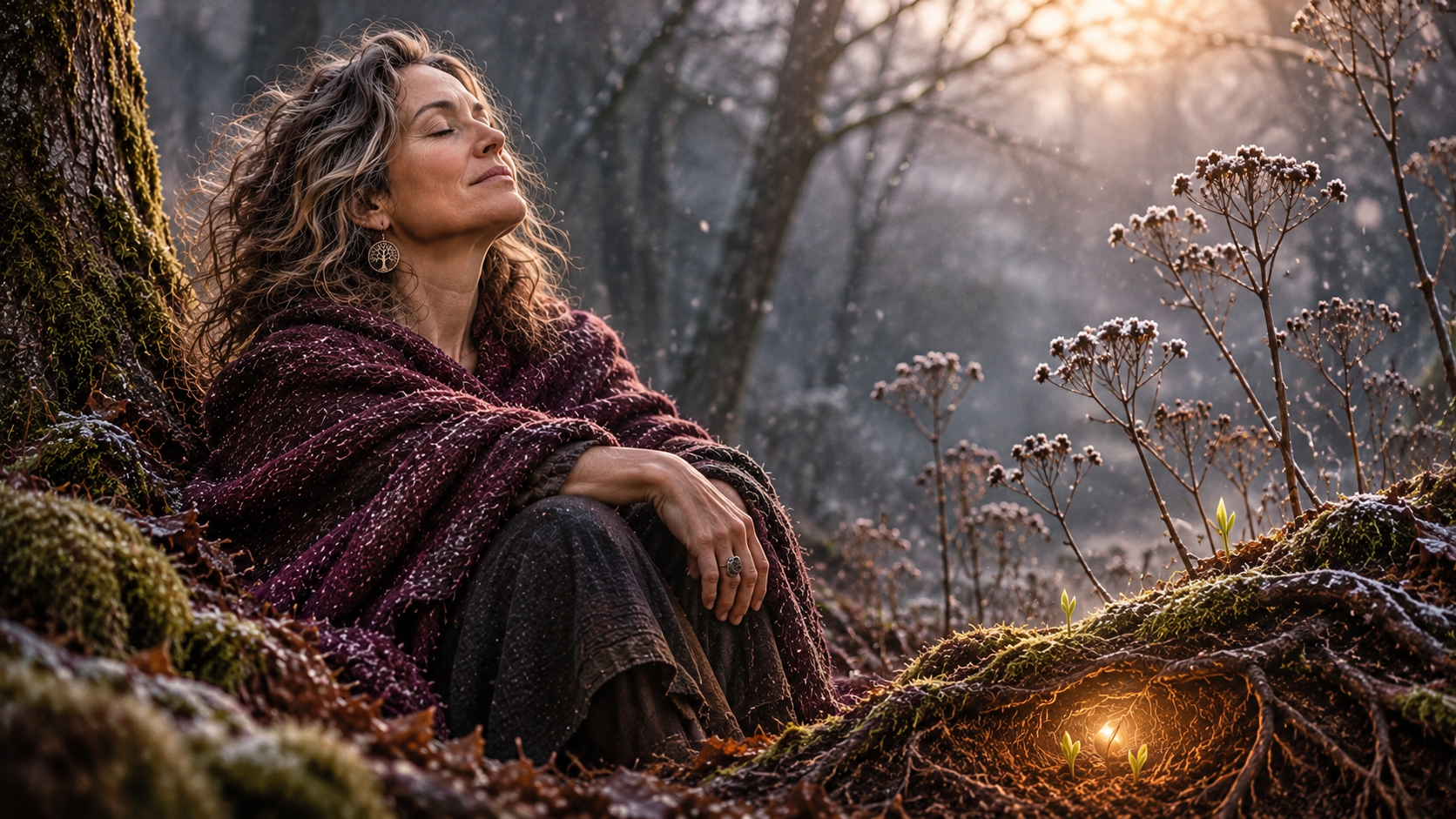
Digital Art - Kellie Stirling
What are the landscapes of our Inner Winter?
In our menstrual cycle it is our bleeding week where we have a physical pull inward, dropping into quiet, solitude and deep listening. In our erotic life, winter is the slow meditative integration after a peak release or, the seasons when sexual energy cools so the body can rejuvenate. Rest is an active part of our erotic practice.
The Post-Partum time is a major winter inner season that requires rest and support so that a new mother can rejuvenate her body and cope with the complexity of the initiation into creating her inner mother. The only requirement of the post-partum experience is to BE. Be still, rest, be with the new baby. This can be challenging for many women who have been in a cycle of constant doing. It requires surrender. In countries where there is no parental leave for new mothers they often go back to work weeks after having a baby before their body has healed. There is a lot of pressure on new mothers now to get their body ‘back in shape’ quickly and this is often done without fully embracing the winter season of post-partum and allowing the body to heal from the birth.
In life stages this winter season equates with the archetypal Crone. As Crones we have gone through the journey of menopause where we have been through a process of paring down; letting go of parts of ourselves we don't need and birthed new parts of ourselves. We acknowledge what we can no longer DO all the time and take the time to focus on what is meaningful for us. The Crone embodies wisdom, she IS the wisdom. Many women in the menopause transition (Autumn seasons) claim their voice as part of their maturing into their wisdom, feeling like they have nothing left to lose. They speak their truth, to open up the world as they birth their work which is their soul's journey. Their work focused on supporting society and community. When this doesn’t happen, what has been left unattended comes up in our transition to Crone.
Emotionally there are certain emotions that force us into a winter. Grief and deep sadness require us to slow down and rest. Grief, especially the profound loss of a loved one, is perhaps our most physical inner winter that we can experience as humans. It drops us directly into the void of quiet. It strips away our capacity for linear productivity demanding total stillness, deep listening and quiet surrendering to the waves of missing them. I have been riding this season myself as I lost my father two months ago and the physicality of the fatigue has been rather profound. I have found myself having to rest and really slow down to allow my body to process my grief. Somatically these emotions are able to move through the body when we lie down.
However modern culture treats grief like an inconvenience that is temporary. Something that we should wrap up in a few days of bereavement leave so we can get right back to Summer output and performance.
The Developmental task of any winter season is to Let go, Rest, Receive and Trust. Just as Autumn asks us to harvest and prune, Winter asks us to let go of outdated roles, expectations and the need to control.
This looks like:
Letting go - Surrendering the urge to force momentum.
Resting - Treating rest as deep medicine rather than something that has to be earned.
Receiving - Allowing support, stillness and quiet insight to flow in.
Trusting - Believing in the intelligence of the void, the inbetween space we often feel in a winter season. We know that in nature under the cold soil there is a lot happening, seeds are quietly gathering some energy to emerge in spring.
What are the hidden costs of resisting winter?
When we stay in summer we cause damage to ourselves. Pushing through fatigue, ignoring physical signals and clinging to high output demands leads directly to nervous system fatigue, depletion, burnout and physical illness.
I want to add that grief in particular is a non linear winter. Unlike the predictable week of the menstrual cycle, a grief winter doesn’t run on a neat timetable. It can take months, sometimes years for the nervous system to feel safe enough to move onto spring. When society pressures us to put on a brave face and bounce back we are forced to bypass the necessary somatic work of mourning; whatever the nature of our loss. Resisting that winter doesn’t make the pain go away, it simply buries the unexpressed grief in the body where eventually it manifests as exhaustion, numbness or physical illness.
What are some practical ways you can reclaim your winter?
We start by honouring our body’s cues. When we hear those subtle signals to slow down, we can hear our body before she starts to ‘scream’ at us.
You can lower your expectations of productivity during your bleeding week in your menstrual cycle or in the depths of perimenopause.
Practice radical boundary setting against the GO, GO, GO demands of modern life.
Engage in quiet restorative and integrative practices. I am thinking of activities like Yoga Nidra and Qi Gong, moments of rest and maybe reflective practice like journaling. For me there is nothing like sitting in the garden quietly reading a book.
Think of the rest stage of winter as rebirth. When you grant yourself permission to enter your winter season whether it be for a week, a season or a year, you honour your true cyclical nature. The promise of our inner seasons is that winter is never the end of the story; it is the foundation. When you create space for deep rest today you ensure in your next spring season you will rise with clarity, power and a sense of deep knowing.
I think of winter as a radical act of self-stewardship. When you reclaim your inner winter during a loss, whatever it may be, you are demonstrating a quiet act of defiance over a culture that values doing over being. It is giving yourself permission to lie down ‘in fallow dirt’ to let your tears recalibrate your body and to trust that the quiet, unhurried rest is the only path toward true integration.
Where in your life right now is your body calling for an inner winter? What would it like to trust that pull today?
If you would like to know more about your Inner Seasons head over to my website to read about all of the them and down a free copy of the content for yourself.
