couples coaching

Some reflections on Nostalgia and Collective Grief

There’s a trend circulating at the moment on social media. “Mum and Dad… what were you like in the 90s?” People are posting old photos, grainy images, oversized denim, sun-faded afternoons. There’s something almost tender about it. A collective wistfulness and I’ve noticed it in myself too.

Recently, I’ve been watching Ryan Murphy’s series on John F. Kennedy Jr. and Carolyn Bessette Kennedy. There’s something about it, the aesthetic, the pace, the feeling that evokes a different era. A quieter one. It stirs something. Not just memory but something deeper. The visuals evoke memories of my twenties living in London in the UK and times I visited New York in that time period.

Nostalgia is a slow form of grief where time shifts without our awareness. Chapters of our life end really quietly without much self awareness whilst we are living them. There are people, places and versions of ourselves that we never really got to say goodbye to, because we didn’t realise that we were at the end of something, until it was over.

We don’t really think of nostalgia as grief. Many of us learned that nostalgia was fondness or sentimentality. The yearning for the good old days. It is a felt sense, it’s very somatic; our senses are the gateway to our memories. A song comes on and reminds you of a time and place. You smell something and a whole era of your life comes flooding back. You might come across an old photo and as you look at it you remember the version of yourself that you see in your hand. How it felt to be that version of you. Sometimes you miss that version of yourself and sometimes you smile and think I am glad I am past all of that.

A few mornings ago, I was walking with my 17-year-old son. He’s been feeling the weight of the world lately like many young people are. The complexity of it. The uncertainty. The constant stream of information that never really lets the nervous system settle.

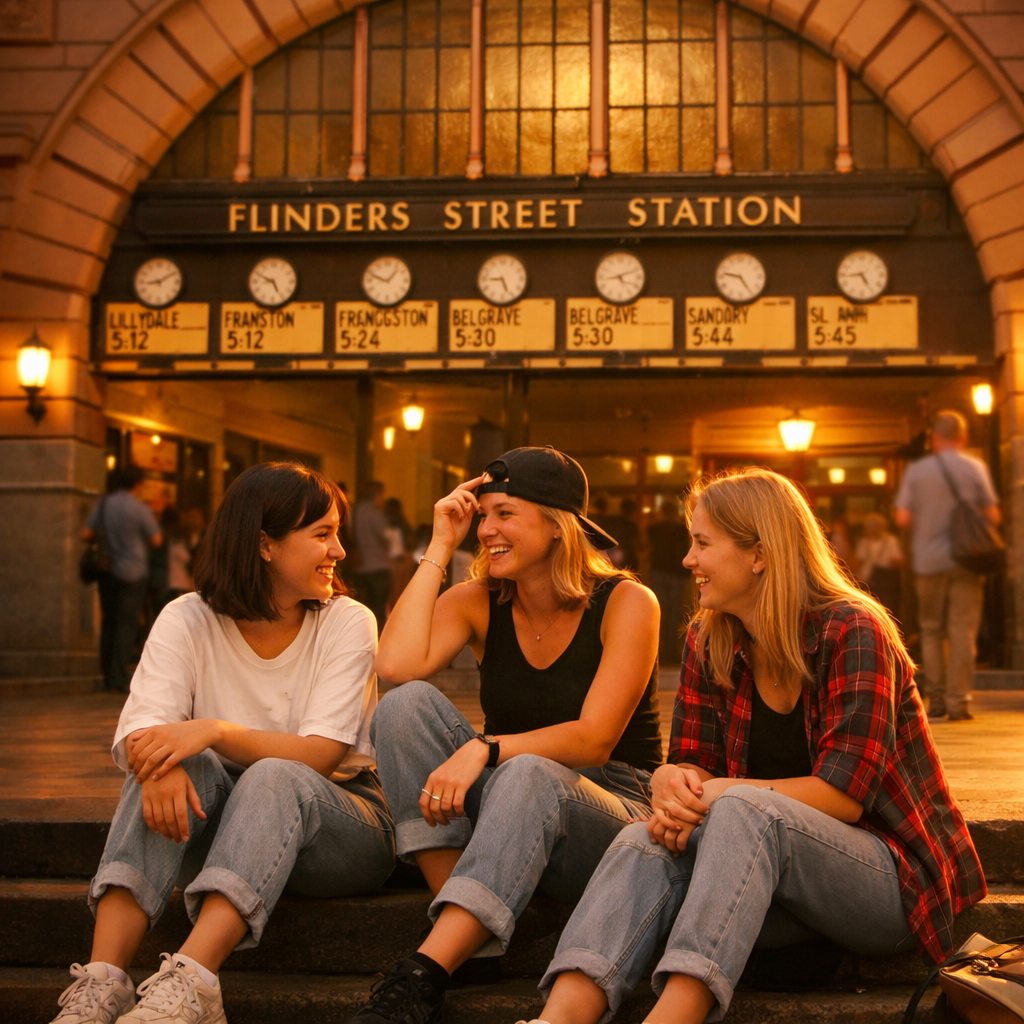
And he asked me: What was life like when you were 17, Mum?” So I told him about 1989. There were no mobile phones or internet. You rang your friends on the house phone and hoped they were home. People turned up when they said they would and most of the time you waited. We used to spend a lot of time waiting around for each other. Shops were closed on Saturday afternoons and Sundays. Nights were quieter. Life moved more slowly. As I spoke, I could feel something in my body soften. What was strengthened in our nervous system when we waited around was a greater capacity for uncertainty and a quiet trust that connection would come.

Digital image, Kellie Stirling. Waiting for our friends by the clocks.

Not because everything was better, it wasn’t. But because something about the pace of life was different. It was a little more contained, less exposed and relentless. I think that’s part of what we’re feeling when we experience nostalgia at the moment.

It’s often described as longing for the past but I don’t think we’re really longing for a decade. I think we’re longing for that felt sense. A way of being in ourselves when the world moved differently.

Later that day, I was in the car with my sons. My eldest, who’s nearly 20 and an engineering student at University, was driving. We were talking about fuel shortages and what might change in the future, electric cars, shifting systems, renewable energy options, the way the world is having to adapt.

I found myself asking: “What do you think we’ll learn from this?” He said, quite simply: “I think people have to realise that the only way we’re going to get through this is together. We have to collaborate. We have to support each other. We’ve got to change.”

I felt it land in my body as he spoke because in that moment, something shifted. Nostalgia looks back. But what he named looks forward. We can’t recreate the conditions of the 90s. The world is more interconnected now. It is more complex and demanding on our attention, our nervous systems, our capacity to process.

The slower pace we remember wasn’t just a lifestyle it was an environment that offered a kind of built-in regulation. There was less information, stimulation. and there were more natural boundaries between “on” and “off.”

That world doesn’t exist in the same way anymore. So the question isn’t, how do we go back? It’s: ‘How do we live well here? Perhaps this is where nostalgia becomes something more than wistfulness. Maybe it becomes a kind of remembering. Remembering not of a time but of what mattered and what was valued.

There was connection, presence and rhythm. It felt a little more spacious for our nervous systems and there was more connection and time spent in different types of community.

We are being asked to express those things differently now, not through simplicity, fewer inputs or retreating from the world, but through conscious collaboration with greater discernment. By learning how to stay connected within it.

What my son named, in that simple sentence, is something I see in my work every day. Whether I’m working with leaders, couples, or individuals navigating change the same truth emerges: we regulate in relationship and we find our way through complexity together.

So maybe the nostalgia many of us experiencing at the moment isn’t asking us to return to the past.

Maybe it’s helping us feel what we’re missing, so we can choose how to bring it forward. We may not get the slower world back, but we can create moments of slowness. We may not escape the complexity but we can learn to meet it with others, rather than alone.

I think perhaps that is the quiet invitation underneath all of this; not to go back but to become more intentional about how we live now.

Together.

The verbs that support our relationships

When it comes to the relationships in our lives, there are some very important verbs that are actually skills we need to learn to thrive in our relationships. It can be challenging to learn how to do these skills because we don’t have many good role models of healthy relationships in our lives. Well some of us do, but many of us haven’t had good role modelling. This is because many of our parents, grandparents and great grandparents are of the generations of people who have been in survival mode for a long time. In the past two centuries we have had the industrial revolution, a couple of world wars, mass migration of displaced people all over the world. Just to name a few traumatising incidents. So learning how to thrive in their relationships was not top of their priorities; they were just trying to stay alive.

I feel like we are at a very good point in time where we can start to thrive in society. There is a lot of damage to marginalised groups that has caused a lot of harm, that is going to take a long time to repair. I feel like we are at the stage where we can really start to focus on learning to have better relationships with ourselves and with others.

So what are these verbs? Well I am just going to go through and explain each one. I want to say to you though that each verb, that is a skill, is really essential to your relationship with yourself and is a key foundation of healthy adult relationships with other humans. With everything around you really.

So here we go…

To want. What do you really want? I think this is one of the most important verbs. When you get clear on your desires, boundaries become easier, purpose and the big questions in life become clearer. Here is the kicker. Culturally we have been brainwashed to believe that to want anything is a terrible thing. If you put your own needs before others you are not a good person. I think that so many women in particular do not know what they want and it is affecting their relationships, their sexuality and their erotic life. Desire is sacred. It is a good place to start when it comes to your relationship skills and getting your needs met. You have to practice this though. Start by writing a list, what do you want? Do it every day for a week and see what comes out.

To Ask. Once you know what you want you can ask for it. Sounds easy enough. So many people struggle to know how to ask for what they need. Your partner is not a mind reader they will not know unless you tell them.

To Receive. This is a hard one. I have had to practice this a lot because I am a very independent person. Being able to receive is a key to abundance. I am talking about material and non-material things. Learning how to receive help from others. In your intimate relationship if you cannot receive, surrender is really difficult. Surrender is important when it comes to orgasm. If you cannot and relax and surrender, if the nervous system does not feel safe to surrender and receive, orgasm can be challenging.

To Take. Don’t be afraid to reach out for what you want. Many of us have been culturally conditioned that to take is selfish, that we are not a good person. Learning to take what you want when it comes before you is definitely a skill. Many of us have developed protective strategies to protect us from doing this. We dim our inner radiance so that we are not offered opportunities, we reject new friendships or intimate relationships so we don’t get hurt. It is OK you can reach out and take what you want.


To Share. Sharing parts of ourselves, being vulnerable can be really scary. I understand why because maybe when we were younger we did this and our confidence wasn’t kept. Maybe we have grown up in environments or worked in places where it has not been safe to share our innermost thoughts, to be really open to how we are feeling. Try with a friend or partner. Then think about the actual experiences you have shared wth others. Whether it has been a friend, a lover, your kids. Something that really lit you up inside, write down how you felt. Sharing life with others and co-creating experiences with others is one of the foundations of being a human. We are not meant to do it alone. Our nervous systems are wired for connection. That ventral vagral part of our nervous system which susses people out when we meet them; that’s the part that is curious and wants to connect to others.

To Refuse. This is challenging when you want to please people all the time, or if your nervous system response is fawning. To refuse is also really dependant on understanding desire. When you know what you really want and what you don’t want, refusal becomes easier. Refusal is also important when it comes to boundaries and enforcing them.

To Play. Why do we stop playing? Play is such a huge part of our learning process, of bonding with other humans. We are so good at it as children, it is how we learn as children. As teenagers we are great at playing but sometimes we stop because we don’t want to lose face. Foreplay is play. It is a really important part of arousal, of your intimate life. Playfulness is a beautiful part of being human. It allows us to try make mistakes, try again, refine, try again. To live is to play. To learn is to play. To have a thriving erotic life with another is to play. To have friendships we like to play. The spirit of play brings us into presence, when we play we are being human.

To Imagine. Maybe this should have been before play? Our imagination drives our creativity. Do you know the sacral area in your body is where you creative energy and your sexual energy come from. Yep same place. Our imagination is fuel for play. Our imagination is fuel for what is possible in life. When you share the imaginations of your inner world with your partner, anything is possible. But that can be a little scary some times can’t it? Try it. Practice sharing one thing a day. Start with something small and easy the each day, just push the boundary a little. Titration - drip by drip, baby steps. We don’t want to freak out your nervous system. Act out your imagination when it comes to your creativity. Draw, make, bake do something with those creative energies coming from your inner world.

I am sure there are far more verbs that are helpful for us in our relationships but I feel like these are a good start. It can be hard to start when you haven’t been doing these and for those of you with trauma it might be harder to partake in some of these skills. Baby steps, start with the one that feels the most comfortable and see how you go.

If you want some support and to explore these skills, you can work through these in coaching. One on One coaching offers deep exploration into many different parts of us that might be getting in the way or protecting us from branching out into these new skill areas. If you would like to explore coaching with me, head on over and book a clarity call with me to explore further.

As always pass this onto a friend if you feel it might be helpful to them.