Middle Passage

The kings and queens of the push through

I tend to work with a lot of high achievers who come to me in midlife in a quandary. They are either burned out, they have lost their motivation or they have lost their inner compass. They are incredibly capable people. Brilliant creatives, leaders and thinkers, the people everyone relies on to get the job done or come up with the solution.

When they come to me there is something fundamental happening underneath, deep in their system, that they can’t solve or workout. They have lost connection with their deepest needs and desires. Their emotions, what they value, what is important to them has become fuzzy. Something is wrong in their world and they cannot put their finger on it. They are overly tired or have lost their zest. This drives them crazy, they feel like a failure because they are so used to solving all the problems. They love solving problems and creating value.

It is a body in freeze.

For many of us, we are still functioning and functional freeze is the nervous system’s quiet survival strategy: a blend of dorsal vagal shutdown with just enough sympathetic activation to keep you moving, performing, achieving.

You look “fine,” you produce, you deliver, you impress people but you have lost connection with your internal world. You’re upright, responsive, competent but you feel dead on the inside. No real vitality, internal pulse or felt sense of self.

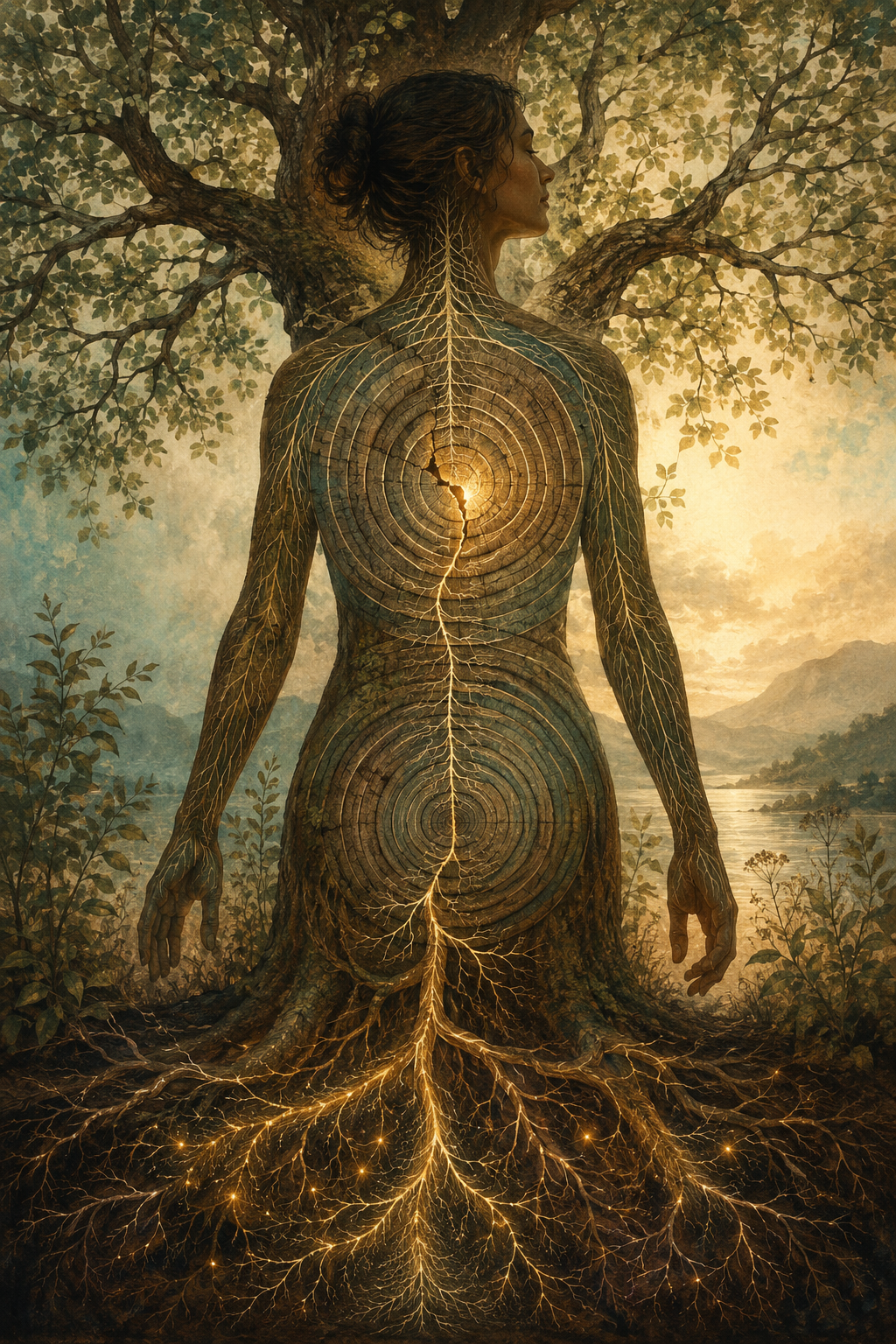
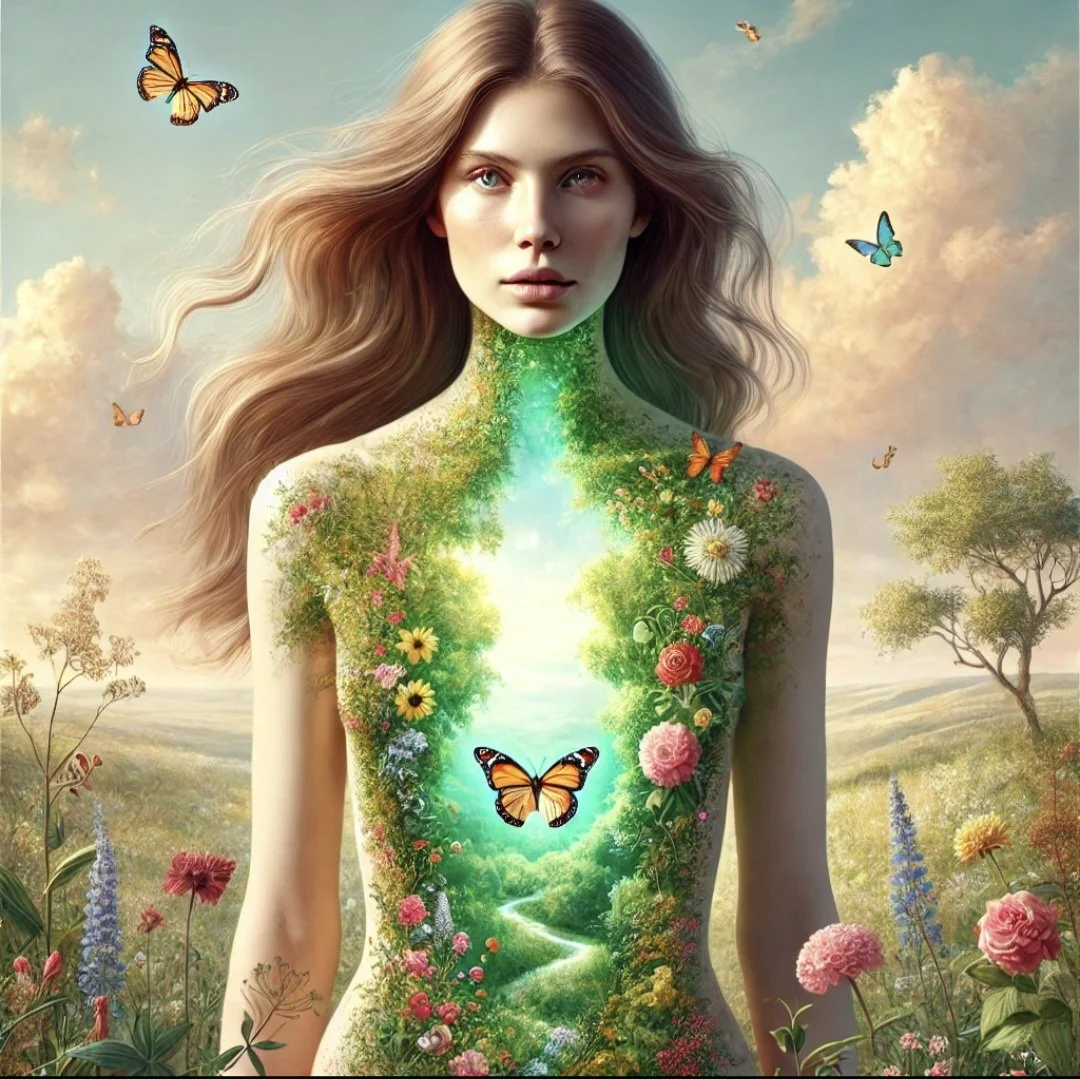
Digital Art - Kellie Stirling, People thawing their freeze

For many overachievers, this becomes the air they breathe until their body says No, not any more. Often it happens at midlife.

So how does this overachieving freeze pattern start?

Well most overachievers learned early in their life that there needs were either: inconvenient, ignored, criticised, overwhelming to caregivers, unsafe to express or simply too much.

So they adapted in the only way their system knew how, they turned down the volume on their body and turned up the volume on their mind. They became brilliant, fast processors, high-capacity thinkers. They became the problem-solvers, the responsible ones, the reliable ones.

But brilliance built on freeze has a cost. We stop listening to the signals from our body. We stop listening to the signs of tiredness, of what a NO feels like in our body. We learn to override our basic impulses. It is not coincidence. Is is a pattern.

Productivity culture is built on functional freeze.

We applaud over-functioning and self-sacrifice. We reward output and speed and we celebrate people who “just keep pushing through”. I think a lot of Gen X’ers learned to do this early, because in their teenage years they spent a lot of time on their own and just had to get on with life.

We call this excellent work ethic, resilience or commitment. But what if much of what we call “productivity” is actually a socially-validated freeze response?

I have had so many clients, mid forties to late fifties, post-menopausal, who make a big career change and then come to me saying, I don’t know what is wrong with me, I just feel out of sorts. I get stuff done, I am a doer. Nothing is wrong with any of them. Their body has just simply stopped cooperating with the override. Or guys who come to me and say they know their life has to change, they are on the precipice of existential change but they don’t know where to start.

When you have spent decades powering through the classic, go, go go. Your body has a way of bringing you back into right relationship with it. As we age, our hormonal cocktail starts to change and menopause has a way of stripping down and highlighting our compensatory strategies. The freeze structure that held everything together began to collapse. Remember the developmental challenge of midlife is radical honesty, come back to the truth of who you really are.

Gently and slowly we work together to slow down. My client's nervous system immediately start to show what they have been trying to outrun. The survival strategies that were created as children to stay safe aren’t working anymore. Their body is setting a boundary. The freeze is ready to be thawed.

This is why burnout in midlife spikes.

Women lose hormonal scaffolding that kept them overriding their body. and men hit existential thresholds where achievement can’t fill the inner void. Our careers peak while capacity starts to decline. Many parents carry the emotional and logistical load for teens and ageing parents. and many of us find the nervous system can’t run the childhood strategy anymore.

People think they’re falling apart. But what’s falling apart is the freeze, not the person. Burnout is both exhaustion and it’s the breakdown of the freeze scaffold. Burnout is the point where the body says, “I’m not going to keep doing this.”

Overachievers don’t lose their motivation they lose their override strategy. When the freeze starts to thaw, we start to feel all the things we have been pushing down for years. The anger, fatigue, hunger, sadness, longing, boundaries, desire and our No.

For many overachievers learning what a No feels like in their body can be a big revelation.

Many overachievers are very creative. They have lots of ideas. They get excited by their ideas, creatively, strategically, intellectually their mind is alive. They can get flooded by them too and want to put them all into action. Not doing so feels like a failure. Something I have learned personally that I help my clients with is our freeze makes us believe these ideas have to be acted on.

Every impulse becomes pressure, every spark becomes a project, every inspiration becomes responsibility something we feel we absolutely must do. This is where burnout can accelerate.

One of the most powerful shifts in my own midlife has been learning that you don’t have to act on every idea. You can feel it, sit with it and let it breathe.

Sometimes an idea is complete simply by being witnessed. Sometimes it is enough to journal it, or talk it through with a colleague or friend. Sometimes you just have to write it down and let it sit for a few months.

This is how you slowly retrain your system, that not every idea has to be acted on. You start to rewire your nervous system and you will notice that the compulsion to act will turn into more capacity. The pressure to act can turn into being present, and the need for action will become digestion.

To come out of functional freeze we work slowly, relationally and somatically. We learn to track micro-sensations and small pulses of movement. We learn how to set tiny boundaries, small steps at a time. We learn how to titrate our life. Small changes 1% more each day. We learn to enjoy receiving the co-regulation from our somatic therapists and/or coaches. We start to notice we are slowing down, 1% more each day and then we can recognise that rest isn’t a weakness it is a signal. We start to notice, that we are noticing how we feel and we let our ideas sit and percolate rather than having to act on them.

Most importantly we learn that our value isn’t earned by producing. Value is inherent because you are here, you are alive. Your body is your home, your garden, your temple. It is not a machine.

Your needs matter.


Lying in the Dark

One of the things I find most interesting is that we are all, on some level, afraid of the dark. I don’t mean the literal dark, like the night. I mean we are afraid of dark emotionality, dark times, dark moods, that dark place we go when we our life is changing dramatically, death. We are afraid of all that dark.

What I find so striking is that the dark isn’t foreign to us. It’s the first home we ever had. Before we had language, consciousness and identity, we were held in a warm, fluid, completely dark womb.

For nine months, the dark was our sanctuary. We were nourished, protected, and completely connected without ever seeing a thing. We didn’t need sight to feel safe, or light to orient. Our bodies knew how to rest and grow in the dark.

Isn’t it ironic that we spend the rest of our lives fearing the very place we began?

Popular culture treats the dark as something dangerous or disorienting, a space where we lose ourselves. But from a somatic perspective, the dark is often where we find ourselves again. Because the dark asks nothing of us. It doesn’t demand performance, productivity, clarity, or answers.

The dark invites us to rest, to slow into ourselves and just be.

The dark womb is an archetype of profound safety, not because it is soft and easy, but because it strips away everything that is unnecessary. In the dark, we are not seen for what we do. We are held for who we are.

Maybe that’s the deeper truth; the dark isn’t here to frighten us, it’s here to return us to ourselves.

There are seasons in life when everything familiar falls away. Not by choice or spiritual aspiration but because life itself becomes a burning ground. My cancer journey was one of those seasons.

I remember feeling stripped bare, not just physically, but emotionally and existentially. It wasn’t simply the fear or the medical complexity. It was the sense of being dismantled at every layer. The parts of me that used to hold me together stopped working. My usual ways of coping fell away. There was nowhere to run, nowhere to hide inside myself. In fact, I found the best place to be was in the present. I must admit that it felt like being dropped into the dark womb of the world and strangely, or maybe not that strangely at all, that’s exactly where the healing began.

We all have experiences in life where we feel like everything is being burned down and we are going to fall into our own dark hole. You don’t need to have cancer to experience this. Midlife, menopause, divorce, grief, trauma healing, big career transitions, or sometimes all the above at the same time. The thing is they all bring us to the same threshold.

That threshold is a place where you realise you can no longer be who you were, you feel rudderless, but if you can stick with it you have this deep sense of knowing that you are being carved into who you truly are. You are becoming yourself.

While this process can feel brutal, it’s also profoundly sacred.

Sometimes life breaks us open so the truth can finally be felt. Sometimes life drags us into the dark so we can be remade. Sometimes life strips us bare so we can emerge more honest, more embodied, and more deeply alive.

When we come through the other side of these big life transitions, we often notice that yes we are still here, but we are not the same person we were before. We will never be that person again.

There will be parts of you that survive and are the same, there are parts that are gone and there are new parts of you that are being birthed.

During my treatment I spent my days resting and I read a lot. I came across Meggan Watterson’s Divine Feminine Cards (which are great by the way) and within them I found the archetype of the Black Madonna. I would shuffle the cards and many times she would just drop out.

The Black Madonna, archetypally, represents the power we all have to emerge from dark times transformed. Jungian Analyst, Marion Woodman believes that the Black Madonna represents a new awareness or consciousness toward out bodies. She represents the wisdom we can only gain when we go through the painful fires of transformation.

The Black Madonna is not the soft, glowing mother of the light. She is the fierce mother of the dark.

She is the one who meets us in our descent, not to pull us out, but to sit with us in the shadow until something true emerges. She is the archetype of the underworld, the womb, the ashes, the grief that breaks us open.

By connecting with this energy I can tell you that I felt spiritually held; not by something that promised rescue, but by something that promised presence.

The Black Madonna taught me that the dark is not a punishment. It’s a crucible. A crucible is what alchemists used to melt down metals to turn them into gold. The dark and our grief that often comes with it, are a crucible, a container that holds us.

So what burned away for me? Well a few things, a compulsion to hold everything together and the pressure I put upon myself to be endlessly available, a need to make other people comfortable and identity shaped by survival rather than by my soul. What emerged and was born was a quieter and steadier self with clarity about what actually matters, a deeper respect for the wisdom of my body and its profound capacity to heal, an acceptance in the fragility of life whilst at the same time being able to hold a deep trust in life.

The darkness, the feeling of burning down or being stripped bare, it wasn’t destruction it was actually refinement.

If you are in your own dark season right now, feeling like you are burning down, or you are lying down in a hole and can’t move, I want you to know this. What is burning down or being stripped away was never meant to be there.

Like the Black Madonna, the dark can hold you whilst you let go of whatever you need to. It is not to rush you or rescue you, but to support you and witness your becoming.

Because sometimes the most loving thing life can do to us is strip us bare so we can finally see ourselves clearly.


Things I have learned about meeting my edges

Edges we all have them. Some whisper slowly and some flatten us in a moment. A few years ago, a friend said to me, you meet your edges with grace. At the time I must admit I was perplexed by the comment. Mainly because like many people, when I hit my limits and edges I struggle. Edges arrive in many forms, a conversation that stirs something deeply uncomfortable, a season of uncertainty, a devastating illness or a body that whispers enough. So I have been reflecting on this comment this year and I thought I would write about it.

I used to think edges were something to overcome. Now I see them as initiations, thresholds where life invites me to grow a new layer of being. I view them as portals not problems. I have come to understand that every edge , whether burnout, grief, conflict, or uncertainty, is a threshold moment. I don’t try to cross it quickly. I tend the threshold until my whole being is ready to step through. I take my time (where I can), and on the other side, I always emerge with a new layer of wisdom that I quietly weave back into my life, my relationships and my work.

I have always viewed my edges and limits from a perspective of curiousity not control. When something feels uncomfortable, in my body, a relationship, or a system, my first instinct isn’t to fix it. I listen to it with my five senses. I try and get close enough to sense what wisdom it’s carrying. Through years of embodiment and somatic practice, I have trained my nervous system to stay present with discomfort until it reveals the deeper pattern beneath it. This has not been easy, it is very hard work.

Connecting with my body has taught me when to rest, when to deepen and when to let go and shed. There is regenerative intelligence in going slower, what looks like retreat can often be fertile integration. My Winter season has taught me to trust the stillness. Spring, to let new growth emerge without forcing it. The tides, always the tides, to remind me that contraction and expansion belong to the same dance.

I’ve discovered that when I meet an edge, the first thing that matters is slowing down. My mind wants to sprint ahead, but my body asks for stillness. If I can pause long enough to feel what’s happening underneath the surface, the contraction, the ache, the flicker of fear, something shifts. The edge becomes less like a wall, and more like a doorway.

Meeting my edges has taught me that they reveal what’s ready to be integrated. They show me the places I’ve outgrown my old ways of being. They ask for tenderness, not toughness. Sometimes the most courageous act is to soften, to stay present, to breathe until my system remembers that it’s safe to expand again. I don’t do this on my own, I ask for help to hold the container so my body can do what it needs to do.

I have come to understand that meeting your edges in relationship is so much easier than doing it on your own. Healing and growth happen in relationship. I don’t isolate when I reach a threshold, I lean into a trusted circle, my friends, my health providers, my husband, or nature itself as co-regulators. I have learned that building a circle of support around you is one of the most constructive things you can do to live well. I allow others to witness me in the process, those people I have secure connection with are the most supportive to my nervous system. There is something about being seen that can turn fear into belonging.

I definitely meet my edges somatically, not conceptually. Well to be fair, I might start reading about something that is coming up just to get more context and understanding, but I know that path through, is through the body. I’ve come to learn how to locate tension, grief, or fear in my body and to feel it as sensation rather than make it a story. Because our body records every experience of our lives and that tension or emotion is my body’s story. I let my body lead the dialogue: sometimes through stillness, sometimes through tears, sometimes through movement or sometimes just be being in nature. Those edges of mine then becomes a living conversation between my nervous system and my consciousness.

I try to meet my edges in rhythm with nature. There is something incredibly healing about learning about our inner seasons, that brings us back into right relationship with our internal rhythms. I don’t push for transformation, I let it compost. I have noticed both within myself and with my clients, that going slow is more effective, nuanced and has more depth than pushing fast.

Connecting with my body has taught me when to rest, when to deepen and when to let go and shed. There is regenerative intelligence in going slower, what looks like retreat can often be fertile integration. My Winter season has taught me to trust the stillness. Spring, to let new growth emerge without forcing it. The tides, always the tides, to remind me that contraction and expansion belong to the same dance.

Perhaps most of all, I’ve learned that every edge is a form of love, life calling me deeper into myself,
asking if I’m willing to be even more fully alive.

What edge is alive for you right now? Take a moment to feel it in your body.
What might it be inviting you to see, soften, or grow into?

Edges are not walls, they are doorways. Today, notice one edge you’re facing.
Slow down, breathe, and feel what wisdom it might hold if you pause long enough to meet it.

Menopause, coming home to the body's wisdom

It is world menopause awareness month, and like I do every year, I am going to write about it and focus on it for a few weeks. I coach clients through many different life transitions, and menopause wrapped into our broader midlife transition, is the most challenging many people experience. That is because for many of us, our body is going through such a profound shift and biological rewiring, that most of us cannot push through it.

Which is annoying for many because if you are a Gen Xer, you learned to be the Queen of the push through.

Much of the conversation around menopause today is about managing symptoms; balancing hormones, finding the right supplement, or seeking a medical fix for what feels uncomfortable. While these supports can be helpful, they only touch the surface of what this transition is truly inviting us into.

Menopause is not a medical condition to be managed. It’s a profound biological and emotional reorientation; a call to come home to the body’s wisdom after decades of living in our heads, pushing through, and taking care of everyone else.

For many of the women I work with, mostly Gen X women, this transition feels like hitting a wall. For those of us who grew up in the 1960s and 70s, a time when emotional awareness simply wasn’t part of family life, we are suddenly faced with a bucket load of previously ignored feelings and we cannot seem to stop them anymore. We never learned how to safely experience them in the first place. Major things happened in our families and in our communities when we were growing up, and often, no one talked about them. We spent our teenage years roaming the streets after school, hanging out with friends, figuring life out on our own. There was freedom in that, but also a quiet loneliness. We learned early on that to cope, we had to hold it together and we had to do that on our own or learn from each other.

I don’t know about you but I have never met a teenager with a regulated nervous system; its more about co-dysregulation that co-regulation. Which is not surprising given the hormonal shifts and brain rewiring going on in their bodies. Guess what? Our bodies are doing the same thing but in the opposite direction, preparing us for the next stage of life.

As a result, many of us became women who are both hyper-independent and who have incredibly high standards. We are for the most part, competent, capable, and relentlessly self-sufficient. We learned to fix things, to keep going, to never need too much. Somewhere along the way, we equated worthiness with being in control.

But menopause calls all of that into question.

The body begins to speak in new ways through heat, sleeplessness, tears, irritability, or sudden waves of emotion that can feel both foreign and inconvenient. These aren’t problems to be solved; they are signals from the body, asking for attention, softness, and presence.

In my work, I see how powerful it is when women learn to be with what’s happening rather than fight against it. When we slow down and notice the sensations moving through us, the tightness, the bracing, the pulsing, the warmth, the ache, we start to rebuild a relationship of trust with our own body. Over time, this presence helps us gently accept what arises and to fully inhabit our experience.

Many people find at this time in life they have to go back and educated themselves on many things about their body, particularly the impact of changes to our sex hormones, on the hormonal cocktail within our body. It is not just about estrogen and progesterone, there is also insulin, ghrelin, leptin and cortisol levels that are impact by these shifts. They impact both our metabolic health and also our emotional health because our endocrine system is the deepest system in our body and all our body systems work together.

As women learn about their changing body they become more comfortable in their it; they often notice that their relationships shift too. When we’re no longer fighting or fleeing from our own discomfort, we stop projecting it outward. There’s less reactivity with our partners, our kids, our colleagues. There’s more space for connection, empathy, and repair.

There is often a bit of work to do here because most of us did not have our emotional lives fostered as children and teenagers. Combine that with a good whack of cultural shame about having feelings, about women’s menstruality, about being a good girl and not rocking the boat, there is a lot of unpack.

Menopause will show you where you need to focus your attention because it will bring it up front and centre for you to pay attention to. If you don’t attend to it, it will just hang around until you do. So that anger and resentment that has reared its head. That is your body’s wisdom asking you to learn to hold healthy aggression in your body. We need to have anger, it protects our boundaries, it keeps us safe and it fuels our passions.

This is one of the quiet gifts of menopause: it brings us back into relationship, first with ourselves, and then with others.

But this process isn’t easy for our generation. We were raised to keep moving, to stay strong, to fix. Softening, resting, and receiving can feel unnatural, even wrong. Yet that’s precisely what this life stage is asking of us. It’s a somatic initiation, a shift from doing to being, from control to surrender, from self-criticism to self-compassion.

When we begin to trust the body’s wisdom, menopause becomes less about loss and more about liberation. It’s an opportunity to unlearn the old patterns that kept us safe but small, and to step into a more grounded, embodied form of power. One that no longer relies on effort, but on presence.

Menopause isn’t the end of vitality. It’s the beginning of living from a deeper, wiser rhythm, one that the body has known all along. It is a gentle reminder to pause, breathe and notice what your body is telling you.


The power of midlife initiation

Our culture, driven by the cosmetics industry, has created a very distorted, narrow narrative around women, ageing and menopause. One the one hand we are subjected to endless anti-ageing advertising that equates youth with worth, desirability and visibility. On the other side there is a one size fits all mainstream solution, given to women when they reach perimenopause or menopause that HRT will solve all their problems and you can carry on as if nothing has changed.

All of this ignore a deeper truth; menopause is not a problem to fix. It is a profound transition physiologically, psychological and spiritually. In many cultures, it has been seen as an initiation into wisdom and power. Our western productivity focused culture, dismisses that and is focused on keeping women youthful and functional rather than moving through this transition with dignity, agency and choice.

What is frustrating for me about this is it creates many big losses and maladaptive issues. The two biggest I see are:

  • They don’t get the holistic support they need to actually learn to listen to their body, honour its new rhythms and integrate changes and,

  • For society in general, we miss out on the leadership, wisdom and creativity once women aren’t hormonally geared toward reproduction and are able and free to channel that energy somewhere else.

When women step into this new season of life, they expand into their social and relational power. This is the stage of eldership, where wisdom, creativity, and leadership can flourish.

I am not saying HRT is wrong, it can be super supportive when you are going through this transition which takes years, but it shouldn’t be the only story. Midlife offers an invitation to step into a new way of being with our body and with life itself, rather than staying locked in the old story.

Menopause, when not pathologised, is often a time when childhood and ancestral trauma comes to the surface, because the body is less able and willing to keep these patterns locked down. Hormonal changes will drive changes in the autonomic nervous system (ANS) so layers of freeze stuck in the ANS can come up strongly. It is your body telling you it cannot carry this anymore.

I do a lot of work helping women reclaim healthy aggression and what I find is that we are so culturally conditioned to suppress our anger, which is suppressing our life force energy, our boundaries and our right to take up space. So doing this work to reclaim our aggression is deeply countercultural. Because what the cultural script tells women is quiet down, look young, stay useful in ways we deem okay (appearance, productivity and caretaking). The deep truth about menopause is it asks us to reclaim all of this. It is inviting us to reclaim our vitality in a different form, one that is fierce, wise, protective and deeply relational.

In modern society we see a loss of interdependence in modern family systems. In many cultures, grandmothers were never ‘done’ after menopause. They became pivotal in holding the community web, through storytelling, wisdom keeping, guiding younger adults, offering support to children without being a primary caregiver. Our isolated nuclear family model is what contributes heavily to burning women out, not the fact that they are ageing.

So the cultural story becomes ‘you are no longer fertile you are less valuable’. When actually the truth is the opposite. This is the time in life when women expand their social and relational roles, if the culture allows it. Throughout my career I have seen many women thrive once they entered midlife, either in new business ventures, in community work, in advocacy work. They really are in their prime.

So this life stage is not just about personal healing, it is about cultural repair.

Midlife is this pivot point: either a woman breaks free from the old narratives and survival patterns, or she risks staying trapped in victimhood, silence, or suppression. When a whole generation of women stays trapped, society loses out on the wisdom, leadership, and fierce love that could be shaping our communities, workplaces, and systems.

At a peace summit in Vancouver in 2009 the Dalai Lama said ‘the world will be saved by the western women’. Well I think its women globally actually. If women embrace this midlife initiation, they don’t just heal themselves, they begin to model a different way of being in power. A power that is relational, embodied, self-authored, and deeply interconnected into the web of life around them.

When a woman can step through her midlife transition with the right support, they don’t just attend to their own healing and personal growth, they become catalysts for cultural change. Connecting to their voice, their presence, expanding their capacity to step into and become their personal power, ripples out into families, workplaces and communities.

This is the work of midlife: not just healing ourselves, but reshaping the world through connection with the deep essence of who we really are and the authority of who we are becoming.


The soul of sensuality - awakening the beauty within through pleasure and presence

Most of us do not enjoy sitting with uncomfortable feelings, we tend to try and escape them. At midlife, many of us experience a lot of discomfort because a lot of our old patterns and habits that no longer serve us, come into the forefront to be dealt with and healed. The body has such a unique capacity for healing and as we age and grow through our life stages, it gives us many opportunities to heal our childhood adaptive strategies to come home to our core self.

Midlife is huge transition for most people. As our bodies start to age and we enter perimenopause, things start to shift and what once worked for us no longer works. Whether it is the way we exercise, what we eat, our arousal patterns, our behavioural coping strategies, everything seems to be thrown up in the air. What most people report is a sense of confusion and betrayal by their body.

More than ever, as you enter this stage, you need to learn how to meet and be present with the feelings and emotions you are experiencing and give space for them to be expressed. This can be challenging, particularly when many people grew up in environments where they were not able to express their emotions, so their management strategies are all about repressing and squashing down said emotions.

Our sensuality, can be a beautiful bridge of support for you to connect with your pleasure, and that pleasure can be wonderfully supportive in regulating your nervous system (which drives you behavioural responses), restoring trust in your body and repairing any past wounding around sexuality.

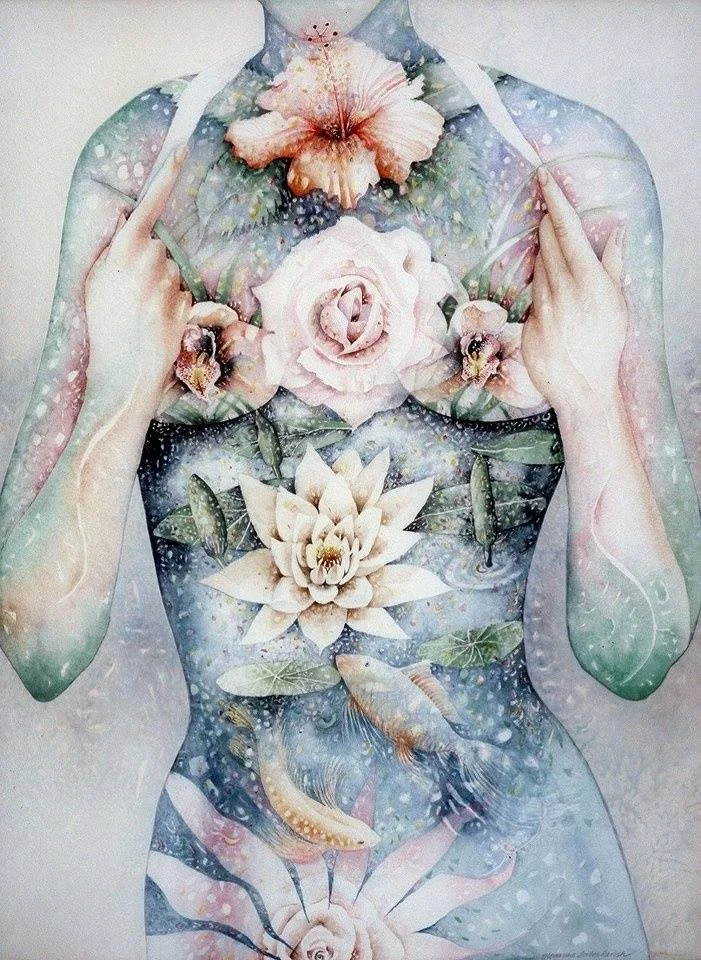
Artist unknown

In fact, reclaiming your sensuality can be one of the most supportive practices you can use to reconnect your body and restore a sense of awe, reverence and wonder for it. Sensuality is about being alive and present to your senses - taste, smell, touch/feeling, sight and hearing. This makes it a safe and accessible starting point for women feeling disconnected from their body. And yes, it is also a doorway to your sexuality because sensual practices are like portals to embodiment and presence, which naturally open the door to pleasure and the body feeling safe again.

When we are able to connect with pleasure and what feels safe inside our body, we lay the foundations for deeper sexual awakening and expression, because sensuality practices can be a rehearsal space for women to explore their bodies and remember and/or learn what feel good without any pressure.

For many people sexuality can be extremely complicated. It carries the weight of cultural conditioning, expectation and often pain. Before we dive deep into exploring our sexuality, which can feel like an enormous burden, sensuality offers us a gentler path.

Sensuality is the art and practice of being alive to our senses. Its the visual feast of the mountains, streams and lakes, the taste of ripe fruit of your tongue, the feeling of the sun on your face, the texture of silk against your skin and the smell of your favourite meal. Unlike sexuality, their is no overhanging expectation of performance, outcomes or anyone else’s involvement. It is quite simply, you and your body in deep connection.

Through our sensual practices we return to our body as home. We learn to connect with our body again and trust it one small breath at a time, one sensation at a time. When we learn and connect with what feels safe and pleasurable within us, the doorway to our sexuality can open naturally without any force or agendas. Sensuality becomes the practice to connect with ourselves and experience intimacy; with ourselves, with life and when we are ready, with another.

A huge part of trauma healing work I do through somatic experiencing is about connecting people with their sensuality through the use of the language of the Felt Sense. Sensuality practices are not just physical practices they open, through the ability to focus on our internal experience, our felt sense which is the language of our nervous system.

When we use this approach, we bypass the logical mind which often drives many women to approach pleasure practices with an underpinning drive of shame (I should be able to do this). The nervous system doesn’t shift through thinking so we can’t think ourselves to safety. When we use the language of the felt sense we drop into sensation; the warmth of my belly, the softening of my jaw. We bypass corticol control and connect with the truth of the body.

Each time we feel, notice and observe or savour we are witnessing our bodies story instead of ignoring it or overriding it. This transforms sensuality into not just a pleasure practice but also to deep belonging, to oneself and to life.

How do we practice the felt sense of sensuality?

Notice one sensation - maybe the warmth of your hands, or tingles in your feet. Stay with it, without judgement. Notice what happens in your body.

What are some simple sensual practices you can try?

  • Applying oil or moisturiser to your skin, slowly and intentionally,

  • Pausing to smell flowers in a garden and noticing when you smell that flower, how you feel,

  • Moving your body to music in a free flowing way - not following a dance routine or sequence,

  • Savouring the smells and tastes of healthy food,

  • Laying still and gently placing one hand on your womb and one on your heart, noticing your breath and feeling warmth expand in your body.

Sensuality is not an indulgence, it is a remembering. Pleasure is our birthright, our bodies are designed brilliantly to feel, to savour, to awaken. Our sensuality is a pathway to our personal agency and power, not through striving and pushing ourselves but through softening and slowing down, to being present to each day of our life, moment by moment.

If you would like to practice some feminine embodiment practice, I have a complimentary mini course on my website that may be supportive of your sensual learning.


Co-regulation, sharing joy, awe and wonder

My husband and I go for a walk most days. It’s our rhythm — a way to move our bodies and catch up on the day. Yesterday, something unexpected caught our eye. Tucked along the top of a fence were a handful of tiny plastic ducks, placed as if they'd just wandered into the world on their own. There was no sign, no explanation. Just… ducks.

We both smiled, paused, and shared that kind of gentle, wide-eyed delight you get when something small pierces through the ordinary — wonder, joy, amusement. We giggled and wondered who might have placed them there. There are several schools in the area and we thought maybe one of the high school students. We wondered, is it art? Is it a puzzle? Or, did someone do it just for their own delight? And as we walked on, I noticed: I felt better. Not just because of the ducks, but because of how we felt together.

You see, you could have easily missed these tiny ducks they were as big as an Australian 5 cent coin. If you were caught in your head thinking about some problem, or looking elsewhere, looking at your phone, you would never have seen them. I will admit my husband saw them first, I was looking at some trees wondering when winter will end and when might the leaves start to arrive. As we started looking together, we saw 8 little ducks along two streets over an 800 metre stretch.

That moment we experienced together was co-regulation.

Co-regulation is more than a feel-good moment — it’s a biological necessity. Our nervous systems are constantly scanning the environment and people around us for cues of safety or threat (neuroception). When we feel safe with someone, our ventral vagal system activates — this is the branch of the parasympathetic nervous system responsible for connection, calm, and social engagement.

Co-regulation is the process by which our nervous systems connect and attune to one another, helping each other return to a state of balance, calm, or connection; especially after stress or activation. It’s something we are wired for, from birth. In infancy, we rely on caregivers to regulate our nervous system through touch, voice, gaze, and presence. As adults, we continue to rely on co-regulation in our relationships, though we often forget just how powerful it is.

At its heart, co-regulation is:

  • Relational regulation: one person’s regulated state helping another feel safe, grounded, or more connected.

  • Non-verbal: eye contact, tone, facial expression, body language, even silence can co-regulate.

  • Mutual: it’s not about fixing, it’s about being with.

  • Built on safety: when we feel safe with someone, our nervous system can soften and settle.

Co-regulation matters to the nervous system because it is foundational to nervous system health supporting vagal tone, heart rate variability and overall resilience. It supports our emotional well-being because when we share these tiny moments of joy, we feel less alone and more supported, seen and understood. It fosters trust and attunement, between partners, within families, friendships and teams, Co-regulation is supportive of trauma healing. Remember Trauma occurs when we experience too much, too fast, too soon or too little for too long. Healing happens in safe relationships when we can go slowly together. It is fair to say that without co-regulation our nervous system could end up in a constant state of vigilance or shutdown. With co-regulation we slow down, we are more present and we expand our capacity to feel joy, grief, pleasure and connection.

How do we find these moments for co-regulation?

Well every day offers us opportunities of ‘moments of tiny joys’.

We often think co-regulation has to be deep, profound or emotional. It can be, and, it can also be simple and playful too. What matters is the shared presence and the ability to attune to each others experience.

When I was going through cancer treatment five years ago, I decided I wanted to practice orienting to pleasure and what feels good to support my nervous system. You see I knew that small moments of pleasure are very healing for the nervous system. So I used to go for a small walk twice a day. This was during the pandemic, so often I would see my neighbours and we would stop and chat from a small distance; remember we had to social distance, and my immune system was smashed from chemotherapy, so I really had to mind how close I got to people. But what I really attuned to was admiring people’s gardens and the plants and flowers. You see I love gardens. My husband and I really looked forward to these small walks because they helped both of us in our own way and we could appreciate the moments of tiny joy in what was a really tough time for us.

“Being awestruck dwarfs us, humbles us, makes us aware we are part of a universe unfathomably larger than ourselves… Wonder makes us stop and ask questions about the world… whether spectacular or mundane.”
— Phospherescence - Julia Baird

What are some practice ideas for you to find little moments of co-regulation with another person?

Walking rituals: Regular, low-stress time in movement and nature together.

Noticing beauty: Make it a shared game to find one “small wonder” each day — something delightful, surprising, or tender.

Name the moment: Saying aloud, “That’s so sweet!” or “That made me smile” helps anchor the moment and co-regulate more deeply.

Touch points: Eye contact, a hand squeeze, a shared laugh — they reinforce safety in subtle, nervous-system-friendly ways.

You can build a micro-ritual around this — one that supports connection even during stress or busyness.

So here is your invitation to think about what brings you shared delight, awe and wonder?

What are the small and unexpected things that bring you joy?

When was the last time you felt a quiet togetherness in a moment of delight?

Is there someone you could begin a small ritual of ‘tiny moments of joy’ with?

Remember, co-regulation doesn’t require words, big feelings or problem solving. It begins with another.

Why the feminine are the change makers - part 1

I have been doing a bit of work with a biodynamic cranio osteopath on my pelvis. I have had pelvic issues for years, predominantly starting with a car accident as a kid, and things just go layered upon it. I have worked with different body workers over the years and I have to say it is in a pretty good state now. If you aren’t familiar with this modality it is a lot of neuro-affective touch work, and the body in all its wisdom and intelligence, reorganises, because it knows how to heal. It is very similar to the touch work we do sometimes in somatic experiencing.

My osteopath and I have big chats when I am on the table. Last session she asked me “do you think it is trauma that causes all the autoimmune issues in women”. (if you don’t know the stats, something like 80% of autoimmune condition sufferers are female bodies). I said sometimes, but I think it is because as women we carry so much of the relational field and after a while that takes an enormous toll on a woman’s body if there is not enough sharing of the load going on in the family system or she does not have a good circle of support around her. After a period of time the body screams whether it be relational rupture, physical pain or discomfort, illness. It tells us, things need to change now!

So let’s talk about that because there is a price we pay for holding the relational field.

Why do we hold the relational field and how does it prime us to lead change?

Well some of it is biological, some is cultural and some is archetypal.

Biologically and neurologically we are wired for connection. Our estrogen creates the oxytocin that drives us to connect and attune to our children.

Women’s bodies are literally designed to attune:

  • Oxytocin, the bonding hormone, is more prevalent in women. It surges during intimacy, birth, breastfeeding—but also during conversation and emotional connection.

  • Our mirror neuron systems, which help us sense and empathise with others' emotions, tend to be more active.

  • From a nervous system lens, many women are socialised (and biologically primed) to track relational dynamics, often before we even understand we’re doing it.

The social conditioning is strong. From a young age, girls are typically taught to; caretake others’ feelings, keep the peace, maintain connection and be “good,” agreeable, relationally aware. We are socialised to value harmony over truth.

On a deeper level, the feminine principle (not just in women, but especially expressed through them) is associated with; holding, containing, gestating, weaving the web between things

So the relational field—that unseen space between people where emotion, meaning, energy, and nervous system cues travel—is often carried by the feminine. Not because it’s our duty, but because we feel it first, and most acutely.

Women tend to track what's happening in the in-between. This might look like noticing when something feels “off” even if nothing is said, adjusting ourselves to keep harmony, carrying the emotional labour of a relationship or family.

While this conditioning can be limiting, it also hones an early sensitivity to emotional tone, unspoken tensions, and disconnection. We’re trained, often unconsciously, to sense and hold the relational space around us. My neighbour always said to me, ‘if mum is okay the whole family functions well. If she is not the cracks start to occur’. We are the emotional anchor in the family system.

From a more archetypal or somatic-mystic view, the womb is not just a biological organ but a relational centre; a place where life is created, held, and nourished. Even for women who do not have a physical womb, the energetic imprint always remains. The womb and ovaries have a incredibly strong energetic imprint, so even if you have an hysterectomy, the energetic imprint never leaves you.

This womb-space can sense the field like a tuning fork. It picks up resonance and dissonance, and often prompts us to move toward repair, connection, or withdrawal. So even beyond personality, trauma history, or conditioning—there is an embodied deep knowing that many women carry. A sense of what’s happening in the space between.


The big challenge.

Many women hold the relational field at the expense of themselves.

We track everyone else’s nervous systems, needs, moods—and forget our own. We become hyper-attuned, hyper-responsible, and depleted. This is where somatic reclamation, reconnecting with our body, becomes essential. Learning the skills to come back to your body so you can hear it when it is speaking to you. We learn to track ourselves first, then engage from a resourced place. This is what transforms holding the relational field from a burden into a gift.

It is this gift, that tells us when change is needed.

Women don’t hold the relational field because we ‘should’, we hold it because we are tuned to life, to connection, to what moves between. To coherence in the field, to what is working well and what is not working well.

Midlife, when the cost and payment becomes due.

In midlife, the body begins to speak more loudly. Years of holding the field—of tracking, softening, absorbing—can begin to show up as: chronic fatigue, autoimmune conditions, thyroid dysfunction, mystery symptoms, emotional exhaustion and uproar or a sense of grief no one can name.

Many women reach a point where their bodies refuse to keep playing the role. Where the cost of emotional labor has accumulated and the body keeps the score. Not because we are broken. But because we are done.

I often wonder if all of these health issues in midlife or the tough perimenopause journey experienced by some midlife women are the body’s way of saying:

“You’ve spent a lifetime turning against yourself to preserve connection. Now I’m turning inward to get your attention.”

It’s not our fault. But it is our invitation—to begin again, from the inside out

But we’re also being called now to hold it differently; not by abandoning ourselves, but by anchoring into our bodies, our knowing, our rhythm.

That is where true healing begins, not just for us, but for the whole field we’re in.

The healing path isn’t about abandoning our relational gifts. It’s about reclaiming ourselves as part of the field we’re so attuned to.

It’s about learning to: track our own nervous systems first, let others hold space for us, to feel safe saying no, set boundaries without guilt and recognising that we are not here to carry it all alone

This is where deep nervous system healing and somatic work become essential. They help us untangle the pattern of self-abandonment woven into our care.

We were never meant to carry it all.

We are capable of holding so much but we were not meant to hold all of the emotional dysregulation of others, all of the unspoken weight of a relationship. Nor were we meant to hold all of the relational field of a family, the workplace, the world - at the cost and detriment of our own health.

This is a huge price to pay and our midlife transition is the initiation into change we need to let some or all of it go. When this initiation happens it causes change in all the relational fields we are in.

So if you are finding ourself, exhausted or unravelling at midlife, you are not failing, your are awakening. Your body is asking you to step out of the role of ‘holding all the relational energy’ return to yourself.

I work with women who are ready to listen to what their bodies are saying, to come home to their own rhythm, needs, and truth.


Part 2, coming next week…..


The Siren, the Queen Bee and the Journey back to Self

It was my birthday last week, I had a really great week. As I move further into my fifties I have to say I love this time in life so much. I remember one of my coach colleagues, who is ten years older than me, saying to me about 5 years ago, “Oh the fifties are the best”. I have to say that so far, I whole heartedly agree. There is something really great about not having your life run by estrogen and knowing yourself so well - and being more than happy to explore the deep and dark places when they come up. It is liberating. This is the thing about midlife, we talk about it being empowering and it definitely is. But it is more than that. It is liberation. It is not reinvention but remembering.

Midlife is the moment we stop performing. We descent, we grieve. And, we rise knowing who we are.

Over the weekend, I watched the Netflix series Sirens. I went in expecting dark comedy and fantasy. It was all that but there was also a lot of the cultural underbelly on display. And yes, there were nods to the mythical Sirens—those seductive, powerful figures feared for luring men to their doom—and to Persephone, who descends to the underworld and rises as Queen.

But what stayed with me was something more subtle. More familiar.

The story centred around women who contort themselves—twist their truth, their instincts, their bodies, their very being—to belong. And what shook me was how often I see this in the real world, especially in the women I work with. I see it on social media all the the time. I find it bizarre that there is a whole fashion trend of people dressing in a way that makes them look wealthy. The whole anti-ageing story crafted by the skincare industry; it is really insane. Why does a 65 year old woman have to have skin the looks like a 25 year old’s?

After watching, I turned to my husband and said something about how heartbreaking it was, but also how powerful it is to have a television show that cleverly shows us the mirror on the collective unconscious. He looked at me and said, “This is your work. You help people come back to their authentic selves, their essence.”

He was right.

So many of the people I work with—especially women in midlife—come to me having spent years (even decades) twisting themselves into shapes they were told would bring them love, safety, or acceptance. They’ve played the roles: the good daughter, the accommodating partner, the high-achieving professional, the one who keeps the peace. But beneath all that performance is often a profound grief: the grief of self-abandonment.

That shows up in many different ways, it can be anger, deep sadness and grief, and also a deep searching for something different or more.

Mythology offers us maps for these kinds of journeys. The Siren is often seen as dangerous, but perhaps she’s just a woman who refused to stay quiet. And Persephone? She was taken underground, but she didn’t just return—she rose transformed, a ruler in her own right. Stripped of her ego and connected to her core self.

There’s another layer to the story that cut even deeper. One of the central characters—the so-called “queen bee”—is replaced. (sorry for the spoiler if you haven’t watched it yet) She’s ousted by a younger, much less confident version of herself. At first, we’re led to believe, the Queen Bee is the villain; she was behaving pretty badly. Then we think the younger replacement maybe is, but we soon see the truth. It was her billionaire ex-husband, who represents the culture of patriarchy, who had the real power all along. A cultural narrative, that builds women up, shapes them to a particular taste, then discards them when it gets bored or their behaviour no longer suits.

And what struck me most is this:
She had contorted herself to make him/them happy.
She had shaped her power around what he wanted, not what was true for her.

I see this in so many women in midlife. They realise, often with some pain, that the power they thought was theirs… wasn’t. It was bestowed—by a relationship, a career, a title, a system. It could be taken away. And often, it is. They don’t know who they are without it.

That’s the heartbreak. But it’s also the turning point.

Because when a woman realises she’s been performing power rather than embodying it, she can begin a different journey. One that doesn’t require contortion. One that descends into grief, yes—but also into truth. Into agency. Into the kind of power that can’t be stripped away. She becomes authoring and starts to write her own story.

These stories speak to the deeper truth: that reclaiming your voice, your instincts, your knowing, often requires going into the underworld of your own psyche. It means feeling the grief of the parts you've left behind. It means listening to the song of the Siren—not the one the world fears, but the one that sings from within your own bones.

This is the kind of healing work I guide people through. It’s somatic. It’s slow. It’s deep. We listen to the body, not just the mind. We notice the nervous system patterns shaped by a lifetime of contorting. And over time, a different kind of belonging emerges—one that doesn’t require performance, one that comes from being rooted in your own truth.

The journey isn't linear. Like Persephone, we may descend many times in our lives. But each time, we bring back more of ourselves. And eventually, we stop contorting to fit the world—and start shaping a world that fits us.

It’s not about becoming someone new. It’s about remembering who you are when you stop performing. When you stop shaping yourself around what others want and start listening to your own body, your own knowing, your own nervous system.

If you're in that moment of reckoning…
If you're realising the version of power you held was conditional…
If you’re longing to come back to the essence of who you are—
I’d love to walk with you.

If this resonates with you—if you feel like you’ve been contorting for too long, or if you’re longing to find your way back to your own voice and centre—I’d love to support you. I offer one-on-one coaching and somatic work for women navigating life transitions, grief, and the reclamation of self. You can learn more about working with me or reach out to talk about coaching.

Your real power is not out there.
It’s in you.
And it’s waiting to be reclaimed.

Your journey home to yourself is sacred. You don’t have to do it alone.

The anatomy of life transitions

Transitions are not problems to fix, they are patterns to Inhabit

We often think of change as linear but it is not at all, it is often a spiral, or a network of spirals. Life transitions are the unspoken pulses that shape our lives. Like the changing of seasons, they are natural and inevitable but they often catch us off guard, pulling us into the unknown. Whether it's the end of a relationship, a career shift, menopause or a profound personal awakening, transitions are both a death and a birth — a letting go and a stepping forward.

When big change happens in our life we are taught to treat change like an emergency. Something is really wrong with us. We search for clarity, next steps, and solutions as if something has gone wrong.

But what if transition isn’t something to fix?

What if it’s a pattern to inhabit?

I’ve come to see life transitions not as interruptions to life, but as part of its underlying design. The common model of life transitions is ending, the liminal space in between and then emergence or new beginnings. Whilst I think this is true to an extent, I believe its actually a bit more complex than that. The metaphor that captures this most powerfully for me is the torus: a self-renewing, spiralling field found everywhere in nature—from galaxies to trees, to the electromagnetic field of the human heart.

The Toroidal Field: A Natural Pattern of Change

A torus is a continuous, dynamic flow. It is not linear. It is not chaotic. It is regenerative. If you can’t picture it in your head it is a donut shaped field where energy moves up the middle and around the edges to the bottom and back up again. The heart has a toroidal field. The earth is a toroidal field.

Image source here

In nature, we see it in the vortex of a storm, the flow of sap in trees, the shape of magnetic fields, the inhale and exhale of breath. In us, it shows up in the rhythm of emotions, healing, grief, growth, and yes—transitions.

The torus reminds us that everything alive follows a rhythm of emergence, dissolution, and return. This rhythm can help us reframe how we experience life changes: not as problems to solve, but as intelligent patterns we are invited to move with.

The Four Phases of Transition (Through the Lens of the Torus)

Transitions often unfold in four phases, which mirror the toroidal flow:

1. The Known Self (Center)

This is the phase of structure and identity. You know who you are, what your roles are, and how the world responds to you. There is stability, predictability, and sometimes stagnation.

2. The Stretch (Expansion)

Something begins to shift. A role no longer fits, perimenopause starts, a relationship starts to change, a loss arrives, or a new longing awakens. You begin to spiral outward, away from the known. This phase can bring both fear and discomfort one minute and exhilaration and joy the next. It often triggers urgency—we want to know what’s next. We feel thrown off our centre - which we literally are because we are moving to the edges of the torus shape.

This is the start of what feels like a wild ride, it begins to get tough but this is a necessary unwinding.

Resistance often comes up here. Whilst this is to be expected, our nervous system feels very uncomfortable often at this point, it is bound to constrict and pull in with fear or anger as a defensive strategy if we have no context to make sense of what is happening. Or maybe we collapse into sadness and grief. This is the time to ask for help or support.

3. The Void (Outer Edge)

The old story has fallen away, but the new one hasn’t formed yet. This is the liminal phase—a sacred pause. It can feel like floating in the dark, ungrounded. We can feel like we have completely lost our connection with our north star or our rudder is missing. This is where many people feel most lost, because the inner compass that once guided them is no longer available. It can feel like being on a road less travelled—or in some cases, a road never travelled before.

This inner void is like a composting process. What no longer serves begins to break down and dissolve. Old identities, beliefs, or stories decompose in the darkness. And just like on a forest floor, that breakdown nourishes the ground of becoming. It's slow, it's unseen, and it's absolutely essential. Composting isn’t glamorous—it’s earthy, rich, and full of alchemy. Nothing is wasted here.

This space is deeply fertile. This is where integration, rest, and surrender happen. The soil of transformation is richest here. This is the time we often need the most support, to hold space for us through the via negativa, the road of letting go. This can also be the hardest because most of us have never experienced what it feels like to let go, we are afraid we may never get up if we do completely let go.

Again at this point more resistance can come up.

When we resist, it adds turbulence to the natural movement of the spiral out, and that can create loops of stagnation, denial and reactivity which shows up somatically in our bodies as tiredness, fatigue, over-activation, as our system tries to hold onto what is known but dissolving, or alternatively rush hard into what is emerging without allowing time to fully metabolise the middle.

4. The Return (Integration)

Eventually, something new takes shape. Not as a quick fix, but as a deeper coherence. You begin spiralling back inward, bringing with you what you’ve learned. You emerge changed. Not a return to the old self, but a return to your centre—wiser, more whole.

I always say to my midlife clients, the developmental challenge of midlife is to be radically honest with ourselves. So that means there is a lot of busting up belief systems, reconnecting with parts of ourselves we have pushed into our unconscious. It is time to do your healing work and come back to that very core essence of who you are. Let go of all the ego strategies that have got you here that don’t serve you well anymore in your adult life. Come back to the real you. You can see that by using the metaphor of the Torus, the core isn’t just a psychological concept, it is also physically coming back to your core.

I see this also in somatic experiencing because the toroidal field shows a natural expression of our vitality and coherence. What I learned form Brigit Viksnins, who is a pretty fabulous trauma resolution teacher is this. The core in the toroidal field is our life force, our true selves, our inner sovereignty. This supports boundaries, presence and our capacity to be with our own emotions and the emotions of others. It sets our blueprint of health. Trauma disrupts the flow of energy, we fragment, collapse in, leak outward, get disorganised, freeze and get stuck outside of our true centre. Our trauma leaves an imprint that can make it hard for us to get back to our centre.

These four phases are not steps to rush through. They are invitations to inhabit. They are cyclical, often overlapping. You may revisit them again and again in any given transition.

Inhabiting the Pattern

Most of us are conditioned to resist the stretch and rush through the void. But when we orient to transitions as toroidal patterns, we allow ourselves to stay in the flow of life itself.

In somatic work, I see how the body holds these transitions intimately: the contraction of loss, the expansion of grief, the trembling spaciousness of the void, the grounded return of integration. Nature doesn’t rush its seasons—why should we?

Whether it’s menopause, a relationship ending, a career shift, or a spiritual awakening, each transition carries the same energetic intelligence. We are being stretched, softened, and re-shaped. And the more we honour the pattern, the more we can inhabit the change with greater ease.

A New Orientation

If you’re in the middle of the stretch, or sitting in the void, you are not broken. You are in motion. You are in the field. The torus is holding you.

Transitions are not detours.

They are invitations into deeper coherence.

So the next time change arrives, try asking not "How do I fix this?" but instead:

"Where am I in the pattern?"

And then, with grace, let yourself inhabit the unfolding.

Reflection Questions for you

  • Where in your life are you being stretched or dissolved?

  • Can you name the phase of the transition you are in?

  • What might shift if you trusted this phase as intelligent, necessary, and even sacred?

Reclaiming menopause as a sacred rite

Somewhere along the way, we have lost our way about the life transition in midlife.

Menopause—this sacred threshold in a woman’s life—has been reduced in the dominant narrative to a list of symptoms to manage, a decline to delay, a hormonal malfunction to correct. It’s treated as pathology. As though something is wrong with you. As though you are breaking down.

And every time I hear that framing, I feel a deep ache in my gut. Because it’s not only wrong—it’s harmful. It robs us of the true power and meaning of this life stage. It narrows it down and over simplifies it. More than that, it obscures the possibility that this transition could be the beginning of something more, not less.

In my work with women moving through midlife, I see something astonishing. When the noise of cultural conditioning is quieted—when we slow down enough to listen to our bodies and our deeper rhythms—what emerges is not depletion. It’s ripening. A flourishing. Something ancient and wise begins to move through. The psyche softens. The soul speaks louder. A different kind of power shows up.

A Culture That Fears Ageing

We live in a world obsessed with youth and productivity. That obsession comes at a great cost. It leaves little room for the natural seasons of life and no roadmap for the descent that midlife brings.

In the medical system, menopause is often treated as a condition to be treated. In the workplace, it’s barely acknowledged. Even in leadership and personal development spaces, there’s an undercurrent of “fix it, push through, stay relevant.” But menopause isn’t asking us to push through. It’s asking us to look deep within and to go downward.

It is, in many ways, an initiation our culture has forgotten how to hold.

The Sacred Descent of Midlife

There is a path in the mystical traditions known as the via negativa—the path of unmaking, undoing, letting go. It is not a glamorous path, but it is a sacred one. Many times during our life we are called into the path of the via negtiva. It is the path of letting go.

Midlife calls us into that descent. It asks us to shed identities we’ve outgrown. To let go of belief systems that no longer serve us. To lay down roles that once defined us. To grieve the things that will never be. And in that letting go, we begin to remember who we are beneath the masks.

This descent is not a breakdown. It is a re-rooting. It is the composting of what no longer serves into the fertile soil of wisdom. And yes, it can be disorienting. But it can also be deeply freeing.

Becoming Ourselves by Deepening, Not Striving

In this season of life, with our hormonal cocktail changing, the nervous system begins to tell the truth we may have avoided for years. The body no longer tolerates what once was bearable. The soul begins to whisper (or sometimes roar), asking for integrity, alignment, authenticity.

This isn’t about striving to become some upgraded version of ourselves. It’s about softening into who we’ve always been. It’s about expanding our capacity to feel—grief, joy, awe—and to live from a place that’s more honest, more grounded, more whole.

This is where somatic work is a game-changer. By learning to be with our sensations, to regulate our systems, to hold ourselves in the tender places, we create the space to truly meet ourselves. Not as a project to fix, but as a mystery to unfold.


Stepping Into Stewardship

The journey doesn’t stop with self-discovery. There is another unfolding—one that calls us into relationship with community, with the next generation, with the wider web of life. We often find our passions and interests broadening to issues of the wider system, of community.

This is the forgotten role of the elder. Not just someone who is older, but someone who has metabolized their life experience into wisdom. Someone who can hold space for others, offer perspective, and serve as a steady presence in uncertain times.

Our communities are starved of elders. Not because they don’t exist, but because the path to eldership has been erased. What if we reclaimed it? What if menopause was not the end of relevance, but the beginning of true leadership?

We don’t just become an elder by getting older. This work requires us to do the deep self inquiry, the deep integration work on ourselves. When we can reclaim the lost parts of ourselves and invite them all to coexist together. When we can honour their voices and tend to them when they need support.


Regulation as a Return to our Blueprint

One of the most powerful shifts I witness in the women I work with—one I’ve lived myself—is what happens when we begin to create more capacity in the nervous system.

It sounds simple. But it’s deeply radical.

So many women have been running on high alert for decades—juggling careers, caregiving, emotional labor, all while trying to keep it together. Their bodies are stuck in “go” mode, and rest doesn’t feel safe. Stillness feels unfamiliar. Slowing down can feel like failure—or worse, danger.

So the work begins gently. We slow down, yes—but we also build the internal scaffolding to support that slowing down. We build safety in the body through somatic practices. We learn to recognize sensation without needing to fix it. We explore the thinking patterns that reinforce overdoing. And little by little, something begins to shift.

There’s more space inside.

And in that space, something magical happens. Life doesn’t get easier—but it becomes more liveable. Triggers still arise, but they’re like whispers instead of alarms. You start to notice: “Ah, there’s that pattern again”—and you choose how to respond instead of being hijacked by it. The nervous system no longer dictates your reactions. You come home to yourself.

This is what I mean by returning to our core, our blueprint.

Not just physically—though that’s part of it. But to the energetic and psychological centre of who you are. That place in the body where you are most you—before the world told you who to be. That grounded, wise, tender place that knows how to move through life with presence.

It’s not about becoming someone new. It’s about remembering who you’ve always been—beneath the striving, beneath the masks, beneath the noise.

And that remembering? That is the real gift of this life stage.

This return to the core also supports what I believe is the central developmental challenge of midlife: radical honesty. Not the performative kind, but the deeply embodied kind—the honesty that arises when you’re no longer willing to betray yourself. At this life stage, we’re invited to tell the truth about where we are. About what hurts. About what we want. About who we’re becoming. And the more capacity we have in our nervous system, the more we can meet those truths without collapse or denial. We can meet them with presence. With curiosity. With love.

"At midlife, the call is not to climb higher, but to descend deeper — into the ground of the soul, into the roots of being, into the core of what is most genuine and lasting in us."
Michael Meade

A New Story

I believe we are being called to tell a new story—or perhaps to remember an old one.

A story where menopause is not a problem, but a portal.
Where aging is not decline, but deepening.
Where midlife is not a crisis, but a rite of passage.
And where those who walk through it with presence and courage emerge as the elders and stewards we so deeply need.

If you’re in this threshold season, you’re not alone. And there’s nothing wrong with you. You’re ripening. And the world needs your wisdom.

Becoming in Midlife

What if midlife isn’t a crisis, but a threshold?

Not the beginning of decline, but the beginning of becoming. A shedding of what no longer fits, and a ripening into who we were always meant to be. Not the self built to survive—but the self born to belong. To the body. To the truth. To community. To the wider web of life.

This isn’t a solo journey. We need spaces—safe, regulated, and wise—where we can do this work together. Spaces where we can slow down enough to hear our own knowing. Where our nervous systems can root into rest. Where radical honesty is welcomed, not feared. And where the fullness of this life stage can be honored as the powerful initiation it truly is.

Because when women reclaim midlife, they don’t just change themselves.

They become stewards. Guides. Elders-in-the-making. Not in the hierarchical sense, but in the soulful sense—those who carry the flame of embodied wisdom forward for others to gather around.

This is the gift. This is the work. And it’s time we told a different story about what it means to grow older.

If you would like to explore your deepening come talk to me about life transitions coaching or somatic experiencing.

If you are based in Melbourne, I will be holding a talk on Tuesday 13th May at the Tree of Life Integral Centre, 3 Denmark St Kew at 6pm. Click here to book your spot as we explore Midlife as a sacred rite of passage.


Ghosting and silent treatment; miscommunication and the avoidance of deep intimacy

Ghosting and ‘the silent treatment’ are often framed as problems of miscommunication, or, poor communication skills. We often tell ourselves that the person simply didn’t know what to say, or how to say it, or that life got in the way. But at there core, ghosting and silent treatment are not just about a lack of words. They are about a deep avoidance of intimacy. This occurs in both intimate and platonic relationships.

For many, the ability to engage in honest, clear communication is not just a matter of willpower; it is a reflection of their nervous system’s capacity to hold emotional intensity. When someone disappears—leaves a conversation dangling, ignores a message, or cuts off connection without explanation—it’s rarely about us. It’s about their own inner world and the deep-seated discomfort they have with relational transparency. It is about not having the spaciousness inside of them, to express exactly how they are feeling.

The more we understand this, the more we can make empowered choices about who we invite into our most intimate spaces—and the more clearly we can recognise when someone’s silence is not just avoidance, but a form of emotional withdrawal known as the silent treatment. Like ghosting, the silent treatment is not a neutral act. It can activate deep wounding and confusion in the person on the receiving end, while giving the illusion of control to the one withdrawing. The truth is, the person is not doing this to get control of the situation, they are doing it to try and get some regulation back into their nervous system. They are overwhelmed by the emotions they are feeling and terrified of deep relational intimacy because they did not have the experiencing growing up where they could talk about their feelings openly and honestly.

They are using silence as a tool to resource themselves.

The Nervous System and Relational Avoidance

Our ability to communicate with honesty and clarity is deeply tied to our nervous system’s regulation. If someone has never developed the capacity to stay present with the discomfort that arises in difficult conversations, their body perceives deep intimacy as a threat. Their system does not register open-hearted honesty as safe.

For people who ghost, or struggle with direct communication, disappearing may feel like the only way to avoid overwhelm. It is not a conscious, malicious act—it is a survival response. Their nervous system is simply not equipped to navigate the vulnerability required for clear, honest communication.

It can hard to be the receiver of this. Silent treatment in a relationship can be very hard to receive, and many people who are on the end of it often feel very lonely in their relationship. They feel very misattuned to and very misunderstood because they are not receiving the mirroring or reflection of their experience back from the other person.


Image - Stockcake

Deep Intimacy Requires Capacity

Clear, open communication is not just a skill—it is an embodied experience. It requires us to feel the full range of emotions that arise when we are seen, when we express our truth, and when we hold space for another person’s truth in return. It means being with the discomfort of hurting someone’s feelings, of disappointing someone, of witnessing another’s emotional response without shutting down or fleeing.

But not everyone has built the capacity to stay present in these moments. Many have never been taught how to regulate their nervous system in the face of emotional intensity. They may have grown up in environments where difficult conversations led to conflict, abandonment, or emotional withdrawal. In these cases, avoidance becomes the learned response. Or maybe they grew up with parents who struggled to acknowledge their own emotions and learned that to express them was messy and unruly, so they would never have been able to be with their kids emotional expression. So the kids learn, we are safe and will receive love if we are very good children who do what we are told and do not complain. Over time, big emotions start to feel unsafe, so we push them away.

Some of us become masters of this and use our enormous willpower to push them down. Others soothe with food, alcohol and maybe drugs just to stay regulated. At some point, typically big life transitions, our body starts to push what has been repressed and ignored back up. This often shows up as conflict in relationships, physical health issues or the person feeling very lost and discombobulated and not knowing what is going on within themselves.


Reframing Ghosting, Silent Treatment and Miscommunication

When we experience ghosting, silent treatment or confusing miscommunication, it’s easy to take it personally. We might feel rejected, unworthy, or left in a state of anxious uncertainty. But understanding ghosting as a nervous system response can shift the way we hold these experiences. It allows us to see that this behaviour is not about us, but about another person’s limitations in holding intimacy.

This does not mean we excuse the behaviour. We can hold compassion for someone’s struggles while also recognising that a healthy, reciprocal relationship requires both people to be capable of presence, honesty, and emotional responsibility.

These behaviours are often rooted in avoidant attachment. When closeness feels threatening, the nervous system chooses distance over connection. Avoidant attachment creates a belief system (often unconscious) that says “If I get too close, I will lose myself’ or, ‘If I express my truth, it won’t be safe’ or maybe ‘If you need too much, I will disappoint you'“.

Moving Toward Conscious Communication

If we want to cultivate relationships rooted in trust and depth, we need to surround ourselves with people who have the capacity to hold both their own emotions and ours. We also need to deepen our own ability to stay present in the face of discomfort.

This means:

  • Strengthening our own nervous system regulation so that we can engage in honest conversations without collapse or reactivity.

  • Choosing relationships where both people are committed to staying in connection, even when it’s hard.

  • Recognising when someone’s avoidance is a sign that they simply do not have the capacity for the depth we seek.

  • Honouring our own worth, by not chasing people who are not available for honest, clear communication.

Ultimately, ghosting and silent treatment are not about miscommunication or poor communication —they are about an inability to stay in connection when things get emotionally complex. That inability is rooted in the nervous system’s struggle to feel emotions and feelings that allow us to hold and be present to deep intimacy that we can experience with another person when we have the capacity to be with their feelings. To listen to them, to see them and be able to stay with what they are feeling.

The more we understand this, the more we can make empowered choices about who we invite into our most intimate spaces.

If you would like to expand your capacity for deep intimacy in your relationships come talk to me about relationship coaching.


The fear response, a double edged sword

Fear is a master of disguise. It doesn’t always show up as a racing heart or sweaty palms; sometimes, it speaks in the language of logic, whispering that we’re “not ready yet.” It convinces us to set arbitrary deadlines, create endless prerequisites, or delay action under the guise of preparation. But if we look deeper, we often find that fear is at the root of our hesitation, quietly orchestrating our self-sabotage.

At its core, fear is a survival mechanism, designed to keep us safe from danger. But in modern life, fear doesn’t just react to physical threats—it responds to uncertainty, failure, judgment, and change. Our nervous system doesn’t distinguish between the fear of a tiger and the fear of speaking our truth, starting a business, or pursuing an intimate relationship. It just registers the discomfort and sounds the alarm.

This alarm triggers one of four responses: fight, flight, freeze, or fawn. Each of these can subtly shape our choices in ways we don’t always recognise and we create adaptive strategies to push through and avoid our feelings. Here are some examples:

  • Fight: We overcompensate, push too hard, and exhaust ourselves with perfectionism.

  • Flight: We distract ourselves with busyness, convincing ourselves we’re productive while avoiding the real work.

  • Freeze: We get stuck in analysis paralysis, endlessly researching or seeking validation.

  • Fawn: We over-prioritize others’ needs and expectations, losing sight of our own desires.

Fear as self sabotage

One of fear’s trickiest tactics is its ability to masquerade as prudence. We tell ourselves we’ll launch the business once we get one more certification, we’ll write the book when life is less hectic, or we’ll pursue love when we feel more secure in ourselves. These milestones often feel responsible and logical, but in reality, they are fear-driven delays.

Self-sabotage isn’t always about overt destruction; sometimes, it’s simply about waiting too long. The longer we delay, the more distant our desires feel. And the more distant they feel, the easier it becomes to believe they weren’t meant for us in the first place.

Ignoring our fears

Sometimes we develop adaptive strategies to ignore our fears and push through. This becomes problematic when we learn to ignore the limits of our own bodies and keep on pushing through. Some of us, to have more courage, learn to ignore our fears and push through (I used to do this a lot). The problem with this is that we are ignoring our bodies risk assessment system, our autonomic nervous system, and that ultimately can cause us to get run down, ill or so stressed that our focuses narrows so much we find it hard to function with the complexity of life. So I am not saying learn to push through your fears, I have saying learn to understand them and listen to them, what they feel like in your body. Learn to discern between levels of fear.

Making decisions from a survival state versus coherence and feeling safe

The state we are in when we make decisions matters. When we make choices from a place of survival mode—driven by fear, anxiety, or urgency—our nervous system is dysregulated. In this state, we tend to react rather than respond. Our thinking becomes narrow, focused on short-term relief rather than long-term impact. This can lead to reactive decision-making, avoidance of necessary risks, and choices that feel safe in the moment but create more complexity down the line.

On the other hand, when we make decisions from a state of coherence—where our nervous system is regulated, and we feel safe—our thinking is more expansive. We can be truly strategic, discerning, and appropriately prudent. We’re able to see the bigger picture, weigh options without urgency clouding our judgment, and engage with complexity without feeling overwhelmed.

This is why when we cultivate nervous system regulation—through practices like breathwork, grounding, or simply slowing down—we tend to make more sustainable, wise decisions. The more we develop the ability to recognise when we’re making decisions from fear in survival mode versus from a regulated state, the better we can lead ourselves and others.

“Courage does not always roar, sometimes it’s the quiet voice at the end of the day saying, I will try again tomorrow”

Mary Ann Radmacher


So how do we break free from fear’s grip and step toward what we truly want?

  1. Recognise Fear’s Voice – Become aware of when fear is masquerading as logic, caution, or endless preparation. Notice when you’re setting unnecessary milestones that delay action.

  2. Slow Down and Regulate – Instead of reacting from fear, pause. Use breathwork, grounding techniques, or somatic practices to settle your nervous system so you can make choices from a place of clarity rather than reactivity.

  3. Make Micro-Moves – Fear thrives in the enormity of big leaps, but it loses power when we take small, consistent actions. Instead of waiting for the perfect moment, take one small step today. This goes for those of you having to make harder choices at work in your leadership role. Small iterative changes help people to adjust and accept change rather than big sweeping changes that often put people into their survival response and usually result in them trying to avoid the changes.

  4. Reframe Fear as a Companion – Fear will never fully disappear, but it doesn’t have to lead. Instead of resisting it, acknowledge it: “Hello fear I see you, and I know you’re trying to protect me. But I choose to move forward anyway.”

  5. Commit to Your Desire – If something truly calls to you, trust that desire. Your nervous system might resist, but deep down, your body knows what it longs for. Trust that wisdom.

In our big life transitions we often go through periods of review and reflection. The biggest regrets aren’t usually failures—they are the things we never tried, the dreams we postponed, and the desires we denied. They are often the relationships we didn’t foster or pay attention to. Fear will always try to keep us safe, but safety isn’t the same as fulfilment. The good news? We can choose differently.

What have you been delaying that your heart is calling you toward? What if you took one small step today? Because the truth is, you’re already ready.


Fawning and hypersocialisation, when survival becomes over accommodation

I have talked quite a lot about the fawning response before. A few years ago I was introduced to Brigit Viksnins work. In it, I was introduced to the concept of hypersocialisation, and as I thought about my own fawning response it made a lot of sense.

We often think of fawning showing up as people pleasing behaviour, which it is. But do you know it is actually more complex than that. Fawning which was coined by therapist Pete Walker, refers to the instinct to appease and accommodate others as a way to stay safe. When we fawn we use our social engagement system, which is the part of our nervous system where we usually feel safe and connected, as a survival response. Women and children are more predisposed to do this for a couple of reasons. Children because of relational power dynamics and the fact they have less physical strength, will use fawning as a response to evade danger. Women because they have estrogen and oxytocin which wires them for deep attunement and connection, will also use this strategy for the same reasons of power and strength, but also because they are biologically wired to connect. For those people with developmental trauma, fawning can become a deeply ingrained survival strategy, shaping how they relate to others and even to themselves.

Brigit Viksnins, a somatic trauma practitioner, expands on this concept with the term hypersocialisation. She describes hypersocialisation as an extreme form of fawning, where the nervous system is wired to prioritise social connection at all costs—even at the expense of one’s own needs, boundaries, and authenticity. Hypersocialisation isn’t just about being ‘nice’ or ‘people-pleasing’; it’s a profound survival adaptation rooted in early experiences where belonging and attunement to others felt like a matter of life or death.

Where I have seen this within myself and with clients is when we over function and over accommodate at the expense of our own needs. Yes, some people do develop this in their family system, and, I think the rough and tumble of the playground at school can deeply hone some nervous systems to develop this response to stay safe, as can some pretty toxic workplaces. With this, it brings some profound strengths. For me it is deep empathy, a sixth sense for what people are feeling which is of course a gift of being hypervigilant and the ability to read a room or space very quickly down to a somatic level. When we fawn like this we are putting on a mask and hiding behind it for protection. This disconnects us from our authentic self and from making deep authentic connections with others.

Understanding Hypersocialisation as a Trauma Response

Hypersocialisation emerges when a child’s primary survival strategy is to attune to others so finely that they anticipate and meet the needs of caregivers before their own needs are even acknowledged. This pattern often develops in environments where emotional safety was inconsistent or where a parent’s approval, love, or even basic presence was conditional. Rather than risk conflict, rejection, or abandonment, the child unconsciously learns that being hyper-aware of social cues and modifying their behaviour accordingly offers the best chance of maintaining attachment.

This adaptation doesn’t just disappear in adulthood. Instead, it can manifest in ways that are often mistaken for positive traits: being highly empathetic, socially skilled, and attuned to group dynamics. However, the cost of hypersocialisation is high—it often results in chronic exhaustion, resentment, and a disconnection from one’s own truth.

Signs of Hypersocialisation in Adults

  • Chronic Over-Attunement: Constantly scanning for social cues, micro-expressions, or shifts in others' emotions to adjust behaviour accordingly.

  • Shape-Shifting: Adapting personality, opinions, or emotional expressions based on the perceived expectations of others.

  • Difficulty Setting Boundaries: Feeling guilty or anxious when asserting needs or saying no.

  • Fear of Rejection or Conflict: Feeling emotionally unsafe if others are displeased, leading to habitual self-silencing.

  • Emotional Exhaustion: Overextending in relationships and social interactions, leaving little energy for self-care.


Healing from Hypersocialisation

Recovering from hypersocialisation requires a gradual process of reclaiming one’s inner truth, bodily autonomy, and emotional safety. Some key elements of healing include:

  1. Reconnecting with the Body: Because hypersocialisation is a nervous system response, somatic practices like breathwork, grounding, and body-based therapies (such as Somatic Experiencing) can help restore a felt sense of safety.

  2. Developing Internal Awareness: Journaling, meditation, and self-inquiry can help identify the automatic patterns of fawning and where they show up in daily life.

  3. Practicing Boundary-Setting: Learning to say no, even in small ways, can be a powerful act of reclaiming agency.

  4. Titrating Social Exposure: If social interactions are a primary trigger for hypersocialisation, gradually practicing authenticity in low-stakes environments can help retrain the nervous system to tolerate healthy differentiation from others.

  5. Building Secure Relationships: Finding relationships where authenticity is welcomed—and not contingent on over-accommodation—can be deeply reparative.


Digital art - Kellie Stirling

Beyond Fawning: Reclaiming Authentic Connection

The paradox of hypersocialisation is that, in an effort to maintain connection, it often leads to self-abandonment. True connection, however, doesn’t require over-accommodation—it flourishes when both people can show up as they truly are. Healing from hypersocialisation is about shifting from relational survival to relational agency. It’s about allowing the nervous system to trust that being real is not only safe, but also the foundation for deeper, more fulfilling relationships.

For those who recognise themselves in this pattern, healing is not about becoming less social or less empathetic—it’s about integrating those gifts with a deep and abiding connection to self. From that place, true belonging can emerge—not because we’ve molded ourselves to fit, but because we’ve learned to stand fully in who we are. Connecting with desire and understanding our boundaries, supports us to move to this place of being comfortable and safe being in our own bodies.

If you think you might be abandoning yourself through fawning and hypersocialisation, come talk to me about somatic experiencing or relationship coaching. We can work with your nervous system so you can feel comfortable to express your boundaries and feel safe to be your true self.

If you want to understand your survival responses a little better, click on this link to download a complimentary copy of my short explanation of your brilliant nervous system's survival responses.

Healing Our Trauma: Reclaiming Our Connection with Nature

For me, there is nothing better than walking barefoot in the sand on the beach, then having a dip in the sea. I love floating in sea water and the rocking that comes with floating on top of waves as they ebb and flow. It is highly restorative. It grounds me and brings me back into my body. I can feel my nervous system coming into my zone of resilience.

In the quiet of a forest, the crash of ocean waves, or the vast openness of a starlit sky, many of us feel something stir within—a longing, a recognition, a sense of home, a feeling of belonging. But for many, that connection feels distant, as if nature is something separate from us rather than a living web in which we belong.

Much of this disconnection stems not just from modern life but from unhealed trauma—both personal and collective. Our nervous systems, shaped by past wounds, can keep us in states of hypervigilance or numbness, making it difficult to truly be present with the natural world. However, as we heal, something shifts. We begin to experience nature not just as scenery but as an extension of ourselves, rich with wisdom and reciprocity.

So how does trauma disconnect us from nature?

When we experience trauma, our nervous system adapts to keep us safe. If safety was scarce, our body may have learned to stay on high alert, scanning for danger even in peaceful settings. If overwhelming experiences left us feeling powerless, we may have learned to disconnect, numbing ourselves to sensations—including the subtle, grounding presence of nature.

Maybe you are thinking but I haven’t really experienced trauma why do I feel disconnected from my body. Well, modern life is very challenging and often it is the micro-aggressions of daily life that overwhelm us and this stacks up in our nervous system. All of these moments of overwhelm sometimes hit us when we least expect it and we experience pain, illness or relational rupture.

Many of us also carry inherited trauma, passed down through generations. Our ancestors may have lived through displacement, war, colonisation, or environmental destruction, severing their relationship with the land. That rupture doesn’t just exist in history books—it lives in our bodies, shaping how we relate to the earth. The study of epigenetics has explained this to us, so we can see how this unhealed trauma is passed down through generations in both cell expression but also in the attachment system in each of us, that is formed through the maternal bond between an baby and their caregivers.

In modern life, this disconnection manifests in subtle ways as we project our internal disconnection outwards and this shapes how we relate to ourselves, others, the world and life itself. We may find it hard to slow down enough to notice the intricate beauty of a leaf, the rhythmic cycles of the seasons, or the deep nourishment that comes from being immersed in nature. We are stuck on the hamster wheel of flight and fight. Instead of feeling like we belong to the land, we often treat it as a resource to be extracted and used, a background to our human-centered world.


How does healing our trauma restore our sense of belonging within us and also to something greater than us?

The good news is that healing our trauma—whether through somatic work, deep nervous system repair, or ancestral healing—opens the door to a profound reconnection with nature. As we learn to regulate our nervous system, we develop the capacity to be present, to notice, and to receive. The very same skills that allow us to process and release trauma—slowing down, attuning to our sensations, and cultivating safety—are the ones that allow us to feel at home in the natural world.

When we heal, we begin to:

Feel the land as alive – Instead of seeing nature as an object, we start to sense its intelligence, its rhythms, and its ability to communicate. We might begin to feel the energy of trees, the presence of the wind, or the way a particular landscape holds us.

Move beyond fear and control – Trauma often teaches us to control our environment for safety. As we heal, we can interact with nature in a more reciprocal way—learning from it rather than trying to dominate it. When we feel safe in our own bodies, we can soften into a sense of safety in the world.

Trust the body’s belonging – Nature is not something we visit; it is something we are. As we learn to listen to and trust our body and appreciate its deep wisdom, we also learn to trust the wisdom of the earth. We develop a deep understanding of the rhythms of nature and the rhythms in our body. Our understanding of one pattern helps us see this replicated through our own body and other systems we interact within.

Feel the cycles of life more deeply – Instead of fearing endings and beginnings, we start to embrace the cycles of nature as part of us. We see death, decay, rebirth, and renewal not just in the world around us but in our own emotional and spiritual journeys.

Increased self-awareness and environmental awareness - When we tend to our inner landscapes, we become more attuned to the landscapes around us.

Healing give us a new way of relating to each other and a new way of orienting ourselves in the world.

As we heal, we begin to walk through the world differently. We no longer see ourselves as separate from nature but as part of an ongoing conversation with it. We listen more deeply, honour its gifts, and recognise that the earth, like us, holds both wounds and the capacity for regeneration.

Our personal healing ripples outward. When we feel connected to the land, we are more likely to protect it, not from a place of fear or guilt but from love and reverence. Our actions shift from extraction to reciprocity, from dominance to stewardship.

Healing trauma is not just personal work—it is planetary work. As we reconnect with ourselves, we reconnect with the earth. And as we learn to belong to our own bodies, we remember that we have always belonged to the web of life.

Digital Art - Kellie Stirling


What if healing is not just about feeling better, but about remembering our place in the great unfolding story of the earth?

Perhaps the most radical thing we can do is to slow down, place our hands on the earth, and listen.

Healing happens in community and when we connect with something bigger than us. There are many ways we can look at nature and draw a comparison with our body and its innate intelligence and understanding of how to heal.

Just as nature moves through seasons of growth, rest, decay, and renewal, our nervous system cycles through activation, integration, and restoration. Honouring these natural rhythms supports long-term well-being. Here are some other comparisons that might deepen you understanding of both our body and nature’s capacity to generate healing and growth through the building of virtuous cycles and coherence.

Roots & Grounding – Trees grow strong by sending their roots deep into the earth. Similarly, we cultivate resilience by grounding ourselves in connection—whether to our breath, body, relationships, or a sense of purpose.

Storms & Emotional Intensity – A thunderstorm may feel chaotic, but it brings necessary rain and clears the air. Intense emotions may feel overwhelming, but when we allow them to move through us, they can bring clarity and transformation. Emotions like natures storms pass through us when we let them be expressed. When we allow ourselves to feel emotions fully, we become more open to experiencing the depth of nature.

Ebb & Flow of the Ocean – The tides rise and fall in a constant dance with the moon, just as our emotions and energy levels naturally fluctuate. Trying to force constant calmness is like trying to stop the ocean’s waves—it’s unnatural.

Symbiosis & Co-Regulation – Ecosystems thrive through interdependence; plants, animals, fungi, and microbes all support each other. Likewise, humans regulate best in connection—our nervous systems co-regulate through relationships, just as trees share nutrients through their roots.

Fire & Transformation – I have always been fascinated by the dual nature of fire. It can be a force for regeneration and a force of destruction. Wildfires, though destructive, create space for new growth by clearing out the old. In our nervous system, moments of challenge or breakdown can lead to profound transformation when we move through them with support.

Where do we start?

Of course you can start with the simple connections you can make with nature around you. Even if it is taking a walk on the grass in your bare feet start there. Do it with a friend or your partner, take a walk together. Trauma occurs in the absence of a compassionate witness, so healing happens in the connection with one and in the presence of community. We are wired for social connection, we are not meant to do life on on our own.

The web of life, we are not just in nature, we are nature.

For centuries, humans have told themselves a story: that we stand apart from nature. We build cities, design technologies, and shape landscapes to meet our needs. We name ourselves as observers of nature, as though it is something out there—separate from us. But this illusion of separation is just that—an illusion.

The truth is, we are not just in nature. We are nature.

We have this myth of separation, a mental model that we hold that we are separate to nature. We need sunlight, water and oxygen to survive. We take all that in, plus food (from nature) and we breath out carbon dioxide which the trees take in to make oxygen. We are a system living within a system.


Somewhere along the way, many human cultures began to see nature as something to be tamed, managed, or extracted from. The industrial revolution accelerated this thinking, and modern life often reinforces it. We go from temperature-controlled homes to air-conditioned cars to office buildings, rarely touching the earth with bare feet or feeling the true rhythm of the seasons.

But no matter how much concrete we pour, how many walls we build, or how advanced our technology becomes, we are still living, breathing organisms shaped by the same forces that shape the forests, the rivers, and the wind.

Our bodies speak the language of the earth even, when we forget our connection, our bodies remember.


We have our own rhythms and cycles just liken nature, some of these are:
- The circadian rhythms that govern our sleep are tuned to the rising and setting of the sun.
- Our lungs evolved in partnership with trees, exchanging oxygen and carbon dioxide in a continuous, reciprocal dance.
- The minerals in our bones were once part of ancient mountains.
- The water that makes up most of our bodies has cycled through clouds, rivers, and oceans for billions of years.

We are the land, the sea, the sky—just temporarily arranged in the form of human beings.

Human beings are relational beings, we are wired for connection and we need other people around us to co-regulate our nervous systems - we are not wired to do life on our own. In nature, everything is relational. Forests are not just collections of trees; they are living systems where roots exchange nutrients, fungi form underground networks of communication, and birds and insects pollinate plants, sustaining the whole.

Humans, too, are part of these systems. We have always been in relationship with the land, with animals, with each other. Indigenous cultures have long recognized this interdependence, honoring the earth not as a resource to exploit, but as kin to respect.

When we embrace this view, our decisions shift. We stop seeing ourselves as rulers of nature and instead become participants—stewards in an ancient, living network.

So how do we connect back to our natural place in nature?


Remembering our place in nature is not about abandoning modern life. It’s about reweaving our awareness into the fabric of the world.

We can start small:
- Walking barefoot on the earth, this is one of my favourites and I often do laps each night in a park in my house,
- Swimming in natural bodies of water,
- Noticing the phases of the moon,
- Eating food that actually comes from the soil, not just a package,
- Listening to birdsong in the morning.

Our body actually loves being in nature and connecting with the earth helps to anchor us back down into our bodies when the daily machinations of modern life and technology lift us out of it.

These simple acts reconnect us to something ancient within ourselves. They remind us that we are not just visitors here—we belong. Whilst these are great activities we can do on our own, they are even better when we do them with friends. We build little spots of coherence in our life with these activities and coherence has the capacity to shift a system. Coherence. both within our nervous system and in ecosystems, act as small attractors and they pull the system toward greater organisation. This is because systems are often fractal, which means that small patterns reflect and influence the larger whole.

Digital Art - Kellie Stirling

So in a system that is dysregulated, a single stable rhythm, like a leader modelling nervous system regulation in a group, can influence a group to entrain to steadiness and calm.

Our nervous system is not separate from nature—it is nature. The same principles that govern ecosystems also govern our inner world:

Just as a forest needs diversity and resilience to thrive, our nervous system needs a range of experiences and emotions to stay regulated..

Just as a river adapts to the landscape it moves through, we heal by allowing our emotions and sensations to flow rather than becoming stagnant.

Just as animals shake off stress to reset their systems, we can release stored trauma through therapeutic modalities like somatic experiencing that work with the natural rhythm of the body and we can use somatic practices that restore regulation

How do we come home to ourselves?


The climate crisis, biodiversity loss, and ecological destruction we face today stem, in part, from our belief in separation. But if separation is the problem, then reconnection is the medicine.

When we stop seeing nature as something outside of us and start feeling it within us—as us—we open the door to a different way of living. A way that honours interdependence. A way that leads us back home.

Because we were never separate. We just forgot.

Now is the time to remember. Although we face many big global problems, act as that small port of coherence, start local. Start with yourself and in your systems you interact with.

Shame and our bodies

Shame has a huge influence over how we perceive and see our bodies. Many people have been strongly influenced culturally to compare our bodies to others, particularly those others we see in the media and popular culture. These are impossible standards to live up to, particularly when we know that technology allows manipulation of photographic images. What we are looking at is not reality.

So much of what we believe about ourselves, when it comes to body image, comes from outside of ourselves. It comes from our family and larger society. From a very young age we internalise messaging about what we are supposed to eat, how we are supposed to look, who we are supposed to be, who we should love, what we should be able to do.

Our body is centred in all of this.

Notice there are a lot of should and supposed to be there.

When you look around the world, what is considered healthy and acceptable, changes culturally. Although this has morphed and blended with social media.

Image - Mohammed Nohasi

I was a teenager in the 80s and young adult in the 90s and this was the time where diet culture was everywhere in popular media. It was aerobics everywhere, hello Jane Fonda and Richard Simmons. I was an aerobics queen, don't get me wrong it was a lot of fun and a great thing to do with friends, but the body standards were impossible and dangerous. The leotards were ace though!

This was also the generation in modelling of the waif. Remember Kate Moss when she started out, impossibly thin. So there is a whole generation of 40 and 50 year olds out there who whose mental models of acceptable beauty are based on, excessive exercise, starving yourself and dangerously thin models.

We are very impressionable in our early years and these impressions around body image last for years. When we don't look like what is portrayed in popular culture as normal, we feel like we aren't enough, like we don't belong. Some of us will go to extremes to fit in. This need to belong is hardwired into our DNA. In Tribal days, we relied on the tribe to be protected and fed. So it literally can feel like a life or death situation when we feel like to don't belong. It puts us into survival mode.

So as you can see, shame has a lot to say about how we perceive our bodies. We have these internal versions of ourselves based on these external images that relate to our self-esteem. Some of us who suffer pervasive shame over our body image, have some very harsh inner critics. Some of these inner critic parts live deep in our unconscious so they are not always that easy to detect and hear. They way to diminish them is to talk about them. Shame thrives on secrecy; when we talk about our inner critic we starve them of their supply.

There is a particular type of shame a lot of us feel as we get older. We compare how we are now to our younger selves. We remember when we were really fit and healthy and could do a lot. We remember our young faces, without wrinkles and saggy skin. We remember our hair before it was grey. Some of us go to great lengths to avoid this. There is a particular strength that can be found in accepting ourselves just as we are right now. A happiness, a contentment, a sense of joy.

Whats the antidote to all this shame?

Pride, curiousity and open conversations, shut shame down. Learning to love your body and all the amazing things they have done for you is the way through. It might not be easy but it is totally doable.

Need some help? Come talk to me.

The midlife reckoning and initiation

For women, the midlife journey is a time of reckoning and it is our menopausal journey that is often the catalyst for this for many women. It is not to say that midlife is not a time of reckoning for males but I think menopause really puts the jet thrusters on it for women in a way that men don’t experience. Sorry to talk in the binary, whatever you identify as on the gender spectrum, I think if you have ovaries and will go through menopause it puts the jet thrusters on it. Notwithstanding, I have had many male clients over the years go through their midlife reckoning in their own way.

I often talk about this process as being the Autumn season of our lives. A time where we review what works for us, work out what we need to let go of in our life and work through the process of doing that so that you can birth new parts of yourself. The rebirth is your initiation into your wise woman power that is your authentic self. This stage is called Maga which is the stage before Crone. We are the first generation of women going through this because we are living longer than the other women in our female lineage.

When we move through this process of letting go, we are going through a process of figuratively dying. All the ideas you had about yourself, who you are, who you thought you were becoming, where you thought your life would take you. So of course there will be grief that comes with that. You will find that what used to motivate you no longer does. You will start to pull back into yourself in a way, rather than giving your energy away.

This is because you are leaving the mother phase of your life. So whether you have been the mother of children or the mother of a business, or the creator and mother of something else in your life, all that energy you put into mothering is not going to be there anymore. This is what happens when our estrogen starts to decline. When I noticed it within myself I noticed I was really tired and I just couldn’t over-function in all the ways I used to and I was not really interested in lots of things I really used to get passionate about.

I have found this to be a hard habit to break but a necessary one. I noticed one day about two years ago, how liberated I felt and not being full of estrogen and what it used to drive within me. The overarching need to connect and make sure everyone is ok. One day I was I sitting at my desk and I felt down to my bones this freedom at not caring so much anymore. Not is a sociopathic way, but in a light and carefree way, I didn’t care what other people thought of me at all. I didn’t care if I put in a boundary and others didn’t like it, I needed to put me own needs first for my own wellbeing.

The reckoning and initiation hits us all in different ways. For some of us it is our physical health, some of this may be perimenopause symptoms but it can also be in poor health. This was me. Cancer came a knocking in a small way about 8 years ago, I got better and went on with my workaholic ways and then five years ago it was back in a big way and I had no choice but to stop. It was bad, stage 3 colon cancer, a big surgery that really knocked me around and lots of chemotherapy that went on for months. I barely functioned during that time and I could not work. “I am listening” I finally said and learned to feel safe to do nothing and sit with my own misery and distressing emotions. I didn’t do it on my own. I created a circle of support around me with different health practitioners and friends. This is often what we need in midlife, to be midwifed through the reckoning process and we can do this by creating a circle of support for ourselves to get us through. Whether it is a psychologist , a coach, your chiropractor, a nutritionist, friends you meet to talk with this about, you can create this circle of support to midwife you through this change.

My healing that I needed to do was nervous system related and deep inner child work to stop the over functioning. It was somatic work that supported me through this so I could find in my body where that small child part of me that had to solve all the problems and find all the answers lived. My excess of will power has served me well in my lifetime, it has got me through some really tough times and kept me going in jobs, relationships and challenging circumstances far longer than I needed to be. It stopped me from getting stuck and left behind often. But I could not will my way through my midlife transition I had to learn to face my shadow head on and be on the proverbial meat hook that Inanna went through in her heroines journey and have faith that I would come off it when it was time.

I think that we often think that menopause will bring us some hot flashes and night sweats and maybe other symptoms but it is so much more than that. You are faced with your own emotional reactivity, your stress levels bouncing around and it is like an out of control roller coaster. What you do not face in this transition will hang around in your life until you do face it. It is a humbling experience.

It can also be very humbling when you have already done a lot of work on yourself. I have been in a constant learning process full of self reflection for the last 20 years. I thought surely I had explored most of my inner territory. No there is always more to be explored. What I can tell you is that for me is that all the tools and knowledge I had, the ones that I work with my clients on, I used them every day and they got me through the really tough times.

What this journey takes us to is our authentic self. It strips away all the strategies our ego created when we are young to stay safe, you don’t need them and they won’t work for you going forward. To step into your wise woman power you need to address all the aspects of yourself that you have repressed. The emotional reactivity you might be experiencing? That is your body telling you to pay attention and connect with what is coming up. It is our menopausal muse showing herself. I love the saying ‘when the muse arrives let them in or they will burn the house down’. If we ignore what is coming up, if we persist in ignoring it, life gets harder.

Who is the muse?

“Your muse is the part of your that you have kept hidden away to belong or fit in. The Muse is the original essence of who we are. They reveals fears, taboos and expectations that need to be explored as this powerful transition unfolds. All those emotions repressed, feelings we have smoothed over, they want them released. As estrogen declines, a veil is lifted from our eyes. All the things we kept silent about we can longer ignore. We must speak up”.

Midlife and Menopause ebook, Kellie Stirling

Everyone goes through this journey in their own unique way. We often parse out challenging life experiences at this stage as something else, something tough that is unrelated and just bad luck. it is all part of the journey. it may not be your health that suffers. You may experience a relationship falling apart, or having to stop everything to take care of an ailing parent, maybe it is a teenager going off the rails or suffering and you need to stop everything to focus on them. Maybe you have a big career change and you know that you need something different and you don’t know where to start. Something will initiate you into this journey. It will mean you cannot go on the way you have been and you have to actually stop and learn to do life differently.

There is something for all of us in this transformation and it offers us an extraordinary opportunity to do it consciously. When you choose to pay attention to your experience and consciously focus on it, you are not only doing your own healing work, you are healing ancestral trauma, the trauma that has been carried down through family lines.

This is the time to learn to choose what you want in life. To move away from your reactive patterns, to learn to sit back, metaphorically and physically and observe. To be able to sit in your chair, in your back body, in a neutral position, back into the chair, feet on the ground, feeling the stability in your body and not lean forward and react. To learn to observe and watch as a wise elder would and then choose which course to take. You don’t have the high energy lots of of estrogen brings anymore, so taking care of your energy is so important. You don’t have to go in and react and clean up every mess. The lesson here is learning to put your needs first which means sitting back and watching. The thing is when we sit back and watch, we often have a clearer view of what is actually going on and we make better choices every time.

Once you move through this, you are naturally drawn to pursue more meaning and purpose in your life in everything that you do. Whether it is your work, your hobbies, the relationships in your life. This is because our purpose is to be our most authentic selves, lead from the our soul, and every aspect of our life wants to align with that. Because after going through the reckoning and initiation we can be nothing else but ourselves.

How emotional neglect and abandonment in childhood fosters a fawning response in us

If in childhood we experienced our caregivers not supporting our emotional lives, abandoning supporting us when we were feeling big feelings, it created a big and deep primal response of being isolated and separated. To a child this feels like death.

We will begin to seek any feeling that will block or override feeling that isolation, that feeling of death in our body.

We need our caregivers to co-regulate us when we are young because we don't have the capacity in our nervous system to regulate ourselves AND we don't have the emotional maturity to contextualise our experience. We just know we are overwhelmed and flooded with feelings.

We are hardwired for connection and being with others. It is in community that we most often feel safe and have a greater chance of survival. We enjoy that feeling of togetherness.

When we are in this pattern of avoiding our big emotions and feelings, of overriding feeling the isolation we experienced as little ones, we disconnect from from our bodies. This brings with it anxiety, auto immune issues and chronic illness.

Many of us also develop a nervous system strategy of fawn, also known as appeasement or people pleasing. We disconnect from our emotions because we are afraid that if we express them, we will be abandoned. That old story of death if we are abandoned is wired into our nervous system.
When we are under threat, the old story is playing out in the present all the time. Like a broken record that keeps returning to the scratch.

Healing happens in the presence of a compassionate witness that can hold space for you to connect with your body somatically.

Trauma happens in the absence of a compassionate witness or community so it makes sense that healing happens with a compassionate witness and within community.

image stockcake.com - mother embracing child, AI generated.


Getting over heartbreak

When we have our heart broken the pain can be so great that we feel it physically.

Heart break is big because there are so many emotions mixed in there; despair, grief, shame, feeling worthless. We can also feel betrayal and anger depending on the circumstances. Our wounded heart is so hurt, there is such a rawness to the pain we experience. We can also feel great stress and may be disorientated and not surprisingly, really dysregulated in our nervous system.

It is no wonder that people shutdown from their hearts in an act of self-protection. The raw pain can be more than our poor heart can bare because the intensity of our emotions, of the sensations we feel is so great.

Our heart feels shredded to bits sometimes.

When we shutdown and disconnect from our heart this gets in the way of connecting with new people and finding new love. It stops us from being able to feel close to another person. It blocks us from feeling our emotions and feelings in our own heart space.

When we disconnect from one emotion we disconnect from all of them. Our bodymind is amazing but it is not clever enough to be selective from what it disconnects from when it comes to emotions and sensations.

Image, Tim Marshall


We can work with your body somatically to expand your capacity to feel, we can expand the container that lives within you so there is more space for your feelings to move around it and when we do this, we expand your capacity to feel and process emotions that are overwhelming.

From there your heart can open again to new love that is coming your way.