attunement

Emotions are not thoughts they are physiology

One of the things I often see and hear, especially during perimenopause is, “I am feeling emotionally out of control” or “I am feeling things that I have never felt before there must be something wrong with me”.  Whilst I have compassion for people feeling that they are on an emotional rollercoaster my first thought is often, what is wrong with feeling emotions?  What did this person learn about emotions when they were growing up and were they allowed to have big emotions when they were a kid.

A lot of clients I have had what I call emotionally neglectful childhoods.  Their parents did not foster their emotional life.  They did not let them have big emotions when they were young.  They were either punished physically or through isolation.  So they learned that expressing emotion was not safe.  

This is more common than you think.

I have sat across from people, brilliant people, some of the most self-aware clients I've worked with, who could narrate their own psychology like a well-rehearsed lecture. They have done the work.  They knew exactly where the pattern came from. They could name the childhood dynamic, trace the attachment wound, explain the trigger with clinical precision. However, when the moment came, maybe being on the receiving end of criticism, silence, or a raised voice,  their body did the same thing it had always done. The same collapse. The same flood of heat. The same bracing.

Understanding hadn't touched it. Not because they weren't insightful enough. Because insight was never going to be the thing that touched it.  Emotions are not a thinking thing, they are physiological.

This is the quiet, exhausting secret of so much personal growth work: you can know everything about why you feel the way you do, and still feel it. You can try and push it away with your mind but it still lives there silently in the background running everything.  Willpower doesn't reach it. Positive thinking doesn't reach it. Even deep, accurate self-understanding doesn't reach it; because none of these operate in the place where the emotion actually lives.

Here's why. The nervous system responds to threat and safety faster than the thinking mind can form a sentence about it. By the time you've had the thought, I'm getting defensive right now, your body has already braced, already flooded, already moved. The mind narrates. The body decides. There is no amount of narrating after the fact that reaches back in time to change the decision.

This is why you can understand everything and still feel exactly the same. The gap isn't a failure of insight. It's a category error, trying to think your way out of something that was never a thinking problem to begin with.

Which is why the work that actually shifts things doesn't start with a better story. It starts in the body itself.  Experiencing slowing down enough to notice the bracing before it completes, building enough capacity in the nervous system that it doesn't have to slam the same door every time. In practice this can look undramatic: a hand noticing it's clenched, a breath that's allowed to finish, a session where nothing is explained but something, quietly, unclenches.  When we slow down and let stuck stress responses be completed, when we touch into the physiological expression of an emotion we let it move and we build capacity to feel it.  The defensive or protective action of the autonomic nervous system doesn’t shut it down or bypass it.

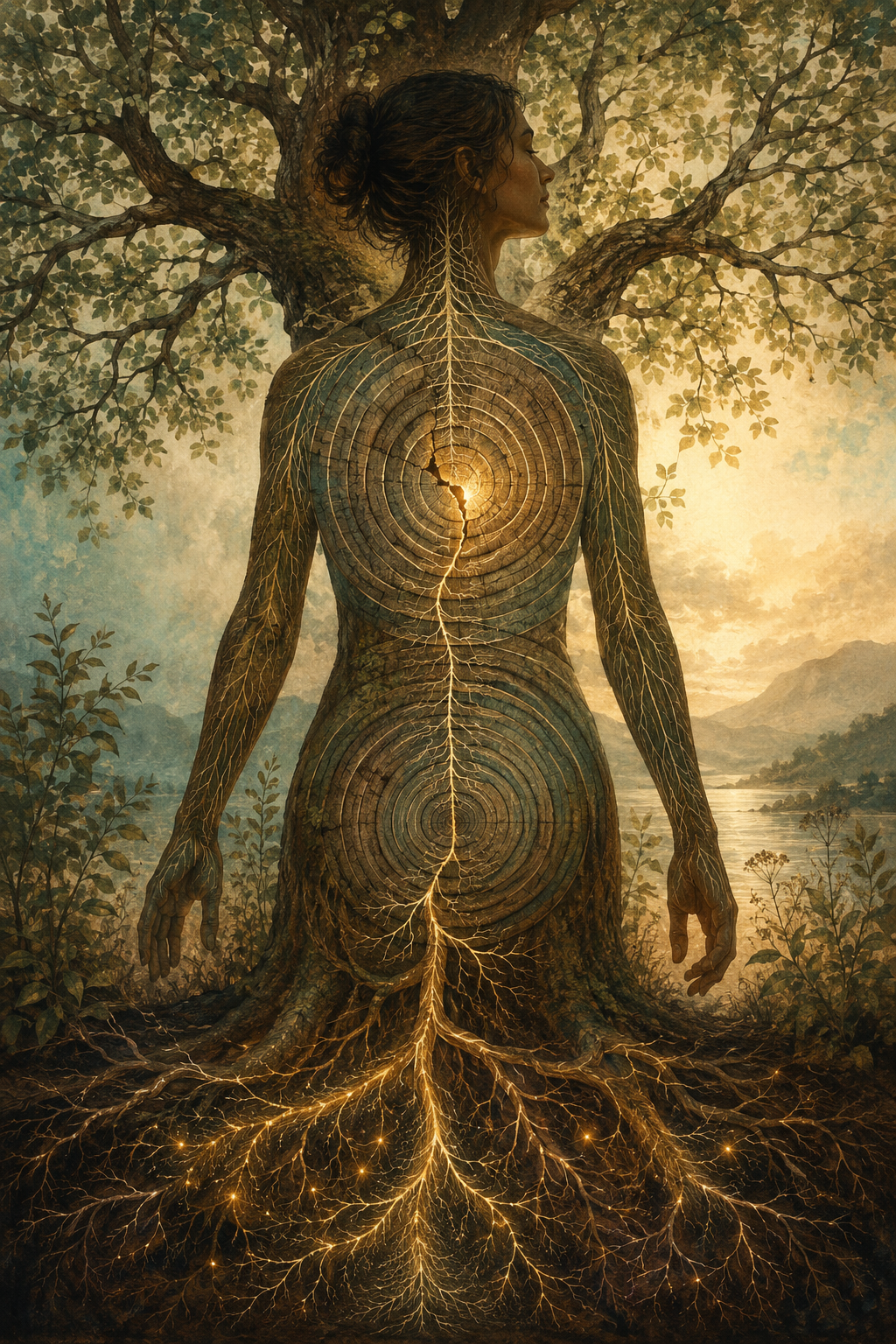
Digital Art - Kellie Stirling

What is the natural physiology of emotions?  Here are some examples.

Grief isn't just sadness. It's the weight in your chest that cognitive understanding never lifts.  It is the body wanting to lie down to let that grief be expressed and that fear we all have that if we lie down we may never get back up again.

Anger isn't a mood. It's heat rising through your body, a tightening in the jaw, before your mind has even found the reason. The body moving into a protective posture.  It is a boundary that has been violated and the body wanting to say no. It is the body preparing to push away danger.

Shame isn't a feeling. It's your body collapsing inward, your chest curling, your eyes dropping downward before you're even aware that it's happening.

Anxiety isn't just a worry. It's your nervous system rehearsing every possible ending, over and over, trying to manage risk and the potential scenarios that might happen, faster than thought can keep up.

None of these are thoughts. They are physiology, that distinction matters more than it sounds like it should.  

The state of our nervous system drives our behaviour and that physiology that I mentioned is our bodies natural response that goes with it and helps it move through.  So when you learn all your life to dampen it down or pack it away, when it randomly starts to come up because your body is exhausted and can't keep the lid on it anymore no wonder you feel overwhelmed.  No wonder you feel exhausted with it.  Imagine the amount of energy it takes to repress all that emotion and you have been doing it for 40 or 50 years.  

Learning to self-attune, to sense and interpret our internal experience, what's sometimes called interoception, is an important skill. Our emotions carry information: what matters to us, what hurts, what we need and what we want to change. When we can hear that information clearly, we can make choices that actually serve us. When we can't, when we override or ignore it, we self-abandon. We stop listening to ourselves, which means we stop knowing what we actually need.

Your body wants you to listen.

It has been trying to tell you this for a long time, it is ready for a change and to do life differently.  So instead of medication what if you learned to feel more safety in your body so that you could own and express your emotions in a way that didn’t feel too much. Like you were too much.


Finding our inner fire

How do we hold our power in service of what matters most?

A woman sits across from me and tells me she never gets angry and she thinks she might have a problem with boundaries. She says it like a diagnosis, almost like an apology. She wants to learn how to say no. She wants scripts, maybe. A formula. But what she's actually telling me, underneath the words, is that she has lost access to a part of herself.

I see this constantly in my practice. Women, often deeply competent, articulate, successful women, who can navigate almost anything except the felt sense of their own no. When we start to work somatically rather than cognitively, something interesting happens: the no doesn't arrive alone. It brings the yes with it.

This is not a skills problem, it is a capacity problem.

We tend to talk about boundaries as if they're a technique. Say this sentence. Hold this line. Don't over-explain. But boundaries aren't really built from the outside in. They're an expression of something underneath  your capacity to feel your own healthy aggression.

I don't mean aggression as violence or hostility. I mean it in the older, more honest sense: the felt charge of “I exist, I take up space, I will push back if I need to”. It's the energetic foundation beneath every no that actually lands not from anxiety, not from over-explanation, but from a settled, embodied place.

Most of the women I work with didn't lose this capacity through some dramatic event. They lost it gradually, often in childhood, sometimes through culture more than through any single relationship.  They learned early in their life that their fire made other people uncomfortable, so it got smaller, quieter, eventually unconscious.

What is surprising to most people is that they find that when we rebuild that capacity, what comes back isn't just the ability to say no. It's the ability to feel everything more fully, including joy and pleasure.  They start to get better at expressing what they desire because with the feeling of safety and what a NO feels like, also comes the kind of full-bodied yes that doesn't come with a flicker of guilt attached to it. The same nervous system gate that was clamped down on anger was clamped down on delight. You can't selectively numb. When you reclaim capacity for one exalted state, you tend to reclaim it for all of them.

So I know you are probably thinking right now, what does healthy aggression actually look like?

This is the part people misunderstand most. They hear "healthy aggression" and picture confrontation; raised voices, conflict, some kind of fire-breathing transformation.

Often it looks like almost nothing at all.

A woman with real capacity for her No can say "no thanks" and feel completely unbothered by it. No story. No spiral. No rehearsing the conversation for three days afterward. The protective response did its job, quietly, and then it was finished. That ease, that lack of charge, is the proof of capacity, not the absence of it.

Drama only enters when the no didn't get to happen early enough, or often enough, for the system to trust that it would be heard. The fire isn't supposed to need to roar. It only roars when it's been ignored.

Culturally we view anger in women as shameful. Why?

I find myth genuinely useful here, not as decoration but as a way of making meaning out of something the body already knows. Lilith is one of the oldest stories we have of a woman exiled not for wrongdoing, but for refusal.  Lilith was the woman who refuses to extinguish her fire to make others comfortable.  She said I will not shrink myself to belong.

If you haven’t heard of Lillith, she was an interesting  woman.  According to early creation myths, Lilith was the first woman created from the exact same soil as Adam. She refused to be subordinate or lie beneath him because she knew they were spiritual equals. As an archetype she asks you to examine where in your life you are settling for less than true equality.

That's the pattern so many women carry quietly: the sense that their fire, their refusal, their full-throated aggression was never met with curiosity. It was met with the message that maybe we are too much. So our nervous system does what any intelligent nervous system does under threat it adapts. We got smaller and found ways to be palatable instead of present.

Reclaiming Lilith isn't about becoming dangerous. It's about no longer mistaking your own aliveness for a threat. It's recognising that the parts of you that got exiled your appetite, your refusal, your fire were never the problem. They were simply too much for the room you were in at the time.  Lilith represents the wild, untamed truth of your soul that refuses to be tamed, managed, or approved of by others

Many women find that Lillith arrives for them in perimenopause.  I want to talk about this because I think it explains so much of what shows up in midlife that gets pathologised instead of understood.

In perimenopause and menopause, something arrives that I think of as the muse, the essential self, the part that was exiled long ago and has been waiting, patiently, for the conditions to change. In perimenopause, the hormonal conditions do change. Hormonally, developmentally, something shifts and the lid that's been sitting on decades of suppressed fire starts to lift, often whether a woman is ready for it or not.

If there's no capacity built underneath that shift, it doesn't arrive as clarity. It arrives as leakage. Rage that seems disproportionate to its trigger. Reactivity that surprises even the woman feeling it. This isn't pathology, and it isn't really about whoever happens to be standing nearby when it surfaces. It's decades of unspoken no finally getting loud enough to be heard, because the quiet no, when we felt safe, was never honoured in the first place.

This is the real difference between healthy aggression and what we usually call rage. Healthy aggression is directed, contained, proportionate, it knows what it's responding to. Rage without capacity is undirected. It escapes containment because the container was never built. The fire was always there. It just never had enough space on the inside of us to hold it.

Women who've done some of this capacity work on connecting with healthy aggression before the hormonal shift tend to meet their muse as something like a homecoming. Women who haven't can get ambushed by her, by themselves, in a way that can feel disorienting and even frightening.

I want to come back to where this started, because I think it's the part that matters most. The more capacity I've built for my own deep no, the more grounded I feel. Not more guarded. Not more isolated. More grounded, more able to actually be present for my life, because I'm not spending energy holding a lid on something that wants to move.

This is the real promise of healthy aggression. It isn't about becoming harder, or more combative, or less relational. It's about widening your capacity for the whole range of being alive, your no, your yes, your fire, your joy. Capacity for life, really, in the broadest sense.

The fire was never meant to burn anything down. It was only ever meant to keep you warm enough to stay present to your own life, all of it, not just the parts that were easy to feel.  I think this is the bigger change we learn to work with in midlife. How do we tend to our inner fire and keep the embers burning.  This makes me think of Hestia, the Greek goddess of the hearth, whose sole role was to keep the hearth burning.  

What I love about Hestia is that she wasn't the goddess of achievement, seduction, battle, or even transformation, she was the keeper of the sacred flame.  The fire that allowed everything else to happen.  In Greek mythology, she stayed at the centre. While the other gods and goddesses were caught up in dramas, quests, rivalries, romances, and wars, Hestia tended the hearth.  There is something profoundly midlife about that.  It is not about withdrawal from life but a movement toward our essence.  The developmental challenge of midlife is coming back to the truth of who we are.

We start to ask ourselves what truly matters now? What is worth investing my energy in?  What keeps my inner flame alive?  From a nervous system perspective, this is such a different way from how our culture frames and portrays vitality.  In popular culture, it is portrayed as worship of the bonfire.  Constant activity, productivity and performance, the endless quest for wellness and self improvement.  Hestia reminds us that endurance comes from a different kind of fire.  The hearth fire is steady, reliable, warm and sustainable.

So Lillith energy invites us to find our fire and build capacity for it and Hestia energy invites us to know how to hold is wisely. To ask ourselves, how do I become a trustworthy keeper of my own inner fire?


Will I Still Belong If I Become Who I Am Becoming?

There is a question that sits quietly beneath many of life's biggest transitions.  Most of us never say it out loud.  Instead, we ask questions about careers, relationships, ageing, health, identity, purpose, or the future.  But underneath those questions is often another one:  Will I still belong if I become who I am becoming? With that there is often fear and also a quiet awareness that life as we know it cannot continue in the same way.  Sometimes it is a whisper and sometimes it is a crisis.  Either way we become aware that change is asking something of us.

That question lives somewhere below the throat. You might not have words for it yet. You might not even know you're asking it. But if you're in the middle of a significant life transition, becoming a new parent, a relationship ending, a career dissolving, a sudden life threatening illness, a version of yourself becoming suddenly ill-fitting, your nervous system is asking it on your behalf, constantly, in the background of everything.

It's not really a question about the future. It's a question about whether you are fundamentally safe to change.

What I have discovered is that thinking your way to the answer doesn't work. Not because you're not intelligent enough, but because the question isn't being asked by your intellect. It's being asked by something much older and much more fundamental, the part of you that is wired, before anything else, for connection and survival.

Last Saturday I sat in a room with a group of somatic experiencing and TCM practitioners and learned something that my body already knew.

We were working with the Five Elements of Chinese Medicine, an ancient framework that maps all of life onto a seasonal cycle. Being taught by the incredible Alaine Duncan (TaoTrauma). Metal, Water, Wood, Fire, Earth. Autumn, Winter, Spring, Summer, Late Summer. Each element with its own quality, its own organ system, its own emotional signature, its own role in the great turning of things.

What stopped me, what caused a kind of internal earthquake I'm not sure anyone else in the room noticed, was the moment I understood that these five elements describe not just the seasons of the natural world, but the seasons of every significant transition a human being moves through. More than that actually.  Each element carries precisely the quality of support a nervous system needs at that particular moment in the cycle.

I've been working with people in life transitions for nearly ten years. I thought I was learning something new about somatic touch work and I want to reaffirm to you that I absolutely did.  But I was also actually finding the map for territory I'd been navigating and creating by felt sense all along.  Every transition we go through has a cycle within a cycle.  These big transitions are not linear, they are fractals within a fractal.  Spirals that move in, out and around.

Digital Art, Kellie Stirling

Here's what I mean.

Every transition begins in Metal that sits with the season of Autumn. Something ends. Something is released, or taken, or outgrown. The Metal element governs our capacity for sensate awareness, the skin that registers the first chill, the gut that knows before the mind does that something has shifted, that sense we have when we experience slight arousal because our gut knows something is not quite right. The resource energy of Metal is respect. Respect for what is ending. Respect for the fragility of the threshold. Precision in how we hold what is being lost.  How might perimenopause be experienced if culturally we had more respect for what women experience at this time.  If we could offer that in a large container for them.  If getting older was not denigrated but rather respected.

In transition, Metal asks: can you let this be what it actually is?

Then comes Water, the element associated with Winter. The not-knowing. The fallow. The period that our culture is most brutal about rushing, most intolerant of sitting inside. Water is where fear lives, but also where wisdom gestates. You cannot see the shape of what's coming yet. The resource energy here is protection,  to anchor, to contain, to hold someone steady while they cannot yet hold themselves.  This is often where we reach out to others for help, trying to regulate through connection.  Our tribal need to connect to help us regulate ourselves through the fear that is rising up.  This is where providing a container of support is really useful.  In Australia, new mothers are connected with other new mothers in a mothers groups so they can have connection during this time.

Water asks: can you bear not knowing what comes next?

Wood is Spring.  Spring cannot be manufactured. But when the conditions are right, when there has been enough winter, something moves. Wood governs the mobilisation of life force, the capacity for healthy anger and also hope.  It is directed forward movement.  Life wants you to move, something new is trying to emerge. A dream that was never pursued, or a  truth that was never acknowledged. A boundary that was never spoken. The resource required here is encouragement. Encouragement is not pushing, it is standing alongside someone and quietly saying: "I think you can trust this next step."

 In our training room last Saturday, a colleague placed her supportive hands under my ankles. The intention with the somatic touch was encouragement and support in the spirit of a coach. As I was lying there I felt a moving forward energy in my body. Then an image arrived in my mind, unbidden, I was running through a field of flowers in pure delight. That's Wood. That's what an unimpeded mobilisation response actually feels like in a body that has been through enough winter. Whilst the resource energy for wood is encouragement, the felt sense is of something or someone believing in your capacity to move, even when you cannot yet believe it yourself.

Wood asks: what wants to emerge through you now?

Fire is Summer, coherence restored. This is the moment in a transition when you suddenly start to know yourself again, when the scattered pieces find their arrangement and come together in a new constellation, when connection becomes possible again. Fire governs the heart, and the heart's capacity to communicate both danger and equanimity to the whole system. The resource energy is love, not sentiment, but the agape quality of full, unconditional presence. Being truly met.

Fire asks: can you let yourself be known again?

Finally Earth, the arrival of late summer, the harvest. This is where the gristle gets digested. Where the lessons move from being things that happened to you into being part of who you are. Where the gut microbiome, the immune system, the capacity for giving and receiving, all of it comes back online. This is the time in a life transition where we have enough distance from the challenge that we can harvest the lessons we have learned along the way.  In menopause in TCM this time is known as the second spring.  The resource energy is support  coming from underneath, nurturing, a trust and knowing that the ground is holding you rather than you holding yourself up.

Earth asks: what has this made you?

Then we move back to Metal again.  Metal is both the beginning and ending of a cycle.  Life is nothing but a series of transitions, beginnings, middles and endings that keep on happening.

Respect. Protection. Encouragement. Love. Support.

Five different answers to the same question. Will I still belong if I become who I am becoming?

Yes. When we are in transition we feel like we have lost our inner compass because our nervous system is often rewiring and this affects other systems in our body.  When we experience all of this it offers a sense of what it feels like to belong within a transition.  Within each season of our life.

The reason transitions are so hard in our culture is not that we lack resilience. It's that we treat them as problems to be solved rather than seasons to be moved through. We try to think our way to summer while our bodies are standing in the frost. We pathologise winter and try to get out of it as soon as we can, often without support. We rush spring. We skip the harvest because we're already anxious about the next thing ending.

But the body knows. The body has always known. What it needs, what it has always needed is not a solution. It is the right quality of presence for the season it is actually in.

When you help someone belong to themselves through a winter they didn't choose, you are doing something that ripples far beyond the room. A nervous system that has been met in its fear, encouraged in its spring, and supported in its harvest doesn't mobilise that unresolved energy outward. It completes the cycle. It becomes available for connection, for contribution, for the next season, whatever it brings.

You don't learn this with your mind first. You learn it the way I did last Saturday through highly attuned presence of another person, sitting with you and holding space for you through it.  With that your  body suddenly remembers what moving forward safely feels like.

That's where we start. Not with the answer to the belonging question. With the conditions that make the question safe enough to ask.

Here are some reflection questions for you if this resonates with you.

Can I respect what is ending in my life? How can I protect myself in uncertainty? What do I need to be able to encourage what is emerging? Can I meet myself with love? What support do I need to foster time and space for the integration of my experience?

Leaning into longing: the distance between being heard and held.

There's something quietly poignant happening right now. People are turning to AI for something that feels like companionship.   A place to be heard. A presence that's available, patient, non-reactive. I don't say that dismissively, because I understand the impulse completely. We are living through an epidemic of loneliness so profound that we will reach toward almost anything that approximates the feeling of being held. The feeling of being connected with another, with each other.

What I keep coming back to is this, what people are actually reaching for isn't information or even reflection. It's the experience of mattering to another nervous system. That mattering to another nervous system, as much as we might wish otherwise, cannot be replicated by a machine.

That is because the nervous system is fundamentally a relational ‘organ’.  It likes to be with others to co-regulate.  It likes connection, choice and agency. What people are reaching for is not information but relationship. The nervous system develops in relationship, heals in relationship and, throughout our lives, continues to seek the regulating presence of other humans.

I must admit, I work on my own a little and I find myself craving the connection of other humans in person. When I have days when I am writing I will often go and plonk myself in a cafe just to be around other people. It might be surprising to you that these days are often my most creative.

We tend to think of connection as a social skill. Something we learn, practice, get better at. But underneath the social layer, connection is a somatic experience. It happens in the body before it happens anywhere else.

When you feel truly met by another person, that feeling of really being seen and being with a person who can hold your experience in their body and stay in connection with you, well something in your physiology shifts. Your breathing changes. Your muscles soften. The part of your brain scanning for threat quiets down just enough to let something else come forward. This is not a metaphor. It is the nervous system doing what it evolved to do: co-regulate with another.

This is why genuine connection is so hard to fake, and so hard to find. It requires two people who each have enough internal settledness to stay present, not just cognitively, but somatically, when things get uncomfortable. When the conversation touches something real. When the other person's activation starts to move through the room.

Most of us never learned how to do this. Not because we're broken, but because most of us grew up in environments where the adults around us hadn't learned either. Neither did their parents or grandparents.  The lack of capacity, inability to attune, it gets passed down through the generations.

Many people talk about the concept of moving our orientation from me to we.  This is not a new phrase, it has been around for quite a few years but what does it actually mean from an embodiment perspective?

Here's the paradox at the heart of relational work: you can't genuinely be with another person until you've developed enough capacity to be with yourself. This isn't about self-sufficiency or emotional independence. It's about having enough internal space to notice what's happening inside you without being completely run by it. To feel your irritation, your fear, your contraction and still stay in the room. Still stay in the relationship, still stay in your body and not dissociate or project it onto another person.

Without that internal witnessing capacity, connection collapses into reaction. We move fast. We get irritated, or angry and we defend. We assert. We project what we can't metabolise internally onto the people around us and then wonder why we feel so alone even in company.

The ‘me’ work isn't selfish. It's the foundation that makes ‘we’ possible.  To receive, we have to learn how to listen with our body, with all our five senses.  In a world where striving, action and constant motion is celebrated and rewarded, where people are expected to ignore their own basic bodily functions and boundaries all the time and keep on doing, this can be hard and slow work. It often feels unsafe for a body that is constantly in motion to slow down. It's also hard when your value is attached to productivity, the state becomes a trait. But it's not who you are. What if you could titrate your experience of slowing down a little bit at a time so that you could feel safe to just be. To receive the presence of another, to really listen and not have to fix anything or be fixed.

One of the things I notice consistently in my work, with individuals navigating midlife transitions, with leaders in organisations, with people doing the slow, courageous work of trauma integration, is how hard it is to receive.

Not just to receive care or support, though that's part of it. But to receive the experience of being held by another person and let it actually land. To feel it in the body rather than process it in the head. To let it matter.

For many people, especially those whose early experiences taught them that support wasn't reliable or safe, this is genuinely threatening. The nervous system that learned to survive on self-sufficiency doesn't easily soften into ‘we’. Even when ‘we’ is right there, available and real.

I've sat with individuals and groups in sessions where something quite profound has happened, a moment of genuine attunement, a shift in the room and watched them move past it almost immediately, back into their head, back into their story, because the body didn't yet have a map for what just occurred.

Building that map is slow work. It happens through repeated experience, not insight. Through the body, not the mind.

Back to AI.  Let's talk about what it can and cannot offer. I want to be honest here, because I think the nuance matters.  I think there is real value in AI as a reflection tool.

There is something useful in having a space to think out loud. A patient, available presence that reflects without reacting. I use AI in my own work to test ideas, to do business analyst work that I don’t have time to do.  That's real.

But nothing in an AI interaction is changed by contact with you. It isn't moved by your story. It doesn't carry you between sessions. It can't offer you the experience of mattering to another nervous system because it doesn't have one.  You can reflect to AI over a tricky experience you had with others and whilst it reflects back to you, nothing in it is changed by the experience that it is witnessing.  It doesn’t actually sense the relational field like our nervous systems do. It can recognise the significance of it but it doesn’t feel anything.  The mutuality of relationships is that our nervous system is changed by the interactions we have with others.  That fact is exactly what makes human relationships irreplaceable.

That mutuality, that being-changed-by-each-other, is precisely what makes human relationships the irreplaceable thing they are. Real connection leaves marks on both people. That's not a bug. That's the whole point.

There is a longing for ‘we’ that we are all desperately hungry for, that feeling of connection we receive from the nervous system of another human who is able to be with our experience and let it be.

What I believe people are reaching for in therapy, in AI, in every form of connection they can find, is the experience of not being alone with their inner life. Of having it witnessed, held, accompanied by another.

That experience is available. But it lives on the other side of the ‘me’ work. It requires a nervous system that has enough capacity to stay slow when things move fast. To receive when receiving feels vulnerable. To be genuinely present to another person without losing yourself in the process.

That's not a social skill. It's a somatic one that is learnable slowly, in the body, in relationship with others, over time. Which is, perhaps, the most human thing there is.

Permission to be slow

There is a rhythm in the body that most of us have never been taught to feel.  It is actually really hard to feel or listen to.

It is not the rhythm of the heart, though that too. Nor is it the rhythm of the breath, though that is closer. It is actually deeper than both of those and also slower than both.  It is a deep rhythm that feels a bit like it is a tidal movement in the body that pulses beneath everything else. It is two deep rhythms, like a deep tide and a middle tide. Or as my teacher described it is like the ocean, which holds both a surface current and a deep undercurrent. The body carries its own layered rhythms. Both are real. Both carry information.They are deep and they require something most of us have forgotten how to do.

It requires us to slow down enough to feel it.

This year I have been completing training in biodynamic craniosacral therapy, a modality that works with exactly this. What struck me most, is how radically unhurried it is. The touch is extraordinarily light, almost weightless actually. The practitioner's hands don't press or manipulate or fix. They listen. They receive. They create enough stillness that the body's own intelligence can begin to express itself.

Art, Vanessa Palmer, Beneath the Lillies 2019

This is a different kind of healing to the one most of us have been taught to expect.

We come to healing whether it be to therapy, to coaching, to body work, often looking for something to happen. We want the insight, the release, the shift we can point to. We have been trained, particularly those of us who live from our minds, to measure progress by what we can articulate and what we can feel ourselves changing. We are used to effort. We are used to working hard, even at our healing.  I would say that many of my clients work incredibly hard.  They show up, they invest in themselves.  I do this too.  I always have, even with my own healing work.

Craniosacral therapy quietly dismantles all of that. Before the body can heal, it needs to feel safe enough to be itself.

This is not a metaphor. It is a biological reality. The nervous system, particularly one shaped by years of high-functioning stress or early relational difficulty, is not simply waiting to be fixed. It is waiting to be met. It is scanning, constantly, for whether the environment, including the practitioner, is trustworthy enough to soften into.  I talked about this last week in my blog when I was discussing how the nervous system is always scanning for safety in belonging and trying to work out what role it can take up in the social system.  It's the same theme.

Attunement is what creates that safety. Not technique. Not expertise, though expertise matters. But the quality of presence that says, “I am not here to rush you. I am not here to interpret or analyse or pull anything from you. I am here to be with what is”.

There are things the body carries that have no words.

Not because they are mysterious or unknowable but because they arrived before language did, or at a moment when language shut down. Shock held in the diaphragm. Grief folded into the chest. A startle response stuck in the body. The memory of a moment when the body braced and never quite let go.

Talk therapy doesn’t reach this because it deals with what is in the rational and logical part of the brain, not the limbic system and primal brain, where the nervous system lives, that holds all the patterns of bracing, tension or stress we may not be fully aware of. The body stores experience in tissue, in posture, in the patterned way the breath moves or doesn't move. Sometimes what a body most needs is not to be spoken to, but to be touched, with such fine attunement, such precision of presence, that the tissue begins to trust it is safe to release what it has been holding.

This is what the lightness of biodynamic craniosacral touch makes possible. It is not passive. It is listening at a cellular level. It is a hand that says, ‘I can feel you. I am not frightened of what I find. You don't have to do anything’.

That kind of touch is a language. One the body recognises before the mind has time to evaluate it. The body is the most incredible self healer.

What continues to move me, both as a practitioner and as a person who has spent years working with what the body holds. It is not the practitioner doing the healing, it is the person on the table receiving the gentle touch.

The body already knows. It has always known. The intelligence that knows how to close a wound, regulate temperature, move food through the gut without a single conscious instruction from us; that same intelligence knows how to process and integrate experience, when it is given enough safety and enough time.

My job as a somatic practitioner is not to fix. It is to create conditions. To hold space that is regulated, attuned, and unhurried enough that the body's own healing capacity can come online.

Slow is not passive. Slow is the speed at which the nervous system's deepest layers operate. Slow is the speed at which the tidal rhythms of the body move, carrying their information. Slow, it turns out, is where the most profound healing lives.  I have constantly been surprised by how much depth and nuance can be achieved when we slow things down. It allows stress cycles that have been stuck for years to be completed.  It creates a level of unwinding in the body that can only happen when the body is not rushed.  Slow is more. 

If you are someone who has worked hard at your healing; and I suspect many of you reading this are, I want to offer you this.

You are allowed to receive.

Not just information. Not just insight. Not just techniques to practise between sessions. But the quiet, almost-nothing of being held in a regulated, attuned presence and allowed to simply be. The body does not need to be pushed into healing. It needs to be trusted to know the way.

Permission to be slow is not a luxury. For a nervous system that has been organised around effort and vigilance and productivity, it may be the most therapeutic thing on offer.

The tide is always moving. We simply need to learn to feel it.

The Nervous System Never Lies

Attunement, the Inner Critic, and What We're Really Missing

Humans are relational by nature. Our bodies are hardwired for connection, and we regulate through co-regulation. When we try to regulate from a place of urgency, to fix ourselves or change something, we might be missing a vital step.

Breathwork and vagus nerve exercises are genuinely useful tools, and they can absolutely support us in the moment. But they are not what a young, developing nervous system misses out on. What gets missed is something far more fundamental: attunement.

Attunement is being seen, heard and known. Being met exactly where we are when we needed help from a caregiver. When we had big emotions, or overwhelmed, when we might have fallen and hurt ourselves, our caregivers were there to soothe us and had capacity to hold our big feelings. From these experiences, from them attuning to us in the moment, lending their nervous systems to soothe ours, our nervous systems develops and grows. When our caregivers did not lend us their nervous system to hold us through experiences that were overwhelming, we didn't receive the attuned attention we needed to learn how to soothe ourselves.

Babies are not born with the capacity to self-regulate. Caregivers lend them their nervous system, through gentle touch, a gentle voice, and responsive presence, and over time, through that repeated experience, the child's nervous system learns that the world is safe. Gradually, they internalise that capacity and begin to self-soothe. If that attuned care was inconsistent or absent, the nervous system may never have had the chance to fully learn it.

Digital Image - Kellie Stirling. Two women mirroring each other offering deep attunement

This is also where the inner critic is born, though it has other contributors too, including cultural and family messaging. The inner critic is often misunderstood as something we need to eliminate. But it usually formed for a reason.

The inner critic doesn't arrive in a single moment, nor from a single voice. It is shaped over time, like rings in a tree. Early relationships often form the core, particularly where attunement was inconsistent and a child learned to adapt in order to belong. But other layers gather around it: temperament, family expectations, cultural messages, moments of shame, and the quiet lessons about who it was safe to be. What we call the inner critic is often a protective ecosystem, one that once helped us stay connected and feel safe, even if it now feels limiting or harsh. It is often an aspect of our inner critic, which emerged to protect us, that shows up in our relationships when we are arguing.

So back to the breathwork and the vagus nerve exercises. These tools matter. But they are not the core of what our deeply relational nervous systems need.

When we learn to practise self-attunement, when we learn what safety actually feels like in the body, something begins to happen that was interrupted early in our development. This work unfolds most powerfully in the presence of a therapist or coach who is trained to hold this kind of space, and who has done enough of their own work to bring a stable, regulated nervous system to the room. That stability matters, because it recreates the very thing that was missing: a regulated system, a compassionate witness to co-regulate with. The body is being met in its experience, not shifted out of it.

From this level of attunement, something remarkable starts to grow: self-trust. We begin to learn how to attune to ourselves, to notice and stay with our inner experience. Another word for this is interoception; our capacity to sense what is happening inside us. As our interoception develops, our own voice starts to emerge. As distinct from the inner critic, which is so often the voice of the caregiver who couldn't meet us.

This is developmental work in the truest sense. We get to grow what didn't get to grow the first time around, so we can move through our lives as empowered, self-aware adults who know how to be in relationship, with others and with themselves.