dissociation

When our children trigger us

Children invite us into rooms within ourselves that we spend a lifetime avoiding

Nothing will expose your early wounds quite like trying to get children out the door before school.  In our house, mornings were often the hardest part of the day. One child moved slowly, just as I do. The other was quick and efficient. I hated the rush because slowness is my natural rhythm, and every morning felt like a collision between who I was and what the day demanded.

These days I meet many parents who are psychologically literate.  They have read a lot but they haven’t necessarily done their inner work.  So, even if you understand your inner child, can name your attachment style, have listened to the podcasts and read the parenting books; your child will meet the unconscious parts of you that haven't yet been integrated. Because it's when you're stressed and exhausted that those parts show up.

So when a little person cries, do you rush to fix them? Or do you shut down, explode, withdraw, go numb, feel guilty? Do you physically or psychologically leave the room?  With your teenagers do you find them too much and hard to handle so you leave them alone?  None of that makes you a bad parent. It makes you human with coping strategies you use to manage your internal experience.  We all have them.  Some of us experience these triggers a lot when our kids are little, some of us later when they are teenagers or young adults.   They are a signpost to where you need to explore your unconscious patterns.

Children have a way of touching our greatest wounds.  The places where our younger parts learned: I'm too much. I'm alone. Love has to be earned. There's no room for my needs.

Those beliefs don't live in your mind. They live in your body. That's why a toddler's tantrum, a refusal to put shoes on, a teenager's stonewalling, can awaken old grief, anger or fear inside of us because our nervous system doesn't know the difference between then and now.

The child isn't creating your triggers. Your triggers belong to you.  They're revealing the places where your younger self is still waiting for someone to choose them, for someone to stay and listen.  For someone to be interested in your emotional world.

That's why parenthood can feel so overwhelming. Children invite us into rooms within ourselves that we locked long ago and forgot existed.  Most of these rooms live in the basement of the psyche. We buried them there because what we were feeling at the time was simply too much. We dissociated, adapted, fragmented and survived. The problem is that the parts we left behind don't disappear. They wait.

Our child doesn't need us to be perfect. They need us to be conscious.  To be able to notice, to stop and pause, to repair when we have a rupture, to stay contained within ourselves whilst allowing them to have their emotional experience.  They need us to soothe them when they are young to help their nervous system learn how to soothe.  Our teenagers need some stabilisation and containment when their emotional swings are really big, so they feel safe and that there is room for them to explore who they are in the supporting container of our love.  That means when they are overwhelmed we can stay in our body, in our internal experience, soothe ourselves and stay connected to them.

Our children call us to choose differently, to make a choice that isn't reactive.  This is how we end generational patterns. Ancestral trauma gets passed down from one generation to the next until someone does the work on themselves.  When you choose to explore your inner world, to understand your coping strategies and pull them out of the basement and into the present, you are choosing to love parts of yourself that have been desperate for connection for many years.  

We can reclaim our inner child. We can reconcile with the parents who passed these patterns to us. But the greatest legacy we leave is to do our inner work, we do this for our children, they call us to be better people.

We don't need to keep carrying everything that came before us.

When we do our own healing, our children benefit. Our partners benefit. Our friendships deepen. Every relationship in our life becomes more honest, more connected and more alive.

Relationships are where we are wounded, but they are also where we heal. This is perhaps one of the greatest gifts our children offer us.
When a Child's Survival Strategy Becomes a Culture's Dysfunction

One of the things I love about the nervous system is how plastic it is.  We adapt for survival and our autonomic nervous system which drives our behaviour, adapts to keep us safe.  It is clever, so masterful in how it drives us to adapt so that we stay safe, feel a sense of belonging and receive the love we need to grow and flourish as humans.

That same survival system is also what drives maladaptive behaviour.  When we look at toxic cultures, we have to look systemically at what is driving the threat.  Often it is a leader with maladaptive traits that were developed as a child to survive.  But it can be other things too. It may also be remuneration and compensation structures that aim to foster never ending financial growth, which we know is completely unsustainable.  Maybe it is further out than that.  Maybe it is laws that are overly rigid and drive dysfunctional behaviour, it happens, and there is irony in that because in theory laws are put in place to promote safety, prosperity and harmony in society.  The point is all of this ripples out. We all know that cultural and geopolitical hegemony exists and have to look broadly at what might be going on. Most often in culture it is all these happening together.

Back to the individual though.  Our adaptive strategies start forming sometimes whilst in the womb.  Babies cannot regulate their own nervous system, they need co-regulation of parents and caregivers to learn how to soothe themselves.  We do that by attending to their cries for help, through touch, a soothing voice and meeting their needs to feed or change or soothed back to sleep.  Babies can’t survive without a parent/caregiver, they need to be fed and cared for.  When those needs aren’t met or parents are miss-attuning to them, they start to develop little strategies to receive the love, feel safe and feel like they belong to the family.  You see for a small baby or small child to not receive this attuned care, it feels like death to them.

These are adaptive strategies and as Gabor Mate says, children will choose adaptive over being their authentic selves every time.

It is here our adaptive strategies begin.  Now this is okay in childhood but as we grow and age they get in the way of our adult relationships and often lead to conflict in our intimate and platonic relationships.

I want to add that its not always about our parents.  Some of us were bullied at school, some of us had lots of sports accidents when we were teenagers that really impacted our proprioception which is our bodies’ sense of where it is in space and time.  This can cause some of these strategies to develop also.

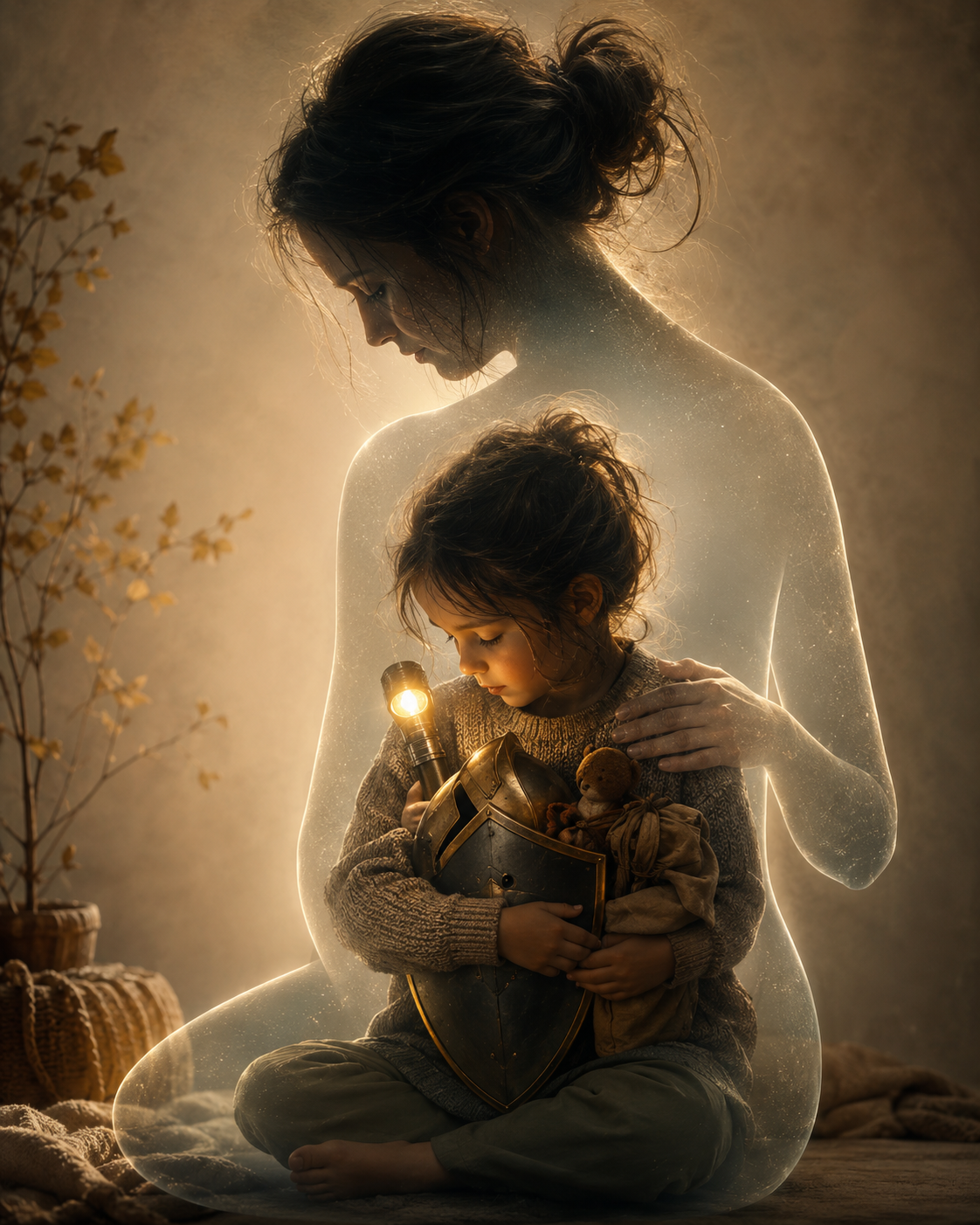
Digital image - Kellie Stirling. An adult soothing their inner child who is metaphorically holding the ‘armour’ of their adaptive strategies.

Let's talk about some of the common strategies that I see.  Some of these are mine too!

Hyper-vigilance — We flinch at footsteps, scan every room we walk into. There's nothing wrong with us; we were just watching for the next threat so we’'d never be caught off guard.

Control — We white-knuckled every plan, every outcome, every unknown. When our past was unpredictable and unsafe, we learned that controlling the details was the only way we could sleep at night.

Overthinking — We stay awake at night, ruminating, replaying conversations from years ago, when one wrong word used to cost us everything. We thought that if we studied every angle, next time we'd see it coming.

Overexplaining — We write an essay to prove that we aren't the problem. When words were twisted or used against us, we thought if we gave enough context, we'd finally be believed.

People pleasing — We agree to things we don't really want because saying no cost us our safety when we were younger. We learned to keep everyone happy; that was the only way we stayed alive.

Perfectionism — Making a mistake felt like a death threat to us. Perfectionism shields us from the pain of losing love, avoiding criticism, and preventing abandonment by being completely flawless.

Self-abandonment — We make ourselves the last person on our list of who we look out for. When choosing ourselves meant punishment, self-abandonment taught us that disappearing, or receiving the crumbs of what was left in the love and attention department was the safest thing we could do.

Shame — Shame made us feel like we were the problem for things that were done to us. We were made to feel like we weren’t deserving of receiving love and attention.  We carried the blame because the person who hurt us didn't have the capacity to take responsibility and we have to hold it for a really long time.  

Freeze — We go deathly quiet, mid-sentence, vacant behind the eyes. When fight and flight aren't options, we froze in place so danger would pass over us. This is such a natural biological response when we are experiencing extreme threat, animals do it too.  It is just that animal’s bodies know how to shake it off and somewhere along the way our bodies stop remembering how to do that.

Dissociation — It makes us disappear when things get too loud, too close, too much. When our body couldn’t run or fight, dissociation came in and it took us somewhere we couldn't be reached.

Isolating — It made us cancel our plans, dodge the calls, and stay behind the locked door. After the people who were supposed to love us hurt us, being alone was the only place we knew to feel safe.

Growing into adulthood isn’t about eliminating these strategies, it is about becoming aware of them and not letting them run your life.  When we work with them somatically, we become so aware of them and we learn to expand our capacity to feel them so we have the choice to pause and slow them down in the moment.  To be actually present to what is happening right now and not disappear into our survival response.

I want to add that many of these strategies can give us superpowers. Here are a couple of examples. In clients that are hypervigilant, I notice they don’t miss anything going on in the meeting at the office.  Super attentive people.  The over-thinkers and over-explainers are great at managing risk in my experience.  The people pleasers, natural carers and they are always very attentive to people’s moods.  The perfectionists, whilst they can be hard to work with, their attention to detail is always exceptional in my experience, and they are generally pretty good at finishing and completion of tasks.  

It’s just that when one of these strategies (or maybe a few together) is the dominant operating strategy, it gets in the way of honesty, deep intimacy and being able to listen to and be okay with different perspectives on life and how we live it.  That is what causes friction at home and in the office.  It is what causes greed and manipulation.  It causes wars and conflict.

In my opinion, healthy adult relationships are the bedrock of a happy life. Loosening these strategies makes room for deeper intimacy, happier lives and healthier cultures.