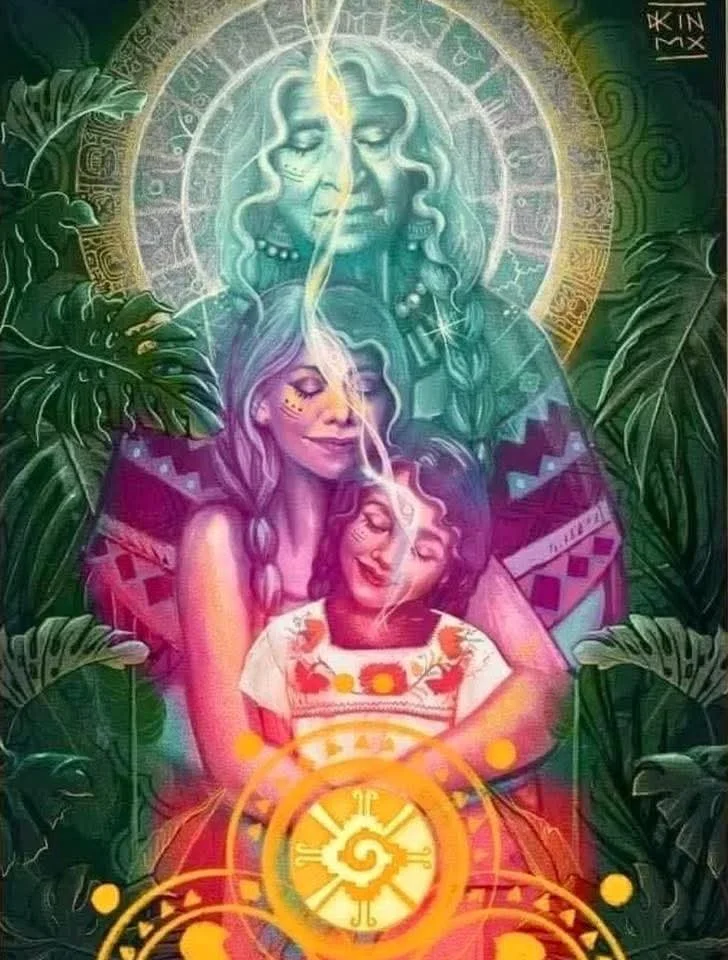
ancestral trauma

Ancestral Trauma and the Midlife Body

How midlife awakens the ancestral stories we carry in our bodies

Midlife has a way of loosening what’s been tightly held. As our hormonal landscape shifts, things that once stayed neatly tucked away, old grief, inherited fear, unspoken stories, they begin to rise. This isn’t failure or falling apart. It’s the body’s way of inviting us to heal what has been carried for generations.

Our body is the keeper of our stories, and sometimes it holds the stories of our ancestors that came before us. We know through research on epigenetics that this is true.

Sometimes the ache we feel didn’t start with us. Sometimes the heaviness in our chest, the tightness in our belly, or the deep tiredness that no amount of rest can soothe, belongs to a story that was never ours to carry. We are born into other people’s stories.

We inherit much more than eye colour and bone structure from our ancestors. We also inherit their nervous systems. This is shaped by the environments, events, and relationships that came before us. The body remembers what the mind forgets.

What is Ancestral Trauma?

Ancestral trauma refers to the transmission of unprocessed emotional pain, fear, or survival patterns from one generation to the next. These are not always passed down as explicit stories. More often, they live in silences, in the shape of a family’s nervous system, or in the ways we unconsciously learn to stay safe. Ancestral Trauma lives in the body’s tissues, rhythms and reflexes.

It can show up in many different ways. Chronic tension that never seems to release, or maybe a tendency to over-function, taking responsibility for everyone else’s wellbeing. Or for some it is deep fatigue or burnout that isn’t fixed by rest.

“When you heal the wound in yourself, you heal the wound of generations before you and generations after you.”
Michael Meade

A grandmother who survived war may never speak of what she endured, but her vigilance might live on in a granddaughter who finds it hard to relax. I have worked with many women who come to me and say they literally cannot stop working and rest, even though their body is screaming out for it and they don’t understand why. The pattern often lies in what has been inherited in their autonomic nervous system.
A father who grew up in scarcity may raise children who, even in abundance, feel guilty resting or taking up space. These imprints are adaptive, they helped someone survive once. But what was once protection can become limitation when it’s no longer needed.

Why does this show up in midlife?

To be fair it can show up earlier. It is just that in midlife, part of our developmental challenge is to come back to the truth of who we really are. This impulse can show up in a myriad of ways. Many people ignore it, so it will hang around until they pay attention. In my experience with my clients, there is a deep discomfort with life and a strong impulse or urge to seek more meaning, purpose, or something different. They find they cannot continue on the way they have been travelling so far.

As our hormonal landscape changes, our emotional landscape does too. The hormones that once buffered and balanced our stress responses shift, and the body’s elegant system of containment begins to loosen. Things that once slipped neatly under the surface start to rise. Old grief, ancestral sorrow, unprocessed experiences; they all start knocking on the door of awareness. So it is not that life suddenly gets harder it is that what has been kept buried in the dark, suddenly starts knocking on the door asking to be seen. While this can initially feel unsettling, it’s also profoundly healing. The body, in its own divine timing, invites us to metabolise what we’ve inherited, so we can step into the next chapter lighter and more integrated.

Our body is a storyteller.

In my work, I see how ancestral stories express themselves somatically. The body carries what hasn’t yet been felt or integrated. Chronic tension, gut and reproductive issues, or a sense of deep fatigue, often emerge as the body’s way of trying to resolve inherited stress.

I’ve worked with many women who, even after hysterectomy or menopause, still hold a palpable energetic imprint in the womb space. These might be a story of loss, silencing, or generational grief that predates their own experiences. When the body is met with compassion and attunement, those old imprints can begin to release. What was frozen starts to move.

Healing doesn’t always mean understanding the exact story, it means restoring a sense of safety so the body no longer has to carry it alone and the pattern that has been long held, can be expressed and completed because there is enough of a felt sense of safety in the body for it to let what has been stuck, be released.

Recognising that an inherited pattern lives within us is not about blame or burden, it’s about freedom. When we see that our over-responsibility, perfectionism, or shutdown might have roots in someone else’s survival, we can meet it with compassion rather than self-judgment. In that awareness, something softens.
We begin to relate to our own patterns differently, not as flaws to fix, but as messages from the body inviting us to complete what was once incomplete.

It is important to remember that these patterns and imprints you inherit, they come from survival and they also come from love. A mother’s hypervigilance was once love and protection of herself and her family. A grandfather’s stoicism was a protective response, grounded in love to protect himself and his family system. They did the best with what they had to keep surviving.

The ripple of healing.

The beauty of this work is: when we heal, we don’t just heal for ourselves. The nervous system reorganises and recalibrates. We slowly and gently start to change how we show up in relationships, in our families, and in our communities. That healing ripples backward and forward . It honours those who came before, and is freeing to those who will come after us.

Ancestral healing is not a thinking activity it is a somatic and relational one. The best therapeutic modalities to heal it are somatic experiencing, internal family systems, somatic attachment work like NARM, family constellations work and ritual, ceremony and nature based practices. Rarely is it one modality. It is often a few woven together to integrate, depending on what is showing up for an individual.

Ultimately the goal is about restoring flow and connection, within the body, within the family system and within the wider relational field of our lives.

As you read this, gently place a hand on your heart or your belly.
Feel your breath, and remember; you are part of a long line of survivors and lovers and dreamers.
What might shift if you allowed your body to trust that it no longer has to hold it all alone?

Breaking the cycles of ancestral trauma, a pathway to freedom

One of the hardest growth challenges I have noticed in my family, friends and clients is the coming to terms with our own ancestral trauma that is passed down through family systems. There comes a time in most people’s lives, a stage in adulthood, when we see our parents for the human being they really are. We see their fragility, their own adaptive childhood survival strategies, and for most of us, this point in time is very confronting. Because even though we are adults ourselves, we are still their children.

When we get curious about our own adaptive strategies, we start to see patterns passed down through family systems and there is a particular kind of sadness that comes when we begin to uncover the depths of the trauma that lives within our family systems.

It’s the grief of realising that those who raised us—our parents, grandparents, aunts, uncles—may have been deeply disembodied, cut off from their own emotional landscapes, and perhaps unable to truly connect with themselves, let alone with us. We can experience a heartbreak that carries a sense of loss, not just for what we personally endured, but for the generations before us who never had the chance to break these patterns. For what they personally suffered.

The symptoms you may be experiencing, whether they by psychological or physical may not just be your story. They be the voice of an entire lineage of your ancestors - one that never got to grieve, express their anger or speak up freely.

As we peel back the layers of our own survival strategies and touch the rawness of our deepest wounds, we often discover that our parents were children once, too—perhaps trapped in their own survival responses, shaped by environments that never taught them to feel or to fully inhabit their bodies. We come to see how their nervous systems, often locked in chronic states of freeze, fight, or flight, struggled to find a sense of safety, just as ours have.

"You are the medicine, the one who can transform the pain of your lineage into love and liberation." – Unknown

This is what we mean when we say the body keeps the score across generations. When grief wasn’t processed, when rage wasn’t allowed or was punished, when speaking up freely was unsafe - all of those emotions didn’t disappear because the stress cycle was not able to be completed. They become stored in the body. They are carried an often passed on.

This awareness can open a well of grief, a mourning for the parents we needed but never truly had, and acknowledging the parenting they received that wasn’t attuned to their needs. It can be excruciating to confront the emotional immaturity or disconnection we see in those we love, and to reckon with the reality that they may never be capable of meeting us in the depths where we’ve begun to live. This is not just a loss of connection, but a loss of potential, of the kind of love and relationship we yearned for and perhaps still do.

Yet, within this grief lies an invitation to reclaim our own aliveness. As we touch these deep places within ourselves, we begin to unearth the layers of ancestral pain, shedding the weight of unspoken histories that live in our tissues. We can choose to break these cycles, to live more fully in our bodies, to find the connection and safety that may have been missing for generations. This is the work of becoming embodied, of coming home to ourselves even when our family could not.

As we move through this, it’s important to honour the complexity of what we feel. To allow our sadness, anger, disappointment, resentment and grief to rise, to be held and processed, rather than pushed aside. In doing this, we give ourselves the chance to break the cycle, to break free from the survival strategies that once served us but no longer define us. We offer ourselves the possibility of living a life that isn’t just a reaction to the past but a conscious choice toward wholeness and connection.

This is deep somatic work that is required because these patterns that we are carrying are wired into our system down to a cellular level.

This kind of deep work is often cyclical, arising in layers over time, each wave bringing a deeper sense of clarity and a renewed capacity for compassion. It can be heart-wrenching and beautiful all at once—a reminder that, even amidst the heartbreak of what never was, we hold the power to reshape what can be. The pain or despair you may be feeling are your body speaking to you in its language, asking you to take notice, offering you a pathway through. Asking you to feel them, to honour them, to release them.

This isn’t just healing for you, it is healing an ancestral line. Perhaps this is where true freedom lies—in the messy, heartbreaking, awe-inspiring work of becoming more human, more whole, and, ultimately, more authentically ourselves.