tree of life

Trauma, Joy and the Space between

I was reading the newspaper on the weekend and I saw an interview with Bessel van der Kolk.  It was one of those Q and A style interviews and he was talking about MDMA therapy which is very interesting but he was asked a few general questions about trauma.  In one of his responses he said ‘I don’t know a single person who doesn't have trauma’.  This stopped me and it got me thinking about our definitions of trauma, the clinical definitions and then what we understand about it in popular culture.

We've inherited a story about trauma that is too narrow, too dramatic. We imagine it belongs to people who've survived catastrophe, war, abuse, disasters, big accidents.  Yes it is associated with those things but there are many more categories that we work with in somatic experiencing practice.  What I have noticed with many clients is that we place it at a safe distance from ourselves and from our ordinary yet very complex lives.  The reality is most of us carry something we don't have a name for. A tightness that arrives without warning. A habit of bracing. A way of going quiet in rooms where we used to feel at home.

Trauma isn't the story of what happened to us. It's what happened inside of us in response to what happened or a series of things happening.   It is the imprint it left on your nervous system, the way your body learned to brace, to shut down, to stay small, to stay safe. It doesn't care how big or small the event looks from the outside. It only knows what it felt like to be you, in that moment, without enough support or safety to absorb what was happening.

That's a very different thing and when you understand that it changes your meaning making around the topic of trauma.

Because if trauma is that ordinary, that universal, it means we are all, to varying degrees, navigating life with some part of us still keeping watch, still waiting for something or maybe still braced for what might come next.

Sometimes it is also about things that didn’t happen.  Not being attuned to, not feeling like we are being seen or heard.  Not receiving physical touch.  Not feeling like we belong and having to disconnect from what we feel in our body to survive the environment we are in.  

It widens the lens on it a bit doesn’t it?

There is a huge cost to all of this.  It costs us presence. It costs us the easy pleasure of being in our own bodies. It costs us spontaneity, delight, the capacity to be genuinely moved by something beautiful. Not because we don't want those things but because a nervous system that has learned to protect you from pain will, inevitably, protect you from the full depth of joy as well.

Let me tell you what I know about healing.  If trauma lives in the nervous system, so does healing. Healing doesn’t only happen through processing pain, it lives and grows through joy, connection, pleasure and co-regulation.

We seem to have created this story that healing trauma means processing pain and diving into it which is not strictly correct.  In my somatic world it definitely isn’t.  We’ve over-associated healing with pain processing and under-recognised the role of pleasure and connection. I understand why because trauma often narrows interoception; we feel less, or only certain ranges. But did you know that pleasure expands interoception? We begin to feel more safe and co-regulation gives the nervous system a lived experience of safety in relationships.

So joy isn’t superficial, it is regulating, organising and restorative.

Another really inspiring thing happened last week that motivated me to write this blog.  I was watching the Artemis landing and I had been following the astronauts a little when they were in space.  Jeremy Hansen the Canadian astronaut made a comment:

"Our purpose on the planet as humans is to find joy, to find the joy in lifting each other up, by creating solutions together instead of destroying."

He said seeing the Earth from space helped them all realise this.  This brought tears to my eyes, especially with all the crazy shit going on in the world at the moment.

We are not here to be unaffected. We are not here to have gotten it all sorted. We are here, nervous systems and all, to feel as much as we can bear to feel and to help each other bear a little more.  We are here not just to heal ourselves, but to help each other feel safe enough to come back to experience and feel the fullness of life.

This is what helps us metabolise and integrate the overwhelm that we all experience often each day.

This is what I mean when I talk about integration.  It is not fixing, not erasing, not arriving somewhere unblemished. Integration is the slow, patient process of your nervous system finding enough safety to loosen its grip. To let a little more life in. To discover that aliveness is available to you again.

The signs of that are most often quieter than you might expect. A moment when you actually taste your food. A laugh that surprises you from somewhere low in your belly. The ability to receive kindness or a compliment without immediately deflecting it. A morning when your body doesn't feel like something to manage, but something to inhabit.  A changed reaction to regular dysfunctional behaviour you experience from another on the regular.

Coming full circle on my thoughts at the start of the blog, when you understand all of this it really changes how you view all the people that come into your life each day.  I think it brings us more compassion toward each other and it makes us reflect on what we can do to support each other.

When we understand that everyone is carrying something; that the person who cut you off in traffic, the colleague who snapped at you, the friend who disappeared when you needed them, the parent who couldn't quite get it right.  When we understand that all of them are navigating some version of a nervous system that learned to cope, we start to see and feel our world a little differently.  

I am not talking about excusing what isn't okay. I am talking about a kind of tenderness that makes more room for yourself and others. For the whole complicated, tender mess of being human together.


You can't think your way into feeling

Feeling your feelings is harder than it sounds.

We have increasingly found sophisticated ways not to feel. We've all heard it. Just feel your feelings. It sounds so simple , almost obvious. Yet, for most of us, it's one of the hardest things we'll ever do.

Not because we're weak, or broken, or doing something wrong. But because somewhere along the way, we learned that feelings weren't entirely safe. Then, quietly and collectively, we built an entire world that confirmed it.

The interesting thing about feelings is that they show us one simple truth, the body knows first. You know when you walk into the room and sense the emotional climate? That is what I am talking about, the nervous system reads the room first and we feel it.

Feelings aren't thoughts about emotions. They are physical events.

A tightening in the chest. A hollow opening in the stomach. Heat rising in the face. Heaviness settling in the shoulders like something invisible just landed there. The body receives experience first, before the mind has a chance to name it, frame it, or find somewhere useful to put it. Feelings don't live in your head. They live in tissue, in breath, in the subtle language of your nervous system.

So when we talk about avoiding feelings, what we're really talking about is learning to move away from sensation. From the body's own signal system and most of us have been doing it for so long, we don't even notice we're doing it.

The avoidance rarely starts as a choice. For most of us, it began as an inheritance.

We absorbed it from the culture we were born into, a culture that prizes productivity over presence, resilience over vulnerability, and forward motion over the messy, necessary work of actually processing what's happening inside us. “Push through. Stay positive. Don't dwell”. We've dressed emotional suppression up in the language of strength for so long that many people genuinely can't tell the difference between regulation and repression.

The "good vibes only" movement, for all its cheerful intentions, is perhaps the most recent iteration of a very old story; that difficult feelings are a problem to be solved rather than a signal to be heard.

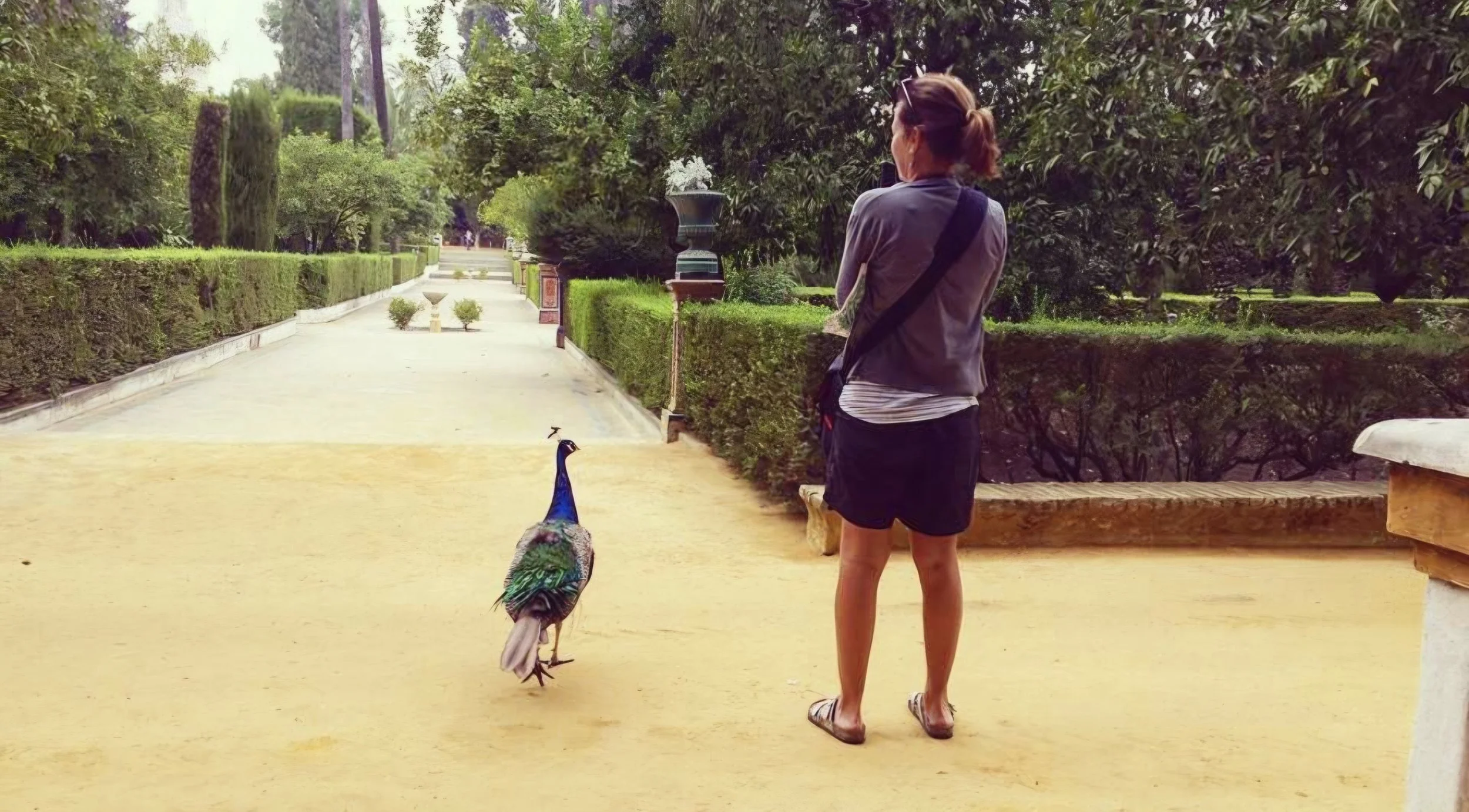
Image - Kellie enjoying the beautiful Alhambra Gardens, a few years ago. A quiet moment of feeling peace, awe and wonder, …….. with an unexpected new friend.

But culture is just the backdrop. The more intimate teaching happens closer to home.

In many families, emotions, particularly big, difficult ones, were not something that could safely exist in the shared space. Not because parents were cruel, but because they were human; carrying their own unprocessed histories, their own unmet needs, their own nervous systems doing the best they could.

Children are exquisitely attuned to the emotional climate of their home. They feel the tension before anyone speaks. They notice the shift in atmosphere when a particular topic is raised. They learn, with remarkable speed, which feelings are welcome and which ones make the air go strange.

So they adapt. They make themselves smaller. They learn to swallow the tears, contain the anger, perform the calm. Not because they were told to, though sometimes they were, but because they felt what happened in the room when they didn't. The withdrawal. The anxiety. The subtle but unmistakable signal that this was too much.

This is not a failure of the child. It is a profound act of adaptation. The child keeps the peace. The child holds the system together. The child learns that their inner world is less important than the emotional stability of the adults around them. The problem with this is it is not the child’s role in the family system to hold space. They don’t have the capacity in their own bodies to do this. Their nervous systems grow well when they have support and co-regulation for parents and caregivers.

That learning doesn't leave when we grow up. It becomes the architecture of how we relate to ourselves.

For some, this went even further. Perhaps there was a parent who struggled, with depression, with alcohol, with the weight of their own unresolved grief. Perhaps the emotional temperature of the household was genuinely unpredictable, and learning to monitor and manage it became a matter of felt safety.

These children became extraordinarily skilled at reading other people. They developed a finely calibrated sensitivity to mood, to need, to the earliest signs of distress in those around them. They learned to intervene before things escalated. To soothe, to deflect, to become whatever the moment required.

What they didn't learn was how to turn that same attention inward.

When your nervous system is organised around tracking others, when your survival, in some early and embodied sense, depended on getting that right , your own feelings become background noise at best. At worst, they feel like a liability. An indulgence. Something to be attended to only once everyone else is okay.

Which, of course, is never. Because these choices were intelligent strategies that our nervous system made, that helped us survive moments when protection, choice and support was missing. Over time they become habituated responses, very strong neural pathways that keep us alive. Those intelligent responses live in the nervous system and tissues; muscles stay contracted, breath stays shallow and the body stuck in a fight response, prepared for a fight that is no longer happening.

Culturally we started to notice in workplaces that we had a problem with poor emotional regulation and here's where it gets interesting.

Emotional disconnection, burnout, relational breakdown, it became impossible to ignore so we developed a response and we called it Emotional Intelligence.

We built frameworks. Competency models. Training programmes. We gave people a vocabulary for their inner world and a five-step process for navigating it. In many ways, it was very well-intentioned a genuine attempt to bring feeling back into professional and personal life. I want to say I think it is brilliant that organisations started to highlight this because left to their own devices, many people wound never come across this content. As I always say, you have to start somewhere.

But look at what we actually did. We took the most embodied, relational, lived thing there is and…. we put it in a PowerPoint. We made emotion into a skill to be optimised. Name the feeling, manage the feeling, deploy the feeling strategically. Which means it's still, fundamentally, a head operation. You're just thinking about feelings in a more sophisticated way. The body, where the feeling actually lives, barely gets a mention.

Emotions arise from the nervous system particularly the limbic system. This is a different part of the brain to the neo-cortex which is receiving this powerpoint information, which is all about logic and reason. If you want to build emotional capacity you have to work with those parts of the brain where implicit memory lives and you do it through the language of the nervous system, which we call ‘The felt sense’.

This, I think, tells you everything about how deep the conditioning runs. That even our solution to emotional disconnection had to be made safe by intellectualising it. We couldn't let it be messy and bodily and unquantifiable. It had to have a score. A framework. A return on investment.

We looked at the problem of not feeling and responded by finding a more sophisticated way to not feel. There is a huge cost of staying ‘just north of yourself’.

When we consistently move away from sensation, the feelings don't disappear. They go underground deep into our unconscious. They show up as anxiety without a clear source, as a vague flatness, as a body that's always tense for no reason you can name. They emerge sideways in sudden irritability, in chronic pain, in the persistent sense that something is off even when life looks fine on paper.

There's also a quieter cost. When we numb or bypass the difficult feelings, we inadvertently turn down the volume on the good ones too. Joy becomes harder to access. Aliveness feels further away. We go through the motions of a full life while feeling strangely absent from it.

Perhaps most poignantly, when we can't feel our own experience, we cannot feel others’ and we struggle to feel genuinely met by others. The connection we most want keeps glancing off a surface we've spent years polishing smooth. In relationships this is a major driver of loneliness because we cannot connect with our emotions let alone talk about them and share what is deep in our heart with another. That level of vulnerability is terrifying.

The body keeps the ledger, it waits, sometimes for decades, for the conditions to be safe enough to finally put some of it down.

We often talk about feeling feelings as though it's a matter of bravery of simply deciding to stop avoiding and diving in. But that framing misses something important.

Feeling, especially for those of us who learned early to move away from sensation, is a capacity that needs to be built. The nervous system needs to learn, slowly and with support, that it can be with experience without being overwhelmed by it. That sensation can be felt and survived. That there is enough space, enough ground, enough steadiness to actually let something land.

This is the heart of the somatic work I do with people. Not pushing into feeling, but gently expanding what can be experienced without the system needing to flee. It's slow work. It requires patience, curiosity, and a willingness to be a beginner in your own inner life.

It is some of the most important work I know.

Somatic work doesn’t force patterns to disappear it meets them with careful pacing and respect. Healing begins when we attend closely to the physiology and introduce layers of support that were not present in the original moment: co-regulation, steadiness, choice, support and the permission to be and move ever so slowly. Slow is more in somatic healing.

The nervous system begins to soften and loosen. It realises that it is no longer in a fight and the body learns that it does not have to hang on so tightly. The support that was missing is finally here.

If any of this resonates, here's a gentle place to start. The next time you notice an urge to reach for your phone, or to get suddenly very busy, or to launch into problem-solving mode, pause. Just for a moment.

Ask: what's happening in my body right now?

You don't need to feel everything. You don't need to go anywhere overwhelming. Just notice. A breath. A tightening. A warmth. A nothing.

That small, curious turn toward the body, that noticing, is the beginning of coming home to yourself.

This is unlike anything you'll find in a competency framework, nobody can teach it to you from the outside. It has to be lived, slowly, from within.

If you would like some support and learn how to build this capacity so that you have more energy to cope with what life throws your way, come talk to me.

The wisdom women carry

Reflections on International Women’s Day.

I am a bit late to international women’s day this year. It happened on the weekend, we had a long weekend where I live and my week last week was really hectic. It arrived before I realised what date it actually was. Sometimes I get a bit ‘meh..’ about it too.

International Women’s Day often celebrates women for their achievements. The roles we hold, the barriers we break, the leadership we demonstrate. All of these things are very important. But I wanted to bring to your attention the deeper truth I witness in my work with women is something quieter, older, and far more powerful. It is the wisdom women carry in their bodies.

The wisdom forged through cycles of life. Through life’s transitions, challenges and the roles we take up in our lives. This wisdom that is forged through birth and loss, relationships that begin and end, careers that are built then changed, and identities that reshaped. All of this through the long and often invisible work of healing.

Women’s bodies are cyclical by nature. We are designed for seasons; for expansion, contraction, renewal and rest. Yet many of us have spent decades living inside systems that expect us to operate like machines: linear, productive, always moving forward.

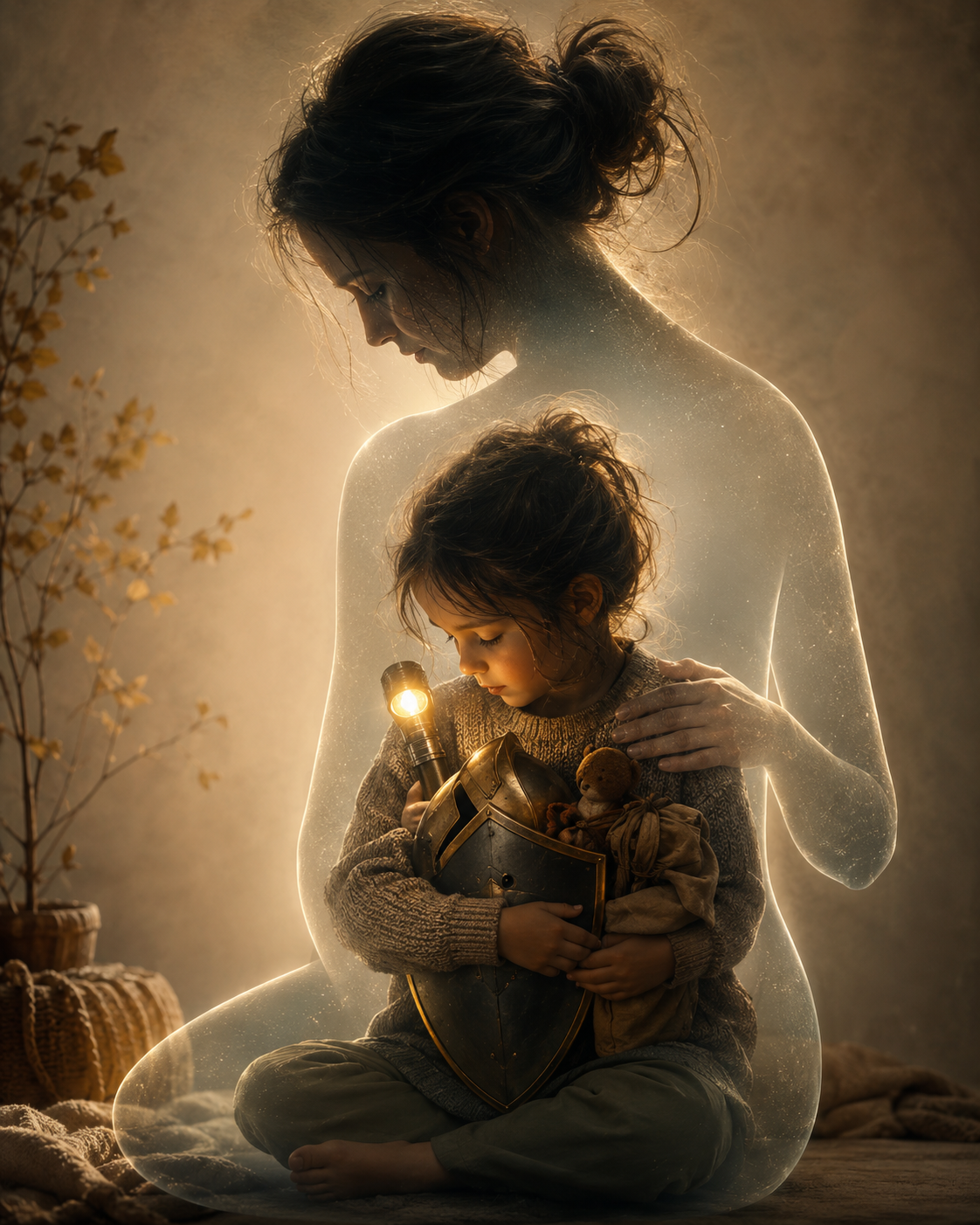
Digital Art, Kellie Stirling

However, a woman’s body never forgets its inherent nature. Eventually it calls us back and there are many different ways it speaks to us to do that. Often this call becomes louder during or after the big life transitions of becoming a mother and in our midlife when perimenopause arrives.

In midlife in particular, things really start to get shaken up. The old identities that once held us together begin to loosen. The roles that defined us, mother, partner, professional, caretaker often no longer fit in the same way they once did. What can start to feel like we have lost our inner compass a little at this point. What can feel like disorientation is actually something else entirely.

A threshold.

In my work as a somatic experiencing practitioner and somatic coach, I often see women arrive at this threshold carrying years of invisible labour, emotional labour, relational labour and generational patterns they have carried quietly for their families and communities.

When we slow down enough to listen to the body, something remarkable happens. The nervous system begins to soften and the old protective patterns that once helped us survive can gently loosen their grip.

Beneath those protective patterns something else emerges. It is not weakness or fragility. It is profound strength and a deep sense of knowing. This sense of knowing, this strength, comes from women who have lived.

What does it mean to have lived? It comes from our lived experience where we have have felt deeply, lost deeply, loved deeply. It looks like women who have learned that true power does not come from pushing harder, but from becoming more deeply connected to themselves, to their bodies, and to the web of life around them.

International Women’s Day, for me, is not only about celebrating what women achieve in the world. It is about honouring the depth of women’s inner worlds. Women who try so very hard to keep healing and growing as human beings. It comes from honouring the quiet courage it takes to heal and the wisdom that emerges when we listen to the body.

I notice the profound capacity women have to transform pain into compassion, for themselves, for others, and for future generations. When a woman heals, the ripple effect of it travels far beyond her. There is a saying that the mother is the anchor in the family system and constellation; when mum is okay, the family is okay. So when a woman works on her own healing the ripple effect is to all the social system she exists within. To her family, her intimate and platonic relationships and to her leadership.

The impact is far reaching.

So today I honour the women who are doing the deep work, the women who are reclaiming their bodies. The women questioning the systems they were taught to live inside and learning to reconnect with their deep knowing and learning to trust it again.

This kind of change rarely makes headlines but it is the kind of change that has a huge impact, one tiny step at a time.


Functional Freeze: When you are coping but not living

For many of the people I work with, they don’t arrive saying, “I’m traumatised.”  They arrive saying things like:  “I’m exhausted, and I am not sure why and I am thinking it might be related to trauma.” or “I am functioning but I really feel flat”.  Others feel like they have lost their spark and zest for life.  Some people know that something is inherently not right, their life looks fine but they feel ‘out of whack’, or sometimes stuck, something about their life is off.

They are holding jobs, relationships, families, leadership roles and often they are capable, intelligent, emotionally aware. Yet, deep inside, something feels stalled or a bit disconnected.

This is what we call, functional freeze.

What is functional freeze?

Functional freeze is a nervous system state where you are operational but disconnected.  Many of us have this in our body. Remember, our nervous system responses are very natural because our Autonomic nervous system (ANS) is our body’s surveillance system.  With functional freeze the brake and the accelerator are both on at the same time.  However, unlike collapse, where everything stops, functional freeze allows you to: keep working, keep caring for others, keep meeting expectations, keep “showing up”.

We can do all this but it comes at a cost.

We often find that the body is braced, that our emotional range narrows. So, joy, desire, creativity, and spontaneity have maybe quietly drained away.  From the outside, life looks fine. On the inside, we can feel numb, effortful, or strangely empty.

Functional freeze serves as a type of camouflage so it can render us, (or a part of us) invisible.  It allows us to be hidden in plain sight, just going through the motions.  The authentic part of ourself, our core essence, is unavailable for participation.

Digital Art, Kellie Stirling

How does functional freeze develop?

Functional freeze often develops in people who had to adapt early.  People who learned, consciously or not, to not be a burden.  They were told to just get on with it, that their feelings had to wait or, if they just kept on going, they would be ok.  It develops in children who couldn’t protest or leave, in relational systems where anger or need was not safe.  So people learn that compliance is a survival strategy.

Metaphorically, we become like the owl, invisible in the tree, feathers blending into the background.  Quiet, but with those big eyes taking everything.  Our flight is quiet and stealthy.  Often when we see an owl in the natural environment we are delighted. They are quiet, wise and all knowing and there are so many we often don’t see because of their expert camouflage. These strategies are not flaws.  They are intelligent adaptations to environments that didn’t reliably support emotional expression, rest, or dependency.

Many high-functioning adults grew up in families or cultures that rewarded: Independence, self-reliance, achievement and emotional restraint.  The nervous system learned to override sensation and emotion in order to keep moving. For a long time, this works.

Until it doesn’t.

Why functional freeze often shows up in midlife?

Midlife is a threshold.  Biologically, emotionally, relationally, the body begins to renegotiate capacity.  So what you could once tolerate, override, or push through starts to feel harder because hormonal shifts change stress tolerance.  This means that  emotional labour accumulates and this happens all in a time in life where caregiving, leadership, or relational demands increase.  Our nervous system starts to have less appetite for suppression and the allostatic load in our body, which is the amount of stress we can tolerate, hits a high.  Our body says “I can't do this dance of squashing everything done anymore, I am exhausted”.  To suppress our emotions and sensations requires an enormous amount of energy from our body.

Those old strategies that once kept you successful now feel unsustainable.

This is why people often experience midlife as a loss of motivation or meaning and where they may experience increased conflict in relationships.  Maybe they find themselves being emotionally reactive or irritable or that they are tired and wired, they have an exhaustion that rest does not fix.  Often there is a sense of “I can’t do this the way I used to’ and also a despair at feeling anchorless and uncertain of where to orient from and to next.

This isn’t failure.

It’s the body asking for a reorganisation, not more effort.

What is important to know is that functional freeze is not laziness or burnout.  It is not a low energy state, it is a contained energy state.  Mobilising energy is present but it is being actively inhibited, our body is working hard to not move.  People in functional freeze are often deeply conscientious.  They care a lot, they try and they keep on going.  What’s happening isn’t a lack of motivation, it’s a protective nervous system state.

Freeze conserves energy when the system has learned that stopping isn’t an option or that help wasn’t available.  It is a very quiet version of survival.

What helps functional freeze begin to thaw?

Functional freeze doesn’t resolve through insight alone.

Understanding why you feel this way can be validating  but it’s not enough.  What helps is gentle, titrated reconnection with the body, often through, slowing down without forcing rest and noticing sensation rather than analysing emotion.  It is about small experiences of choice, agency, and pleasure being experienced interoceptively.  It is about experiencing embodied relational safety and not having to perform anything.

We know when we are ‘thawing’ a bit because we might notice a deeper breath or an emotion coming up spontaneously.  We also might notice a clearer ‘no’ or ‘yes’ in our body when it comes to making choices or that we are able to rest for a moment without feeling guilty. These are not dramatic breakthroughs, they are signs of life returning.

The invitation of functional freeze

Functional freeze is not something to purge or cathartically push out.  It takes slow and gentle work and it is an invitation to stop living from adaptation and start living from presence.  To shift from coping to inhabiting your life.  With the right therapeutic support it is a nervous system state that you can come out of.

So that you can let your body, not just your mind, lead the next chapter.  For many people, this is the initiation of midlife: not becoming better at surviving, but becoming more available to aliveness, truth, and an authentic way of being in the world.

Grief at Midlife: Letting go of you who you thought you had to be

There comes a quiet moment in midlife—a reckoning, a soft ache that sits beneath the surface of busy lives. It's not always dramatic. Sometimes it arrives like a sigh you didn’t know you were holding. But when it comes, it brings with it a flood of emotion: grief, sadness, even anger. And for many, it’s disorienting.

It is disorienting because many of these emotions get couple and mixed up together so it can feel really overwhelming when we are triggered.

This midlife grief we often feel doesn’t always have a name. It isn’t always tied to a death, a divorce, or a specific loss. It’s the grief of a life lived in service to someone else’s expectations. A life shaped by what your parents hoped for you, what culture told you success should look like, or what you thought you should want.

In your twenties, you made plans. You built dreams based on a vision of the world that was handed to you. You worked hard, ticked boxes, created a life. And maybe from the outside, it looked like you “made it.” But at some point—often in your forties or fifties—you wake up and feel the soul knocking.

And it doesn’t always knock gently.

Sometimes it arrives as a sudden wave of sadness or emptiness that you can’t explain. Other times it shows up as restlessness, irritability, or a low-grade resentment toward your life or those closest to you. It might look like a deep craving for freedom—a need to break out of your current life structure—which can get projected outward in dramatic ways: affairs, spontaneous spending, quitting jobs impulsively, or fantasising about starting over somewhere far away.

You might feel like you’re coming undone. But what’s really happening is that something deeper is trying to come through.

This is the soul’s call. It’s asking you to return to the essence of who you are beneath the roles, the responsibilities, and the expectations. Come back to the truth of who you are and it is asking you, what wants to be expressed through you.

And with that call comes a kind of heartbreak.

Heartbreak that you didn’t listen to the whisper of your own longings when you were younger. Heartbreak that you silenced your true self to belong, to be responsible, to be good. There’s sadness for the years that were spent climbing a ladder that wasn’t even leaning against the right wall. Or maybe you got close to the top of the ladder and realised there is nothing there for you , it’s not the place you want to be. There’s grief for all the parts of you that went underground just to survive.

Sometimes, that grief turns to anger. Anger that no one taught you to trust your inner voice. Anger that you betrayed yourself to meet others’ expectations. And sometimes, it turns inward—an ache of self-blame, of “Why didn’t I know better?”

But here’s the truth: you couldn’t have known better. The conditions weren’t there. You did what you needed to do with the tools you had. And now, something new is emerging.

Midlife is not just a crisis. It’s a rite of passage.

It’s a threshold between who you have been and who you are becoming. And every threshold requires a letting go. This is why grief walks alongside transformation—it clears the ground. It softens us. It prepares us to live a life that is more aligned, more honest, and more intimate with our soul.

This grief is not something to fix or rush through. It’s something to be honoured. It’s sacred.


Because on the other side of it is a new kind of freedom. The freedom to stop performing. To stop striving. To live in deeper integrity. To choose from the inside out.

In this second half of life, something quieter but more enduring begins to take root: a life built on your truth; not the one you inherited, but the one you are here to live. Your are free to be the most authentic expression of yourself and it takes time to grow into those shoes because you have been avoiding those shoes for a while to stay safe, to survive, to get the love your old self wanted.

Grief is the crucible that will allow you to transform into your true self, to let go of all the masks you have had on for many years. One of the hardest things to do is to learn to feel the grief in your body and let it express because so many of us have cut ourselves off from our grief. We are terrified if we lay down and let it flow we may never get up again.

You see this is not just an exercise in thinking about our emotions; it is somatic. You have to learn to feel safe to feel the grief in your body so that it will flow and sometimes you might need some help to do this.

Grief is your friend.

The tears of our grief are the fluid that helps us keep on learning, growing and changing.

When we make space for grief, we are not falling apart—we are making room. Room for new life. Room for truth. Room for becoming.

Because on the other side of grief is a new kind of freedom. The freedom to stop performing. To stop striving. To live in deeper integrity. To choose from the inside out.

The freedom to be your true self.

The anatomy of life transitions

Transitions are not problems to fix, they are patterns to Inhabit

We often think of change as linear but it is not at all, it is often a spiral, or a network of spirals. Life transitions are the unspoken pulses that shape our lives. Like the changing of seasons, they are natural and inevitable but they often catch us off guard, pulling us into the unknown. Whether it's the end of a relationship, a career shift, menopause or a profound personal awakening, transitions are both a death and a birth — a letting go and a stepping forward.

When big change happens in our life we are taught to treat change like an emergency. Something is really wrong with us. We search for clarity, next steps, and solutions as if something has gone wrong.

But what if transition isn’t something to fix?

What if it’s a pattern to inhabit?

I’ve come to see life transitions not as interruptions to life, but as part of its underlying design. The common model of life transitions is ending, the liminal space in between and then emergence or new beginnings. Whilst I think this is true to an extent, I believe its actually a bit more complex than that. The metaphor that captures this most powerfully for me is the torus: a self-renewing, spiralling field found everywhere in nature—from galaxies to trees, to the electromagnetic field of the human heart.

The Toroidal Field: A Natural Pattern of Change

A torus is a continuous, dynamic flow. It is not linear. It is not chaotic. It is regenerative. If you can’t picture it in your head it is a donut shaped field where energy moves up the middle and around the edges to the bottom and back up again. The heart has a toroidal field. The earth is a toroidal field.

Image source here

In nature, we see it in the vortex of a storm, the flow of sap in trees, the shape of magnetic fields, the inhale and exhale of breath. In us, it shows up in the rhythm of emotions, healing, grief, growth, and yes—transitions.

The torus reminds us that everything alive follows a rhythm of emergence, dissolution, and return. This rhythm can help us reframe how we experience life changes: not as problems to solve, but as intelligent patterns we are invited to move with.

The Four Phases of Transition (Through the Lens of the Torus)

Transitions often unfold in four phases, which mirror the toroidal flow:

1. The Known Self (Center)

This is the phase of structure and identity. You know who you are, what your roles are, and how the world responds to you. There is stability, predictability, and sometimes stagnation.

2. The Stretch (Expansion)

Something begins to shift. A role no longer fits, perimenopause starts, a relationship starts to change, a loss arrives, or a new longing awakens. You begin to spiral outward, away from the known. This phase can bring both fear and discomfort one minute and exhilaration and joy the next. It often triggers urgency—we want to know what’s next. We feel thrown off our centre - which we literally are because we are moving to the edges of the torus shape.

This is the start of what feels like a wild ride, it begins to get tough but this is a necessary unwinding.

Resistance often comes up here. Whilst this is to be expected, our nervous system feels very uncomfortable often at this point, it is bound to constrict and pull in with fear or anger as a defensive strategy if we have no context to make sense of what is happening. Or maybe we collapse into sadness and grief. This is the time to ask for help or support.

3. The Void (Outer Edge)

The old story has fallen away, but the new one hasn’t formed yet. This is the liminal phase—a sacred pause. It can feel like floating in the dark, ungrounded. We can feel like we have completely lost our connection with our north star or our rudder is missing. This is where many people feel most lost, because the inner compass that once guided them is no longer available. It can feel like being on a road less travelled—or in some cases, a road never travelled before.

This inner void is like a composting process. What no longer serves begins to break down and dissolve. Old identities, beliefs, or stories decompose in the darkness. And just like on a forest floor, that breakdown nourishes the ground of becoming. It's slow, it's unseen, and it's absolutely essential. Composting isn’t glamorous—it’s earthy, rich, and full of alchemy. Nothing is wasted here.

This space is deeply fertile. This is where integration, rest, and surrender happen. The soil of transformation is richest here. This is the time we often need the most support, to hold space for us through the via negativa, the road of letting go. This can also be the hardest because most of us have never experienced what it feels like to let go, we are afraid we may never get up if we do completely let go.

Again at this point more resistance can come up.

When we resist, it adds turbulence to the natural movement of the spiral out, and that can create loops of stagnation, denial and reactivity which shows up somatically in our bodies as tiredness, fatigue, over-activation, as our system tries to hold onto what is known but dissolving, or alternatively rush hard into what is emerging without allowing time to fully metabolise the middle.

4. The Return (Integration)

Eventually, something new takes shape. Not as a quick fix, but as a deeper coherence. You begin spiralling back inward, bringing with you what you’ve learned. You emerge changed. Not a return to the old self, but a return to your centre—wiser, more whole.

I always say to my midlife clients, the developmental challenge of midlife is to be radically honest with ourselves. So that means there is a lot of busting up belief systems, reconnecting with parts of ourselves we have pushed into our unconscious. It is time to do your healing work and come back to that very core essence of who you are. Let go of all the ego strategies that have got you here that don’t serve you well anymore in your adult life. Come back to the real you. You can see that by using the metaphor of the Torus, the core isn’t just a psychological concept, it is also physically coming back to your core.

I see this also in somatic experiencing because the toroidal field shows a natural expression of our vitality and coherence. What I learned form Brigit Viksnins, who is a pretty fabulous trauma resolution teacher is this. The core in the toroidal field is our life force, our true selves, our inner sovereignty. This supports boundaries, presence and our capacity to be with our own emotions and the emotions of others. It sets our blueprint of health. Trauma disrupts the flow of energy, we fragment, collapse in, leak outward, get disorganised, freeze and get stuck outside of our true centre. Our trauma leaves an imprint that can make it hard for us to get back to our centre.

These four phases are not steps to rush through. They are invitations to inhabit. They are cyclical, often overlapping. You may revisit them again and again in any given transition.

Inhabiting the Pattern

Most of us are conditioned to resist the stretch and rush through the void. But when we orient to transitions as toroidal patterns, we allow ourselves to stay in the flow of life itself.

In somatic work, I see how the body holds these transitions intimately: the contraction of loss, the expansion of grief, the trembling spaciousness of the void, the grounded return of integration. Nature doesn’t rush its seasons—why should we?

Whether it’s menopause, a relationship ending, a career shift, or a spiritual awakening, each transition carries the same energetic intelligence. We are being stretched, softened, and re-shaped. And the more we honour the pattern, the more we can inhabit the change with greater ease.

A New Orientation

If you’re in the middle of the stretch, or sitting in the void, you are not broken. You are in motion. You are in the field. The torus is holding you.

Transitions are not detours.

They are invitations into deeper coherence.

So the next time change arrives, try asking not "How do I fix this?" but instead:

"Where am I in the pattern?"

And then, with grace, let yourself inhabit the unfolding.

Reflection Questions for you

  • Where in your life are you being stretched or dissolved?

  • Can you name the phase of the transition you are in?

  • What might shift if you trusted this phase as intelligent, necessary, and even sacred?

Reclaiming menopause as a sacred rite

Somewhere along the way, we have lost our way about the life transition in midlife.

Menopause—this sacred threshold in a woman’s life—has been reduced in the dominant narrative to a list of symptoms to manage, a decline to delay, a hormonal malfunction to correct. It’s treated as pathology. As though something is wrong with you. As though you are breaking down.

And every time I hear that framing, I feel a deep ache in my gut. Because it’s not only wrong—it’s harmful. It robs us of the true power and meaning of this life stage. It narrows it down and over simplifies it. More than that, it obscures the possibility that this transition could be the beginning of something more, not less.

In my work with women moving through midlife, I see something astonishing. When the noise of cultural conditioning is quieted—when we slow down enough to listen to our bodies and our deeper rhythms—what emerges is not depletion. It’s ripening. A flourishing. Something ancient and wise begins to move through. The psyche softens. The soul speaks louder. A different kind of power shows up.

A Culture That Fears Ageing

We live in a world obsessed with youth and productivity. That obsession comes at a great cost. It leaves little room for the natural seasons of life and no roadmap for the descent that midlife brings.

In the medical system, menopause is often treated as a condition to be treated. In the workplace, it’s barely acknowledged. Even in leadership and personal development spaces, there’s an undercurrent of “fix it, push through, stay relevant.” But menopause isn’t asking us to push through. It’s asking us to look deep within and to go downward.

It is, in many ways, an initiation our culture has forgotten how to hold.

The Sacred Descent of Midlife

There is a path in the mystical traditions known as the via negativa—the path of unmaking, undoing, letting go. It is not a glamorous path, but it is a sacred one. Many times during our life we are called into the path of the via negtiva. It is the path of letting go.

Midlife calls us into that descent. It asks us to shed identities we’ve outgrown. To let go of belief systems that no longer serve us. To lay down roles that once defined us. To grieve the things that will never be. And in that letting go, we begin to remember who we are beneath the masks.

This descent is not a breakdown. It is a re-rooting. It is the composting of what no longer serves into the fertile soil of wisdom. And yes, it can be disorienting. But it can also be deeply freeing.

Becoming Ourselves by Deepening, Not Striving

In this season of life, with our hormonal cocktail changing, the nervous system begins to tell the truth we may have avoided for years. The body no longer tolerates what once was bearable. The soul begins to whisper (or sometimes roar), asking for integrity, alignment, authenticity.

This isn’t about striving to become some upgraded version of ourselves. It’s about softening into who we’ve always been. It’s about expanding our capacity to feel—grief, joy, awe—and to live from a place that’s more honest, more grounded, more whole.

This is where somatic work is a game-changer. By learning to be with our sensations, to regulate our systems, to hold ourselves in the tender places, we create the space to truly meet ourselves. Not as a project to fix, but as a mystery to unfold.


Stepping Into Stewardship

The journey doesn’t stop with self-discovery. There is another unfolding—one that calls us into relationship with community, with the next generation, with the wider web of life. We often find our passions and interests broadening to issues of the wider system, of community.

This is the forgotten role of the elder. Not just someone who is older, but someone who has metabolized their life experience into wisdom. Someone who can hold space for others, offer perspective, and serve as a steady presence in uncertain times.

Our communities are starved of elders. Not because they don’t exist, but because the path to eldership has been erased. What if we reclaimed it? What if menopause was not the end of relevance, but the beginning of true leadership?

We don’t just become an elder by getting older. This work requires us to do the deep self inquiry, the deep integration work on ourselves. When we can reclaim the lost parts of ourselves and invite them all to coexist together. When we can honour their voices and tend to them when they need support.


Regulation as a Return to our Blueprint

One of the most powerful shifts I witness in the women I work with—one I’ve lived myself—is what happens when we begin to create more capacity in the nervous system.

It sounds simple. But it’s deeply radical.

So many women have been running on high alert for decades—juggling careers, caregiving, emotional labor, all while trying to keep it together. Their bodies are stuck in “go” mode, and rest doesn’t feel safe. Stillness feels unfamiliar. Slowing down can feel like failure—or worse, danger.

So the work begins gently. We slow down, yes—but we also build the internal scaffolding to support that slowing down. We build safety in the body through somatic practices. We learn to recognize sensation without needing to fix it. We explore the thinking patterns that reinforce overdoing. And little by little, something begins to shift.

There’s more space inside.

And in that space, something magical happens. Life doesn’t get easier—but it becomes more liveable. Triggers still arise, but they’re like whispers instead of alarms. You start to notice: “Ah, there’s that pattern again”—and you choose how to respond instead of being hijacked by it. The nervous system no longer dictates your reactions. You come home to yourself.

This is what I mean by returning to our core, our blueprint.

Not just physically—though that’s part of it. But to the energetic and psychological centre of who you are. That place in the body where you are most you—before the world told you who to be. That grounded, wise, tender place that knows how to move through life with presence.

It’s not about becoming someone new. It’s about remembering who you’ve always been—beneath the striving, beneath the masks, beneath the noise.

And that remembering? That is the real gift of this life stage.

This return to the core also supports what I believe is the central developmental challenge of midlife: radical honesty. Not the performative kind, but the deeply embodied kind—the honesty that arises when you’re no longer willing to betray yourself. At this life stage, we’re invited to tell the truth about where we are. About what hurts. About what we want. About who we’re becoming. And the more capacity we have in our nervous system, the more we can meet those truths without collapse or denial. We can meet them with presence. With curiosity. With love.

"At midlife, the call is not to climb higher, but to descend deeper — into the ground of the soul, into the roots of being, into the core of what is most genuine and lasting in us."
Michael Meade

A New Story

I believe we are being called to tell a new story—or perhaps to remember an old one.

A story where menopause is not a problem, but a portal.
Where aging is not decline, but deepening.
Where midlife is not a crisis, but a rite of passage.
And where those who walk through it with presence and courage emerge as the elders and stewards we so deeply need.

If you’re in this threshold season, you’re not alone. And there’s nothing wrong with you. You’re ripening. And the world needs your wisdom.

Becoming in Midlife

What if midlife isn’t a crisis, but a threshold?

Not the beginning of decline, but the beginning of becoming. A shedding of what no longer fits, and a ripening into who we were always meant to be. Not the self built to survive—but the self born to belong. To the body. To the truth. To community. To the wider web of life.

This isn’t a solo journey. We need spaces—safe, regulated, and wise—where we can do this work together. Spaces where we can slow down enough to hear our own knowing. Where our nervous systems can root into rest. Where radical honesty is welcomed, not feared. And where the fullness of this life stage can be honored as the powerful initiation it truly is.

Because when women reclaim midlife, they don’t just change themselves.

They become stewards. Guides. Elders-in-the-making. Not in the hierarchical sense, but in the soulful sense—those who carry the flame of embodied wisdom forward for others to gather around.

This is the gift. This is the work. And it’s time we told a different story about what it means to grow older.

If you would like to explore your deepening come talk to me about life transitions coaching or somatic experiencing.

If you are based in Melbourne, I will be holding a talk on Tuesday 13th May at the Tree of Life Integral Centre, 3 Denmark St Kew at 6pm. Click here to book your spot as we explore Midlife as a sacred rite of passage.


The fear response, a double edged sword

Fear is a master of disguise. It doesn’t always show up as a racing heart or sweaty palms; sometimes, it speaks in the language of logic, whispering that we’re “not ready yet.” It convinces us to set arbitrary deadlines, create endless prerequisites, or delay action under the guise of preparation. But if we look deeper, we often find that fear is at the root of our hesitation, quietly orchestrating our self-sabotage.

At its core, fear is a survival mechanism, designed to keep us safe from danger. But in modern life, fear doesn’t just react to physical threats—it responds to uncertainty, failure, judgment, and change. Our nervous system doesn’t distinguish between the fear of a tiger and the fear of speaking our truth, starting a business, or pursuing an intimate relationship. It just registers the discomfort and sounds the alarm.

This alarm triggers one of four responses: fight, flight, freeze, or fawn. Each of these can subtly shape our choices in ways we don’t always recognise and we create adaptive strategies to push through and avoid our feelings. Here are some examples:

  • Fight: We overcompensate, push too hard, and exhaust ourselves with perfectionism.

  • Flight: We distract ourselves with busyness, convincing ourselves we’re productive while avoiding the real work.

  • Freeze: We get stuck in analysis paralysis, endlessly researching or seeking validation.

  • Fawn: We over-prioritize others’ needs and expectations, losing sight of our own desires.

Fear as self sabotage

One of fear’s trickiest tactics is its ability to masquerade as prudence. We tell ourselves we’ll launch the business once we get one more certification, we’ll write the book when life is less hectic, or we’ll pursue love when we feel more secure in ourselves. These milestones often feel responsible and logical, but in reality, they are fear-driven delays.

Self-sabotage isn’t always about overt destruction; sometimes, it’s simply about waiting too long. The longer we delay, the more distant our desires feel. And the more distant they feel, the easier it becomes to believe they weren’t meant for us in the first place.

Ignoring our fears

Sometimes we develop adaptive strategies to ignore our fears and push through. This becomes problematic when we learn to ignore the limits of our own bodies and keep on pushing through. Some of us, to have more courage, learn to ignore our fears and push through (I used to do this a lot). The problem with this is that we are ignoring our bodies risk assessment system, our autonomic nervous system, and that ultimately can cause us to get run down, ill or so stressed that our focuses narrows so much we find it hard to function with the complexity of life. So I am not saying learn to push through your fears, I have saying learn to understand them and listen to them, what they feel like in your body. Learn to discern between levels of fear.

Making decisions from a survival state versus coherence and feeling safe

The state we are in when we make decisions matters. When we make choices from a place of survival mode—driven by fear, anxiety, or urgency—our nervous system is dysregulated. In this state, we tend to react rather than respond. Our thinking becomes narrow, focused on short-term relief rather than long-term impact. This can lead to reactive decision-making, avoidance of necessary risks, and choices that feel safe in the moment but create more complexity down the line.

On the other hand, when we make decisions from a state of coherence—where our nervous system is regulated, and we feel safe—our thinking is more expansive. We can be truly strategic, discerning, and appropriately prudent. We’re able to see the bigger picture, weigh options without urgency clouding our judgment, and engage with complexity without feeling overwhelmed.

This is why when we cultivate nervous system regulation—through practices like breathwork, grounding, or simply slowing down—we tend to make more sustainable, wise decisions. The more we develop the ability to recognise when we’re making decisions from fear in survival mode versus from a regulated state, the better we can lead ourselves and others.

“Courage does not always roar, sometimes it’s the quiet voice at the end of the day saying, I will try again tomorrow”

Mary Ann Radmacher


So how do we break free from fear’s grip and step toward what we truly want?

  1. Recognise Fear’s Voice – Become aware of when fear is masquerading as logic, caution, or endless preparation. Notice when you’re setting unnecessary milestones that delay action.

  2. Slow Down and Regulate – Instead of reacting from fear, pause. Use breathwork, grounding techniques, or somatic practices to settle your nervous system so you can make choices from a place of clarity rather than reactivity.

  3. Make Micro-Moves – Fear thrives in the enormity of big leaps, but it loses power when we take small, consistent actions. Instead of waiting for the perfect moment, take one small step today. This goes for those of you having to make harder choices at work in your leadership role. Small iterative changes help people to adjust and accept change rather than big sweeping changes that often put people into their survival response and usually result in them trying to avoid the changes.

  4. Reframe Fear as a Companion – Fear will never fully disappear, but it doesn’t have to lead. Instead of resisting it, acknowledge it: “Hello fear I see you, and I know you’re trying to protect me. But I choose to move forward anyway.”

  5. Commit to Your Desire – If something truly calls to you, trust that desire. Your nervous system might resist, but deep down, your body knows what it longs for. Trust that wisdom.

In our big life transitions we often go through periods of review and reflection. The biggest regrets aren’t usually failures—they are the things we never tried, the dreams we postponed, and the desires we denied. They are often the relationships we didn’t foster or pay attention to. Fear will always try to keep us safe, but safety isn’t the same as fulfilment. The good news? We can choose differently.

What have you been delaying that your heart is calling you toward? What if you took one small step today? Because the truth is, you’re already ready.


Healing Our Trauma: Reclaiming Our Connection with Nature

For me, there is nothing better than walking barefoot in the sand on the beach, then having a dip in the sea. I love floating in sea water and the rocking that comes with floating on top of waves as they ebb and flow. It is highly restorative. It grounds me and brings me back into my body. I can feel my nervous system coming into my zone of resilience.

In the quiet of a forest, the crash of ocean waves, or the vast openness of a starlit sky, many of us feel something stir within—a longing, a recognition, a sense of home, a feeling of belonging. But for many, that connection feels distant, as if nature is something separate from us rather than a living web in which we belong.

Much of this disconnection stems not just from modern life but from unhealed trauma—both personal and collective. Our nervous systems, shaped by past wounds, can keep us in states of hypervigilance or numbness, making it difficult to truly be present with the natural world. However, as we heal, something shifts. We begin to experience nature not just as scenery but as an extension of ourselves, rich with wisdom and reciprocity.

So how does trauma disconnect us from nature?

When we experience trauma, our nervous system adapts to keep us safe. If safety was scarce, our body may have learned to stay on high alert, scanning for danger even in peaceful settings. If overwhelming experiences left us feeling powerless, we may have learned to disconnect, numbing ourselves to sensations—including the subtle, grounding presence of nature.

Maybe you are thinking but I haven’t really experienced trauma why do I feel disconnected from my body. Well, modern life is very challenging and often it is the micro-aggressions of daily life that overwhelm us and this stacks up in our nervous system. All of these moments of overwhelm sometimes hit us when we least expect it and we experience pain, illness or relational rupture.

Many of us also carry inherited trauma, passed down through generations. Our ancestors may have lived through displacement, war, colonisation, or environmental destruction, severing their relationship with the land. That rupture doesn’t just exist in history books—it lives in our bodies, shaping how we relate to the earth. The study of epigenetics has explained this to us, so we can see how this unhealed trauma is passed down through generations in both cell expression but also in the attachment system in each of us, that is formed through the maternal bond between an baby and their caregivers.

In modern life, this disconnection manifests in subtle ways as we project our internal disconnection outwards and this shapes how we relate to ourselves, others, the world and life itself. We may find it hard to slow down enough to notice the intricate beauty of a leaf, the rhythmic cycles of the seasons, or the deep nourishment that comes from being immersed in nature. We are stuck on the hamster wheel of flight and fight. Instead of feeling like we belong to the land, we often treat it as a resource to be extracted and used, a background to our human-centered world.


How does healing our trauma restore our sense of belonging within us and also to something greater than us?

The good news is that healing our trauma—whether through somatic work, deep nervous system repair, or ancestral healing—opens the door to a profound reconnection with nature. As we learn to regulate our nervous system, we develop the capacity to be present, to notice, and to receive. The very same skills that allow us to process and release trauma—slowing down, attuning to our sensations, and cultivating safety—are the ones that allow us to feel at home in the natural world.

When we heal, we begin to:

Feel the land as alive – Instead of seeing nature as an object, we start to sense its intelligence, its rhythms, and its ability to communicate. We might begin to feel the energy of trees, the presence of the wind, or the way a particular landscape holds us.

Move beyond fear and control – Trauma often teaches us to control our environment for safety. As we heal, we can interact with nature in a more reciprocal way—learning from it rather than trying to dominate it. When we feel safe in our own bodies, we can soften into a sense of safety in the world.

Trust the body’s belonging – Nature is not something we visit; it is something we are. As we learn to listen to and trust our body and appreciate its deep wisdom, we also learn to trust the wisdom of the earth. We develop a deep understanding of the rhythms of nature and the rhythms in our body. Our understanding of one pattern helps us see this replicated through our own body and other systems we interact within.

Feel the cycles of life more deeply – Instead of fearing endings and beginnings, we start to embrace the cycles of nature as part of us. We see death, decay, rebirth, and renewal not just in the world around us but in our own emotional and spiritual journeys.

Increased self-awareness and environmental awareness - When we tend to our inner landscapes, we become more attuned to the landscapes around us.

Healing give us a new way of relating to each other and a new way of orienting ourselves in the world.

As we heal, we begin to walk through the world differently. We no longer see ourselves as separate from nature but as part of an ongoing conversation with it. We listen more deeply, honour its gifts, and recognise that the earth, like us, holds both wounds and the capacity for regeneration.

Our personal healing ripples outward. When we feel connected to the land, we are more likely to protect it, not from a place of fear or guilt but from love and reverence. Our actions shift from extraction to reciprocity, from dominance to stewardship.

Healing trauma is not just personal work—it is planetary work. As we reconnect with ourselves, we reconnect with the earth. And as we learn to belong to our own bodies, we remember that we have always belonged to the web of life.

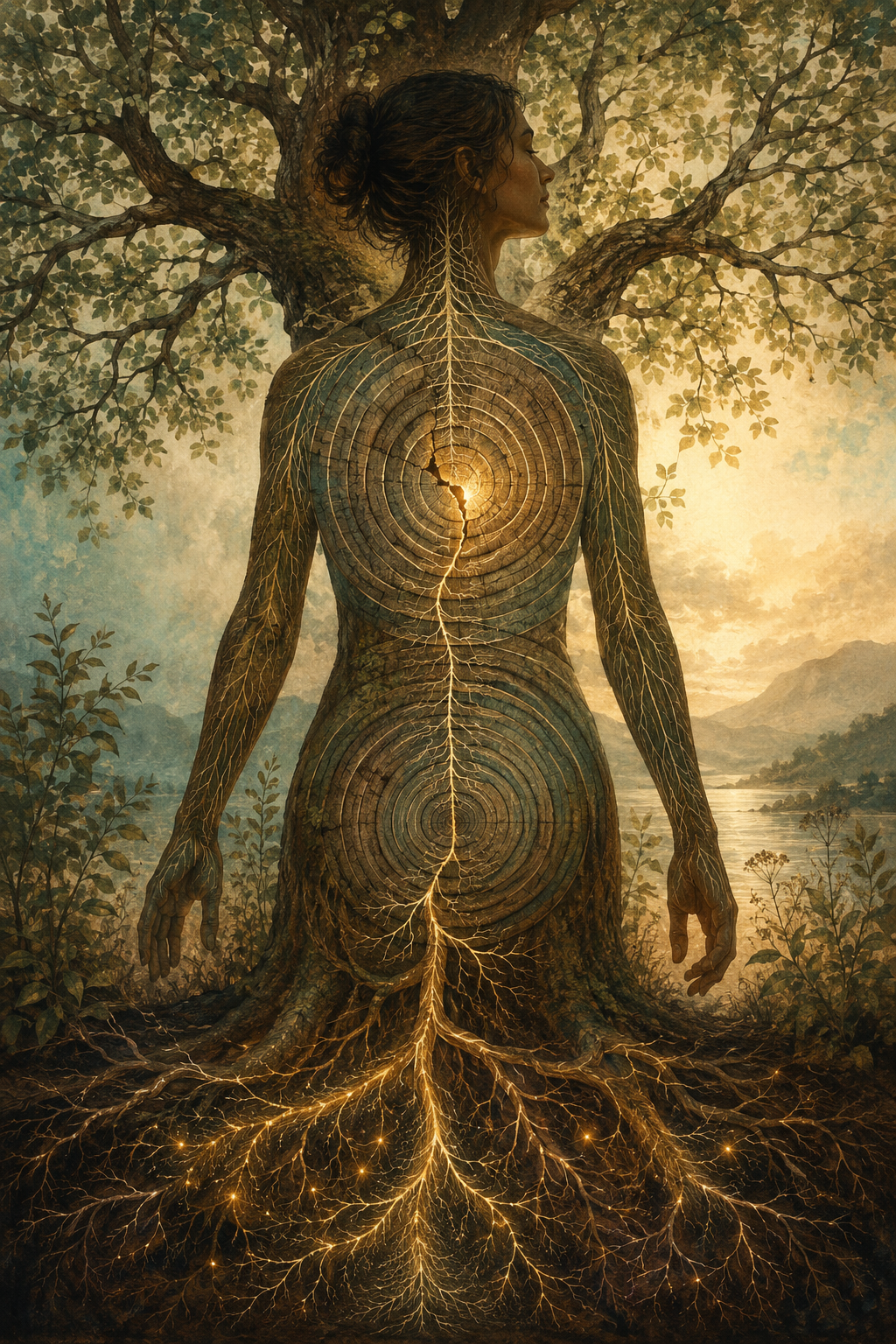
Digital Art - Kellie Stirling


What if healing is not just about feeling better, but about remembering our place in the great unfolding story of the earth?

Perhaps the most radical thing we can do is to slow down, place our hands on the earth, and listen.

Healing happens in community and when we connect with something bigger than us. There are many ways we can look at nature and draw a comparison with our body and its innate intelligence and understanding of how to heal.

Just as nature moves through seasons of growth, rest, decay, and renewal, our nervous system cycles through activation, integration, and restoration. Honouring these natural rhythms supports long-term well-being. Here are some other comparisons that might deepen you understanding of both our body and nature’s capacity to generate healing and growth through the building of virtuous cycles and coherence.

Roots & Grounding – Trees grow strong by sending their roots deep into the earth. Similarly, we cultivate resilience by grounding ourselves in connection—whether to our breath, body, relationships, or a sense of purpose.

Storms & Emotional Intensity – A thunderstorm may feel chaotic, but it brings necessary rain and clears the air. Intense emotions may feel overwhelming, but when we allow them to move through us, they can bring clarity and transformation. Emotions like natures storms pass through us when we let them be expressed. When we allow ourselves to feel emotions fully, we become more open to experiencing the depth of nature.

Ebb & Flow of the Ocean – The tides rise and fall in a constant dance with the moon, just as our emotions and energy levels naturally fluctuate. Trying to force constant calmness is like trying to stop the ocean’s waves—it’s unnatural.

Symbiosis & Co-Regulation – Ecosystems thrive through interdependence; plants, animals, fungi, and microbes all support each other. Likewise, humans regulate best in connection—our nervous systems co-regulate through relationships, just as trees share nutrients through their roots.

Fire & Transformation – I have always been fascinated by the dual nature of fire. It can be a force for regeneration and a force of destruction. Wildfires, though destructive, create space for new growth by clearing out the old. In our nervous system, moments of challenge or breakdown can lead to profound transformation when we move through them with support.

Where do we start?

Of course you can start with the simple connections you can make with nature around you. Even if it is taking a walk on the grass in your bare feet start there. Do it with a friend or your partner, take a walk together. Trauma occurs in the absence of a compassionate witness, so healing happens in the connection with one and in the presence of community. We are wired for social connection, we are not meant to do life on on our own.

The web of life, we are not just in nature, we are nature.

For centuries, humans have told themselves a story: that we stand apart from nature. We build cities, design technologies, and shape landscapes to meet our needs. We name ourselves as observers of nature, as though it is something out there—separate from us. But this illusion of separation is just that—an illusion.

The truth is, we are not just in nature. We are nature.

We have this myth of separation, a mental model that we hold that we are separate to nature. We need sunlight, water and oxygen to survive. We take all that in, plus food (from nature) and we breath out carbon dioxide which the trees take in to make oxygen. We are a system living within a system.


Somewhere along the way, many human cultures began to see nature as something to be tamed, managed, or extracted from. The industrial revolution accelerated this thinking, and modern life often reinforces it. We go from temperature-controlled homes to air-conditioned cars to office buildings, rarely touching the earth with bare feet or feeling the true rhythm of the seasons.

But no matter how much concrete we pour, how many walls we build, or how advanced our technology becomes, we are still living, breathing organisms shaped by the same forces that shape the forests, the rivers, and the wind.

Our bodies speak the language of the earth even, when we forget our connection, our bodies remember.


We have our own rhythms and cycles just liken nature, some of these are:
- The circadian rhythms that govern our sleep are tuned to the rising and setting of the sun.
- Our lungs evolved in partnership with trees, exchanging oxygen and carbon dioxide in a continuous, reciprocal dance.
- The minerals in our bones were once part of ancient mountains.
- The water that makes up most of our bodies has cycled through clouds, rivers, and oceans for billions of years.

We are the land, the sea, the sky—just temporarily arranged in the form of human beings.

Human beings are relational beings, we are wired for connection and we need other people around us to co-regulate our nervous systems - we are not wired to do life on our own. In nature, everything is relational. Forests are not just collections of trees; they are living systems where roots exchange nutrients, fungi form underground networks of communication, and birds and insects pollinate plants, sustaining the whole.

Humans, too, are part of these systems. We have always been in relationship with the land, with animals, with each other. Indigenous cultures have long recognized this interdependence, honoring the earth not as a resource to exploit, but as kin to respect.

When we embrace this view, our decisions shift. We stop seeing ourselves as rulers of nature and instead become participants—stewards in an ancient, living network.

So how do we connect back to our natural place in nature?


Remembering our place in nature is not about abandoning modern life. It’s about reweaving our awareness into the fabric of the world.

We can start small:
- Walking barefoot on the earth, this is one of my favourites and I often do laps each night in a park in my house,
- Swimming in natural bodies of water,
- Noticing the phases of the moon,
- Eating food that actually comes from the soil, not just a package,
- Listening to birdsong in the morning.

Our body actually loves being in nature and connecting with the earth helps to anchor us back down into our bodies when the daily machinations of modern life and technology lift us out of it.

These simple acts reconnect us to something ancient within ourselves. They remind us that we are not just visitors here—we belong. Whilst these are great activities we can do on our own, they are even better when we do them with friends. We build little spots of coherence in our life with these activities and coherence has the capacity to shift a system. Coherence. both within our nervous system and in ecosystems, act as small attractors and they pull the system toward greater organisation. This is because systems are often fractal, which means that small patterns reflect and influence the larger whole.

Digital Art - Kellie Stirling

So in a system that is dysregulated, a single stable rhythm, like a leader modelling nervous system regulation in a group, can influence a group to entrain to steadiness and calm.

Our nervous system is not separate from nature—it is nature. The same principles that govern ecosystems also govern our inner world:

Just as a forest needs diversity and resilience to thrive, our nervous system needs a range of experiences and emotions to stay regulated..

Just as a river adapts to the landscape it moves through, we heal by allowing our emotions and sensations to flow rather than becoming stagnant.

Just as animals shake off stress to reset their systems, we can release stored trauma through therapeutic modalities like somatic experiencing that work with the natural rhythm of the body and we can use somatic practices that restore regulation

How do we come home to ourselves?


The climate crisis, biodiversity loss, and ecological destruction we face today stem, in part, from our belief in separation. But if separation is the problem, then reconnection is the medicine.

When we stop seeing nature as something outside of us and start feeling it within us—as us—we open the door to a different way of living. A way that honours interdependence. A way that leads us back home.

Because we were never separate. We just forgot.

Now is the time to remember. Although we face many big global problems, act as that small port of coherence, start local. Start with yourself and in your systems you interact with.