
There is a rhythm in the body that most of us have never been taught to feel. It is actually really hard to feel or listen to.
It is not the rhythm of the heart, though that too. Nor is it the rhythm of the breath, though that is closer. It is actually deeper than both of those and also slower than both. It is a deep rhythm that feels a bit like it is a tidal movement in the body that pulses beneath everything else. It is two deep rhythms, like a deep tide and a middle tide. Or as my teacher described it is like the ocean, which holds both a surface current and a deep undercurrent. The body carries its own layered rhythms. Both are real. Both carry information.They are deep and they require something most of us have forgotten how to do.
It requires us to slow down enough to feel it.
This year I have been completing training in biodynamic craniosacral therapy, a modality that works with exactly this. What struck me most, is how radically unhurried it is. The touch is extraordinarily light, almost weightless actually. The practitioner's hands don't press or manipulate or fix. They listen. They receive. They create enough stillness that the body's own intelligence can begin to express itself.
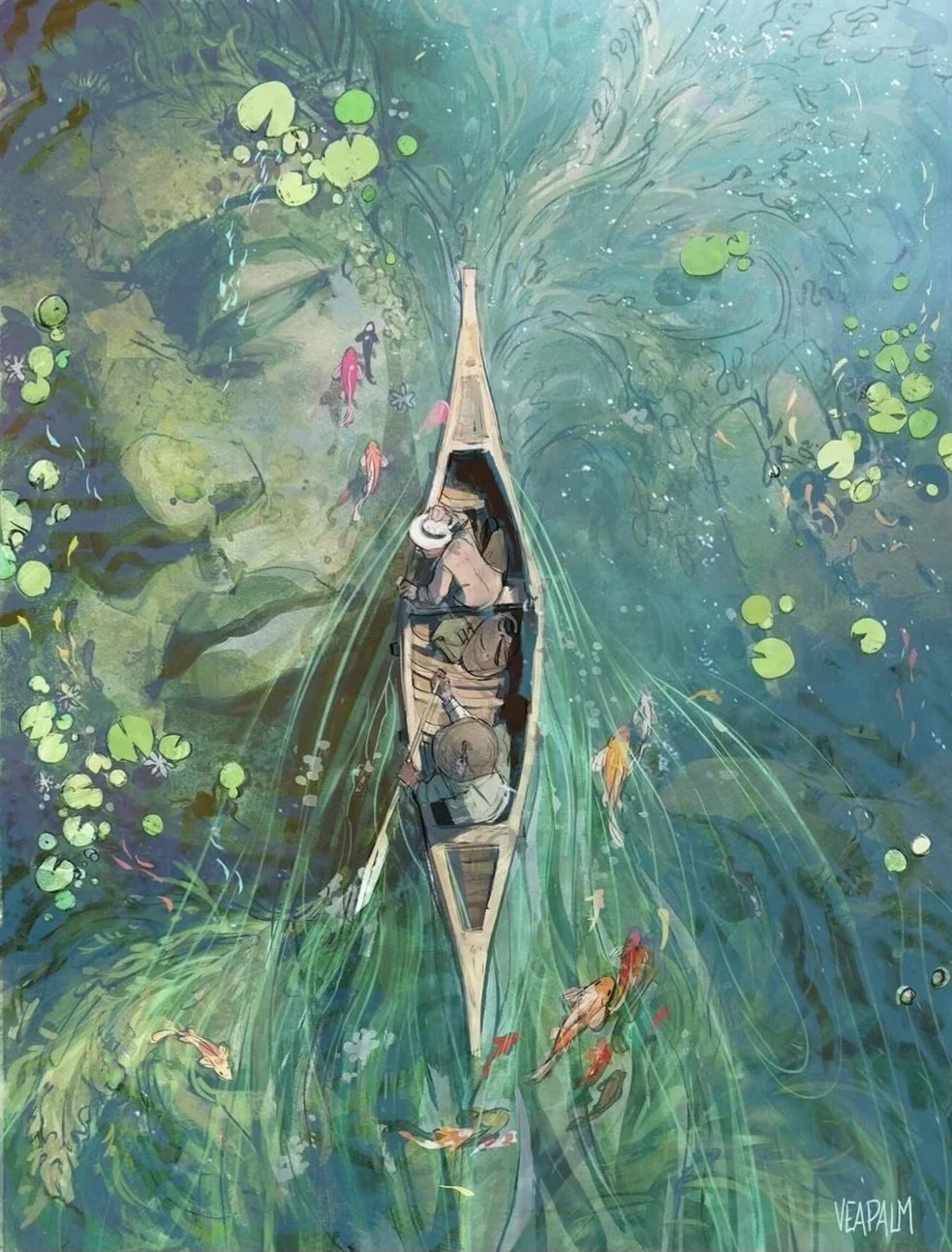
Art, Vanessa Palmer, Beneath the Lillies 2019
This is a different kind of healing to the one most of us have been taught to expect.
We come to healing whether it be to therapy, to coaching, to body work, often looking for something to happen. We want the insight, the release, the shift we can point to. We have been trained, particularly those of us who live from our minds, to measure progress by what we can articulate and what we can feel ourselves changing. We are used to effort. We are used to working hard, even at our healing. I would say that many of my clients work incredibly hard. They show up, they invest in themselves. I do this too. I always have, even with my own healing work.
Craniosacral therapy quietly dismantles all of that. Before the body can heal, it needs to feel safe enough to be itself.
This is not a metaphor. It is a biological reality. The nervous system, particularly one shaped by years of high-functioning stress or early relational difficulty, is not simply waiting to be fixed. It is waiting to be met. It is scanning, constantly, for whether the environment, including the practitioner, is trustworthy enough to soften into. I talked about this last week in my blog when I was discussing how the nervous system is always scanning for safety in belonging and trying to work out what role it can take up in the social system. It's the same theme.
Attunement is what creates that safety. Not technique. Not expertise, though expertise matters. But the quality of presence that says, “I am not here to rush you. I am not here to interpret or analyse or pull anything from you. I am here to be with what is”.
There are things the body carries that have no words.
Not because they are mysterious or unknowable but because they arrived before language did, or at a moment when language shut down. Shock held in the diaphragm. Grief folded into the chest. A startle response stuck in the body. The memory of a moment when the body braced and never quite let go.
Talk therapy doesn’t reach this because it deals with what is in the rational and logical part of the brain, not the limbic system and primal brain, where the nervous system lives, that holds all the patterns of bracing, tension or stress we may not be fully aware of. The body stores experience in tissue, in posture, in the patterned way the breath moves or doesn't move. Sometimes what a body most needs is not to be spoken to, but to be touched, with such fine attunement, such precision of presence, that the tissue begins to trust it is safe to release what it has been holding.
This is what the lightness of biodynamic craniosacral touch makes possible. It is not passive. It is listening at a cellular level. It is a hand that says, ‘I can feel you. I am not frightened of what I find. You don't have to do anything’.
That kind of touch is a language. One the body recognises before the mind has time to evaluate it. The body is the most incredible self healer.
What continues to move me, both as a practitioner and as a person who has spent years working with what the body holds. It is not the practitioner doing the healing, it is the person on the table receiving the gentle touch.
The body already knows. It has always known. The intelligence that knows how to close a wound, regulate temperature, move food through the gut without a single conscious instruction from us; that same intelligence knows how to process and integrate experience, when it is given enough safety and enough time.
My job as a somatic practitioner is not to fix. It is to create conditions. To hold space that is regulated, attuned, and unhurried enough that the body's own healing capacity can come online.
Slow is not passive. Slow is the speed at which the nervous system's deepest layers operate. Slow is the speed at which the tidal rhythms of the body move, carrying their information. Slow, it turns out, is where the most profound healing lives. I have constantly been surprised by how much depth and nuance can be achieved when we slow things down. It allows stress cycles that have been stuck for years to be completed. It creates a level of unwinding in the body that can only happen when the body is not rushed. Slow is more.
If you are someone who has worked hard at your healing; and I suspect many of you reading this are, I want to offer you this.
You are allowed to receive.
Not just information. Not just insight. Not just techniques to practise between sessions. But the quiet, almost-nothing of being held in a regulated, attuned presence and allowed to simply be. The body does not need to be pushed into healing. It needs to be trusted to know the way.
Permission to be slow is not a luxury. For a nervous system that has been organised around effort and vigilance and productivity, it may be the most therapeutic thing on offer.
The tide is always moving. We simply need to learn to feel it.