
One of the things I often see and hear, especially during perimenopause is, “I am feeling emotionally out of control” or “I am feeling things that I have never felt before there must be something wrong with me”. Whilst I have compassion for people feeling that they are on an emotional rollercoaster my first thought is often, what is wrong with feeling emotions? What did this person learn about emotions when they were growing up and were they allowed to have big emotions when they were a kid.
A lot of clients I have had what I call emotionally neglectful childhoods. Their parents did not foster their emotional life. They did not let them have big emotions when they were young. They were either punished physically or through isolation. So they learned that expressing emotion was not safe.
This is more common than you think.
I have sat across from people, brilliant people, some of the most self-aware clients I've worked with, who could narrate their own psychology like a well-rehearsed lecture. They have done the work. They knew exactly where the pattern came from. They could name the childhood dynamic, trace the attachment wound, explain the trigger with clinical precision. However, when the moment came, maybe being on the receiving end of criticism, silence, or a raised voice, their body did the same thing it had always done. The same collapse. The same flood of heat. The same bracing.
Understanding hadn't touched it. Not because they weren't insightful enough. Because insight was never going to be the thing that touched it. Emotions are not a thinking thing, they are physiological.
This is the quiet, exhausting secret of so much personal growth work: you can know everything about why you feel the way you do, and still feel it. You can try and push it away with your mind but it still lives there silently in the background running everything. Willpower doesn't reach it. Positive thinking doesn't reach it. Even deep, accurate self-understanding doesn't reach it; because none of these operate in the place where the emotion actually lives.
Here's why. The nervous system responds to threat and safety faster than the thinking mind can form a sentence about it. By the time you've had the thought, I'm getting defensive right now, your body has already braced, already flooded, already moved. The mind narrates. The body decides. There is no amount of narrating after the fact that reaches back in time to change the decision.
This is why you can understand everything and still feel exactly the same. The gap isn't a failure of insight. It's a category error, trying to think your way out of something that was never a thinking problem to begin with.
Which is why the work that actually shifts things doesn't start with a better story. It starts in the body itself. Experiencing slowing down enough to notice the bracing before it completes, building enough capacity in the nervous system that it doesn't have to slam the same door every time. In practice this can look undramatic: a hand noticing it's clenched, a breath that's allowed to finish, a session where nothing is explained but something, quietly, unclenches. When we slow down and let stuck stress responses be completed, when we touch into the physiological expression of an emotion we let it move and we build capacity to feel it. The defensive or protective action of the autonomic nervous system doesn’t shut it down or bypass it.
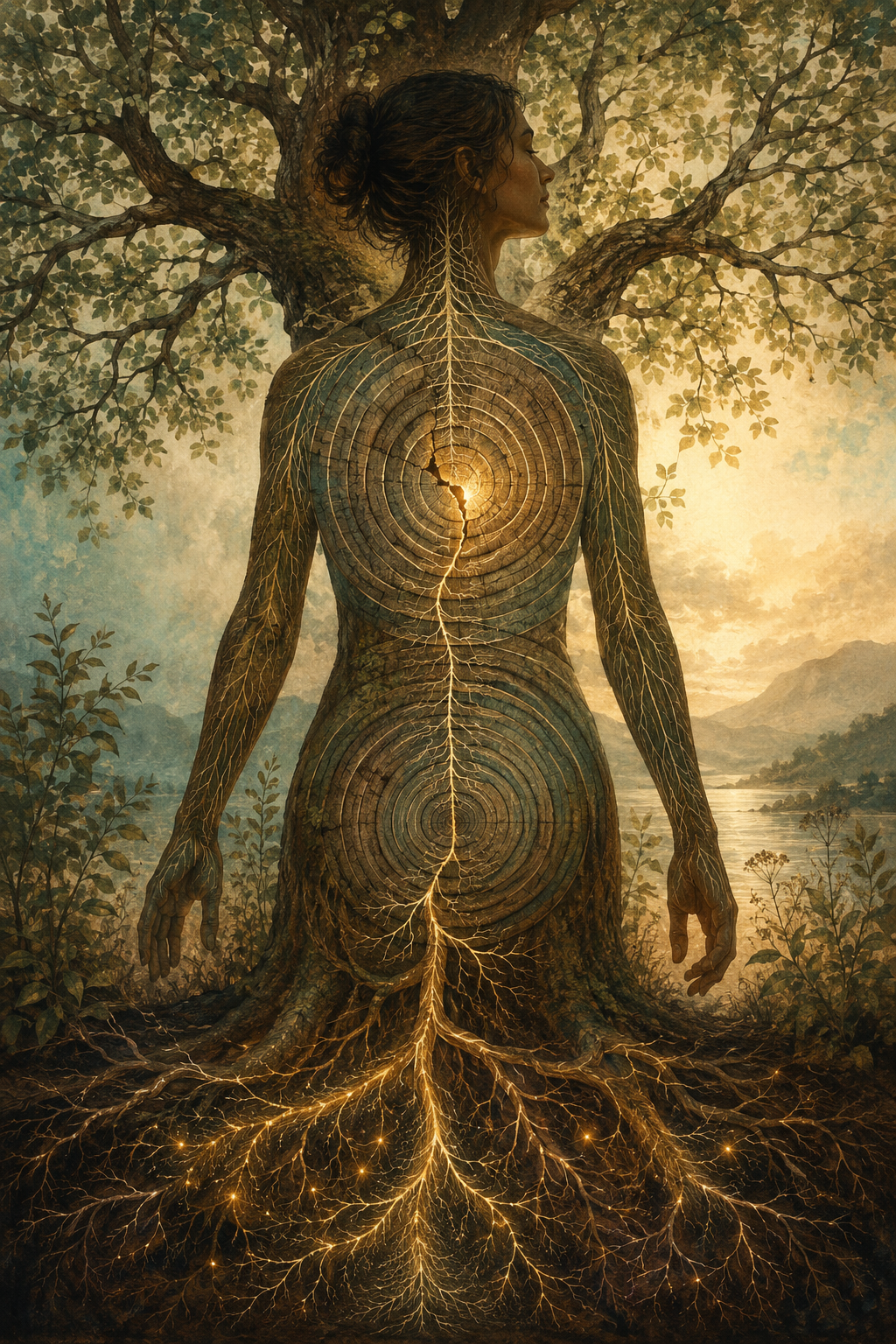
Digital Art - Kellie Stirling
What is the natural physiology of emotions? Here are some examples.
Grief isn't just sadness. It's the weight in your chest that cognitive understanding never lifts. It is the body wanting to lie down to let that grief be expressed and that fear we all have that if we lie down we may never get back up again.
Anger isn't a mood. It's heat rising through your body, a tightening in the jaw, before your mind has even found the reason. The body moving into a protective posture. It is a boundary that has been violated and the body wanting to say no. It is the body preparing to push away danger.
Shame isn't a feeling. It's your body collapsing inward, your chest curling, your eyes dropping downward before you're even aware that it's happening.
Anxiety isn't just a worry. It's your nervous system rehearsing every possible ending, over and over, trying to manage risk and the potential scenarios that might happen, faster than thought can keep up.
None of these are thoughts. They are physiology, that distinction matters more than it sounds like it should.
The state of our nervous system drives our behaviour and that physiology that I mentioned is our bodies natural response that goes with it and helps it move through. So when you learn all your life to dampen it down or pack it away, when it randomly starts to come up because your body is exhausted and can't keep the lid on it anymore no wonder you feel overwhelmed. No wonder you feel exhausted with it. Imagine the amount of energy it takes to repress all that emotion and you have been doing it for 40 or 50 years.
Learning to self-attune, to sense and interpret our internal experience, what's sometimes called interoception, is an important skill. Our emotions carry information: what matters to us, what hurts, what we need and what we want to change. When we can hear that information clearly, we can make choices that actually serve us. When we can't, when we override or ignore it, we self-abandon. We stop listening to ourselves, which means we stop knowing what we actually need.
Your body wants you to listen.
It has been trying to tell you this for a long time, it is ready for a change and to do life differently. So instead of medication what if you learned to feel more safety in your body so that you could own and express your emotions in a way that didn’t feel too much. Like you were too much.