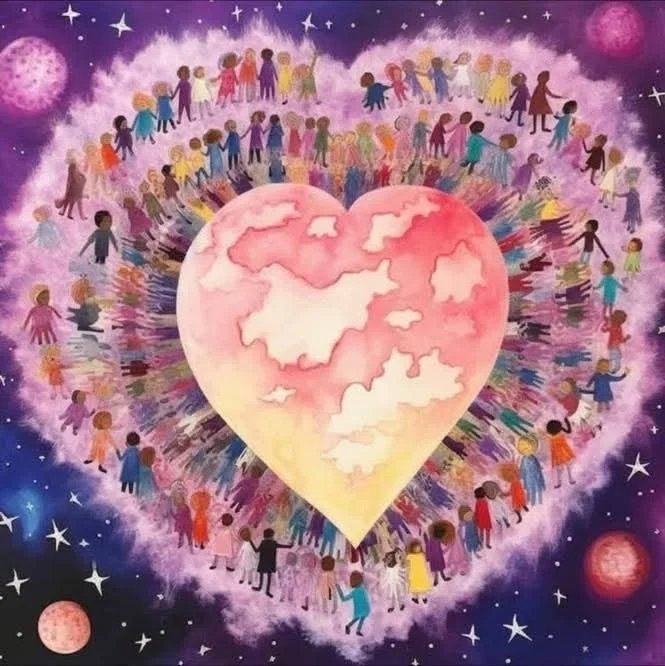
On belonging, the body and the distance we live from ourselves.
Something happens in midlife that our culture has not given us adequate language for.
It arrives differently for different people. For some it is hormonal, the perimenopause that strips away the neurological buffer that kept everything manageable, leaving a rawness, a volatility, a sense of not recognising yourself in your own reactions. For others it is quieter, a successful career that has somehow stopped meaning anything, or a relationship that functions but doesn't nourish, maybe it is a persistent flatness underneath a life that looks, from the outside, entirely fine. For others still it arrives as pure disorientation, Who am I? What do I want? How did I get here? These are questions that feel shameful to be asking at 45 or 52 or 58, as though becoming older adults we should have settled them long ago.
We tend to pathologise this experience. We call it crisis. We treat it as something to be managed, medicated, pushed through. But I have come to see it differently.
What breaks open in midlife is not a malfunction. It is the psyche's insistence on something more true. For decades, most of us have been running on scaffolding; the structures of achievement, role, performance, obligation, that allowed us to function at a distance from ourselves. For a long time, that distance was survivable. Even productive. But the scaffolding has a lifespan. When it begins to dissolve, through hormonal shift, through loss, through the particular exhaustion of having been someone else's version of yourself for too long, what surfaces is not breakdown. It is reorientation. The system trying to find truer ground.
The question midlife is really asking underneath the career confusion, the relationship restlessness, the body you no longer recognise is a much older one. It is the question your nervous system has been asking your entire life, quietly, continuously, beneath everything else you were doing.
Do I belong here? Am I seen? Is there room for me, the real me, in this space?
There is something happening in your body right now that you are probably not aware of.
A scan. Quiet, continuous, it is running beneath the surface of whatever you are thinking about. Your nervous system is checking, as it has been checking your entire life, whether you belong here. Whether you are seen. Whether it is safe to be fully, actually, you in this moment. You didn't decide to do this. You don't need to. The scan is older than language, older than thought. It was written into you long before you had words for what you were looking for. It is called neuroception and it is the role of your autonomic nervous system to keep your safe, it is your body’s surveillance system.
One of my teachers, Anna Skolarikis, speaks of this as relational proprioception, the body's continuous felt sense of where it fits in the space it inhabits. Just as physical proprioception tells you where your hand is without looking, relational proprioception is the body's ongoing orientation to the relational field. The body is always asking, Who can I be here? What is safe here? What is expected of me here? Can I stay connected and still remain myself?
We are always tending this field, always adjusting within it not as a conscious choice but as a biological given. A function as automatic and essential as breath.
Richard Strozzi-Heckler, one of the founders of somatic coaching, describes what we are scanning for: acknowledgement, legitimisation, connection, worth, dignity, love. As we mature, he writes, our sensitivity to these cues becomes more subtle and complex, moving into the background. We may not seem, as functioning adults, to still be seeking acknowledgement but our nervous system and our emotions tell a different story.

Some nervous systems become exquisitely attuned to the relational field. In sensing the emotional weather in the room, they notice tone, tension, facial expression, hierarchy, mood shifts, approval and disapproval. Not because they are “too sensitive,” but because belonging once depended on accurately reading the field. In adulthood, this becomes complicated because people can continue orienting toward external relational safety long after the original conditions have passed.
I would take it further. Not only do we never stop scanning, it is a primal instinct, the scan shapes almost everything. The career chosen to earn legitimacy rather than from genuine desire. The relationship stayed in too long because leaving felt like confirming an old verdict. The hyper-independence worn like armour, the productivity that never quite lets you rest, the way you read a room before you've taken your coat off. These are not character flaws. They are belonging systems. Nervous systems doing exactly what they learned to do.
There is a paradox in the heart of all of this.
What Strozzi names so precisely is that even our defences against belonging are organised around the longing for it. We don't reject intimacy because we don't need connection. We reject it because we need it so much, that the risk of losing it feels unsurvivable. In the rejection of love, he writes, is the determination of our longing for connection.
The person who isolates is not someone who has moved beyond the need for connection. They are someone for whom the need became too dangerous to show. Their nervous system found a solution, distance, self-sufficiency, the clean safety of needing nothing from anyone and it worked. In the sense that it kept them from the specific pain of reaching out and being left. But it didn't resolve the hunger and deep need to be around others, to belong to something. It just drove it underground.
This is worth sitting with, because our culture has built entire value systems around the disguised forms of this wound. We celebrate the person who needs no one. We call hyper-independence resilience. We pathologised vulnerability and we reward performance. So the scanning continues, quietly, loyally, beneath the surface of very accomplished lives, looking for what it has learned not to ask for directly.
Midlife is often when this stops being sustainable. When the performance becomes too energetically costly. When the body, wiser than the strategy, begins to refuse.
You see belonging is not a static state, that we achieve once and for all. As we move between social systems we are having a constant embodied negotiation of the relational field. So we may find that when we live at a distance from our essential self, our real authentic voice becomes lost. Strozzi writes, “The distance we live from our body is the distance we live from our self and from our emotional reality”.
I return to this line often. It seems to me one of the most important things you can say about the particular suffering of our time.
Most of us were not taught to live in our bodies. We were taught to manage them, push them, override them, present them. I look at all the older women who have facial surgery or enhancements to present themselves in a way that seems acceptable to others. I think about the enormous pressure older women face to remain acceptable within a culture that relentlessly comments on ageing women’s bodies, that they are a problem to be fixed. All these enhancements are in the quest for belonging; but to whom do we belong to when we do this? What happens when a woman’s relationship with herself is predicated almost entirely on how she is perceived?
We learned early that thinking was safer than feeling, that the head was more reliable than the gut, that composure was more valued than truth. So we moved up and away, into analysis, into performance, into the very sophisticated cognitive architectures that kept us functional on the surface while something essential went quiet underneath.
The cost of this is staggering. Living at a distance from the body means living at a distance from our emotional reality; which means navigating life, choosing partners, building careers, raising children, from a position of displacement. Not from where we actually are. From somewhere beside it, or above it, or years behind it.
It extends further than the personal. When we live at a distance from the body we lose the capacity to feel others, their joy, their pain, their hopes and fears. We lose our ability to relate to animals, to plants, to water and trees. The empathy that is not a cognitive skill but a felt sense; the capacity to be genuinely moved by another's reality requires that we are present enough in our own bodies to let that reality land. When we are not, life becomes a little one-dimensional. It lacks vibrancy and meaning. Some of us go searching for that outside of ourselves, we seek a high to lift us up. Think of all the ways that shows up.
This is not a small thing. This is describing a kind of exile from self, from others, from the living world. It is, I think, the largely unnamed source of the flatness so many people bring to me. Not depression exactly. Not burnout exactly. Something more like distance. A sense of moving through life without quite touching it. A longing for something more, a confusion about who they are right now.
Which is also, I would suggest, what is breaking open in midlife. Not a crisis of meaning but a return to the body's older knowing. The psyche refusing, finally, to keep living at that distance.
I imagine you are reading at this point and thinking, what is the answer, where do I start?
In my work, which sits at the intersection of somatic experiencing, nervous system regulation, and relational living, I see this displacement constantly. Intelligent, accomplished, genuinely self-aware people who have done years of therapy, read widely, understand their patterns with real sophistication, and still feel stuck. Still feel, underneath the insight, a kind of unreachable ache.
The insight isn't wrong. It's just not landing in the right place.
Because the belonging scan is subcortical. It is not running in the part of the brain that does the talk therapy. It is running in the part of the brain shaped before language, in the earliest relational experiences of being held or not held, seen or not seen, welcomed or found to be too much. Cognitive approaches, however beautifully constructed, cannot reach it directly, they use another part of the brain. You cannot think your way into a body that has learned to brace.
What can reach it is something that happens between nervous systems. Right brain to right brain. The resonance that occurs when one person is regulated and present enough that another person's system begins, slowly, to consider that safety might be possible here. This is not a technique. It is a quality of presence and deep attunement. It is what happens in the space between, in the attuned tracking, the staying with, the not-flinching.
In working with complex trauma and the deep shame that lives at its centre, this is where healing actually occurs. Not in the interpretation of the wound but in the experience of being known and not abandoned. Shame's central conviction is this: if they really saw you, all of you, they would leave. The right brain to right brain work offers the nervous system something the mind cannot manufacture: the actual felt experience of being fully seen and remaining safe. Over time, with enough of these moments, the old template begins to loosen.
The body finds out it was wrong about what belonging requires. This brings up a memory for me of a Game of Thrones episode, where Arya Stark, after her years long quest, which was I think a journey of survival, revenge and reclaiming her identity, finally understands the business of belonging. She grows from an innocent noble daughter to become a skilled, ruthless assassin who seeks justice for her slain family. She tells Kit that she has realised, she belongs, everywhere, nowhere, but ultimately, to herself.
She dismantles the idea that belonging is something fixed or permanent. She sees the vastness of life. The history, movement, death and change and she realises that identity is much less solid. There is grief in this understanding and there is also great freedom. There is something profoundly healing in this realisation when it comes for most people because they realise that no role can permanently secure belonging, no group can remove existential loneliness, no relationship can entirely answer the question of who we are.
The nervous system longs for home. What I have found through somatic experiencing practice, and learning to deeply attune to ourselves, is that we find this when we cultivate that internal sense of home. We learn we belong to ourselves.
I have come to believe that the deepest work of belonging is not solely relational. In the first instance it is internal.
Meaning, real meaning, the kind that doesn't depend on external conditions, arrives when we learn how to belong to ourselves. To close the distance Strozzi describes. To return to the body not as a problem to be managed but as the place where we actually live.
This is deep somatic healing. It happens in the body, through the body, over time, in relationship. It is not dramatic. It is often very slow. It looks like learning to feel the ground under your feet and not immediately leave. Like noticing the tightening in your chest in a meeting and staying curious rather than overriding it. Like letting yourself be moved, by beauty, by grief, by the particular quality of late afternoon light, by the intelligence of a forest that has been communicating underground for centuries without needing to be acknowledged for it.
When we close that distance, even partially or provisionally, something shifts in how we meet the world. We become more available. Some of us become more porous and some of us get better with our boundaries. We become genuinely present to other people, to animals, to the living systems we are part of. We start to notice that we are noticing more. Not because we have healed everything, but because we have come close enough to ourselves that contact becomes possible again.
The relational proprioception recalibrates. The scan, which was always running on old data, consulting old internal maps drawn in early rooms with early people, begins to update. The body begins to find, more often, that the present is not the past. That the ground here in the present moment is different. That it is, perhaps, safe enough to land.
Midlife asked a question. The body, brought home to itself, begins to answer it. All those questions you had, slowly you start to see the answers.