Boundaries

Fawning: why we mirror, merge and self-abandon

Seven years ago, I read Pete Walker’s book on complex PTSD, and it was the first time I truly understood the nervous system response of Fawning. I had known the behaviour as “people pleasing,” but I hadn’t realised until then that fawning was a protective response our body utilises. As I explored it more deeply, I realised it was everywhere and that it was not a personality trait, but a strategy our system uses to keep us safe, particularly in the face of a power-over dynamic.

How many times had I sat in conversations in the workplace where a person was labelled a people pleaser as it if was a personality flaw with no true understanding or curiousity of what was driving it. Let alone acknowledgement that this person does not feel safe. I realised right then that fawning shows up in so many ways. I see it in people who over-function, some organisations are run off the back of employing a workforce who constantly does this. Entire customer service cultures are built on fawning.

Fawning is a nervous system strategy that supports us to stay in connection when we feel unsafe and we are in a double bind; where there are real consequences for us not to fawn. We all do it. Women are a little more predisposed to it because we have lots of estrogen and oxytocin is the neuromodulator of our body. What that means is that bonding and connection helps us regulate and process our lives. It can come up at anytime because it is a strategy your autonomic nervous system uses to keep you safe. If it doesn’t work you go to fight and flight, then freeze. It is a cascade.

Men fawn too, not to soothe, but to belong. Male fawning often looks like “fitting in,” but underneath is the same physiology. In very masculine coded work cultures you see this all the time. Men fawn to avoid being the odd one out. They mute their sensitivity or complexity, mimic bravado or certainty, abandon their authentic relational needs and shape-shift to avoid being shamed.
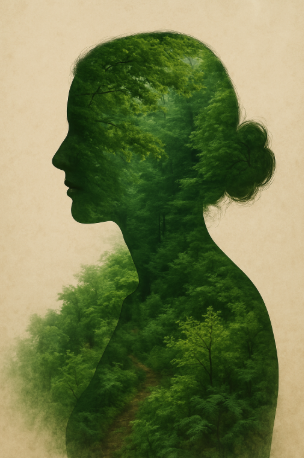
Digital Art, Kellie Stirling. Woman merged with nature

When we fawn we shapeshift, so we morph into a version of ourselves that feels the most likely to keep us safe. For some people, fawning looks like becoming more of who they are; more charming, smart, generous, funny or adored. For other people it is about being less of who you are; less vocal, creative, smart, self-assured or even able to set boundaries. Fawning shows up sexually, in money situations or, in the constant emotional regulation of other people.

We all know about fight, flight and freeze. The fawning response is different because it is a hybrid of these. The hyperarousal part of fawning encourages us to lean into relationships that are causing us harm so we to appease the person. The flight response, self-abandoning to stay safe. The hypoarousal part, or freeze part, numbs our connection to our needs and desires, so we don’t feel the effects of the harm we are experiencing.

When we fawn, we mirror or merge with someone else’s desires or expectations of us to stay safe. We do this to defuse potential conflict because that is our best chance of maintaining safety. In most of these situations there is a power over relationship. Someone has power over us. When we merge or mirror, whilst it keeps us safe, we forgo our own desires and agency and become overly accommodating of others. We become shapeshifters moulding ourselves to each scenario and person. We abandon ourselves, what we care about, our opinions, desires and what we value.

Fawning is so culturally imbued in our society that we are conditioned from a young age to do it. Think of these statements: “give your uncle a kiss”, “be the better person”, “take the high road’, “be a team player’, “you have to learn to compartmentalise it'‘, “just go with it”. We say these every day and they normalise fawning.

Fawning is a common coping system for people dealing with ongoing relational trauma. It also occurs in larger systems of oppression or marginalisation where we must let go of aspects of ourselves to secure membership or a sense of belonging. Over time fawning becomes a systemic pattern.

Individuals don’t just fawn, systems induce fawning. Some examples I see frequently include: A leader who is dysregulated will have a whole team fawning to avoid triggering them. A family with a narcissistic parent creates children who become emotional caregivers or family systems with rigid hierarchy. Workplaces where vulnerability is punished. Relationships where one partner regulates through dominance.

Fawning is not a personal pathology; it’s a predictable adaptation to power-over cultures. So you can see it is not about being nice, it is a nervous system adaptation to relational power dynamics.

One of the deepest wounds of fawning I have observed is the disconnection from anger. Many fawners cannot feel their anger; not because it isn't there, but because it has been repressed for survival. Anger felt too dangerous, too destabilising, too likely to provoke retaliation or abandonment.

So internally, they learned that their anger was not safe and put them at risk. The thing is their anger doesn’t disappear, it goes underground. Into the unconscious.

Over time, this suppressed anger can turn into resentment, chronic tension because you are constantly bracing, exhaustion or collapse, health issues particularly autoimmune issues and a fierce inner critic who constantly self blames.

Restoring healthy aggression, the energy of our boundaries, clarity, and self-protection is essential. But it must be done slowly. Really slowly. Because letting that much anger thaw all at once can overwhelm the system that originally buried it to stay safe.

How do we stop Fawning?

Well it starts with finding safety in the body. You can’t talk yourself out of a fawn response nor can you mindset your way through it. Your nervous system needs to feel safe in the body to try anything new.

The work looks like being able to notice the early cues the anticipatory smile, the shallow breath, the scanning of the other person’s mood and gently interrupting the impulse to fix or appease. Learning to feel tiny drops of healthy anger in an incredibly titrated, slow and digestible way. Allowing the internal critic to soften, which often happens naturally when anger can finally move outward instead of being turned inward

Learning to stop the fawn process from being pervasive is the process of reclaiming power-within, instead of surviving through power-over dynamics. Our fawning response is wisdom it is not a flaw. It has kept us safe and will continue to do so, when we need it in the moment. Our fawn has kept the peace and helped us to function in environments that could not hold our full aliveness.

It is profoundly healing for us to notice our fawn patterns (and to continue to be able to notice them in the moment) and gently let them loosen their grip. Over time it becomes a survival strategy we have access to, not our default mode of functioning. When you start to let go of it you are not losing the nice aspect of yourself, you are becoming more You.

Belonging everywhere, nowhere and to ourselves

If you have ever wondered ‘where do I belong?’, you are not alone. I see it come up in coaching work all the time. Every big transition in life stirs that questions within us. It is our body and our psyches way of recalibrating. Making space for the next version of you to emerge.

The tender questioning of where we belong isn’t a flaw, it is part of being a human. Each transition asks us to find a new version of ourselves. It is a basic survival needs of humans to feel that we belong. We humans are mammals and we are wired for connection.

We spend so much of our lives searching for belonging; in relationships in communities and at work. Sometimes we find it. There are moments when belonging wraps itself around us so softly we barely notice it. Sometimes it slips through our fingers. The truest home we will ever know is the one we carry with us: our body. My body is the house that I live in. The place I return to when everything else feels uncertain, the memory and echo of every place I have ever been and seen, live within it.

Every version of me that once searched for home lives in my body.

There are moments when the world opens to us, when we feel connected to a person, a landscape, a shared purpose. These moments are luminous. We feel the pulse of life running through us, the sense that we’re part of something greater.

It’s easy to think, this is belonging. It is, for a time. But belonging to the world is fluid, it changes, shifts, and evolves as we do.

Then there are the seasons when we don’t fit anywhere. We grow and we change constantly. The old roles don’t suit us, the conversations feel thin, the places that once felt like home start to feel foreign.

That ache of displacement can stir a deep questioning, Who am I now? Where do I belong?
It is here that imposter syndrome often arises, whispering, I’m not enough. I don’t belong here.
But imposter syndrome isn’t proof of inadequacy. It’s a symptom of disconnection from self-belonging, a signal that we’ve drifted from our inner home and started measuring our worth through someone else’s eyes. It is not surprising to me that many people experience this at work, particularly when they are promoted to a new role, because we are constantly judged by external frameworks in organisations. Like show dogs who constantly have to jump through hoops to please. Few people feel like they can be themselves at work. If you do feel that, you are one of the lucky people.

When we come home to ourselves, the landscape changes. We remember that we belong, first and foremost, to ourselves, to the body we inhabit. We reconnect with our own heartbeat, our breath, our quiet sense of deep inner knowing.

Belonging to yourself is not about isolation; it’s about full bodied integrity. It’s the grounded sense that, no matter where you are, you can meet life from a place of wholeness. It is the warmth in your chest when you tell your truth, the grounded spine when you say no, the quiet smile when you know that you don’t need to prove a thing. You no longer need to perform or prove. The voice of imposter syndrome softens because you no longer outsource your worth.

Somatically, this is felt. A softening in the shoulders. A deepening of breath. A quiet, anchored presence that says: I am here. I am enough. I am mine.

In midlife something shifts for most of us. A new north star begins to emerge.

Midlife often unravels the old anchors. The identities that once defined us, parent, partner, professional, caretaker, begin to dissolve or shift. Our compass spins. The ground beneath us feels less certain. It is less about fitting in and more about who you are becoming.

But this loss is not emptiness; it is space. It’s the fertile ground where the new north star begins to form; one that reflects not who we were told to be, but who we truly are.

To find that star, we have to do the healing work: to meet the parts of ourselves were left behind, to grieve what’s ending, to feel the sensations of transformation moving through our body. This is where somatic work becomes essential.

Through the interoceptive lens, through noticing what’s happening inside, we begin to meet our emerging self not as an idea, but as a lived experience. We reconnect with our wholeness, with all the parts of us that are ready to come home.

We belong everywhere and nowhere and ultimately, within. Belonging is not something we earn or find; it’s something we remember.

The work of midlife, and really of a lifetime, is to come home, to feel safe inside your own skin, to live from the quiet strength of belonging to yourself. From that place, connection flows naturally. You can meet life, love, and change with openness, because your roots are within you.

So pause.
Breathe.
Feel the house you live in.
Let your body remind you. You already belong.

Things I have learned about meeting my edges

Edges we all have them. Some whisper slowly and some flatten us in a moment. A few years ago, a friend said to me, you meet your edges with grace. At the time I must admit I was perplexed by the comment. Mainly because like many people, when I hit my limits and edges I struggle. Edges arrive in many forms, a conversation that stirs something deeply uncomfortable, a season of uncertainty, a devastating illness or a body that whispers enough. So I have been reflecting on this comment this year and I thought I would write about it.

I used to think edges were something to overcome. Now I see them as initiations, thresholds where life invites me to grow a new layer of being. I view them as portals not problems. I have come to understand that every edge , whether burnout, grief, conflict, or uncertainty, is a threshold moment. I don’t try to cross it quickly. I tend the threshold until my whole being is ready to step through. I take my time (where I can), and on the other side, I always emerge with a new layer of wisdom that I quietly weave back into my life, my relationships and my work.

I have always viewed my edges and limits from a perspective of curiousity not control. When something feels uncomfortable, in my body, a relationship, or a system, my first instinct isn’t to fix it. I listen to it with my five senses. I try and get close enough to sense what wisdom it’s carrying. Through years of embodiment and somatic practice, I have trained my nervous system to stay present with discomfort until it reveals the deeper pattern beneath it. This has not been easy, it is very hard work.

Connecting with my body has taught me when to rest, when to deepen and when to let go and shed. There is regenerative intelligence in going slower, what looks like retreat can often be fertile integration. My Winter season has taught me to trust the stillness. Spring, to let new growth emerge without forcing it. The tides, always the tides, to remind me that contraction and expansion belong to the same dance.

I’ve discovered that when I meet an edge, the first thing that matters is slowing down. My mind wants to sprint ahead, but my body asks for stillness. If I can pause long enough to feel what’s happening underneath the surface, the contraction, the ache, the flicker of fear, something shifts. The edge becomes less like a wall, and more like a doorway.

Meeting my edges has taught me that they reveal what’s ready to be integrated. They show me the places I’ve outgrown my old ways of being. They ask for tenderness, not toughness. Sometimes the most courageous act is to soften, to stay present, to breathe until my system remembers that it’s safe to expand again. I don’t do this on my own, I ask for help to hold the container so my body can do what it needs to do.

I have come to understand that meeting your edges in relationship is so much easier than doing it on your own. Healing and growth happen in relationship. I don’t isolate when I reach a threshold, I lean into a trusted circle, my friends, my health providers, my husband, or nature itself as co-regulators. I have learned that building a circle of support around you is one of the most constructive things you can do to live well. I allow others to witness me in the process, those people I have secure connection with are the most supportive to my nervous system. There is something about being seen that can turn fear into belonging.

I definitely meet my edges somatically, not conceptually. Well to be fair, I might start reading about something that is coming up just to get more context and understanding, but I know that path through, is through the body. I’ve come to learn how to locate tension, grief, or fear in my body and to feel it as sensation rather than make it a story. Because our body records every experience of our lives and that tension or emotion is my body’s story. I let my body lead the dialogue: sometimes through stillness, sometimes through tears, sometimes through movement or sometimes just be being in nature. Those edges of mine then becomes a living conversation between my nervous system and my consciousness.

I try to meet my edges in rhythm with nature. There is something incredibly healing about learning about our inner seasons, that brings us back into right relationship with our internal rhythms. I don’t push for transformation, I let it compost. I have noticed both within myself and with my clients, that going slow is more effective, nuanced and has more depth than pushing fast.

Connecting with my body has taught me when to rest, when to deepen and when to let go and shed. There is regenerative intelligence in going slower, what looks like retreat can often be fertile integration. My Winter season has taught me to trust the stillness. Spring, to let new growth emerge without forcing it. The tides, always the tides, to remind me that contraction and expansion belong to the same dance.

Perhaps most of all, I’ve learned that every edge is a form of love, life calling me deeper into myself,
asking if I’m willing to be even more fully alive.

What edge is alive for you right now? Take a moment to feel it in your body.
What might it be inviting you to see, soften, or grow into?

Edges are not walls, they are doorways. Today, notice one edge you’re facing.
Slow down, breathe, and feel what wisdom it might hold if you pause long enough to meet it.

Burnout, chronic stress and boundaries

Every week, I meet people who are utterly exhausted, not because they or aren’t capable, but because they’re working inside systems with no boundaries left. Restructures, shifting roles, endless “transformations”, it’s like the organisation itself is in permanent fight-or-flight, constantly reacting to the next thing.

Many people finding it almost impossible to get into the ‘meaty’ parts of their role, they are simply skirting along the top, doing the things they have to do to keep functioning. Inside that chaos, people are expected to just keep pushing and pushing until their bodies finally say, no more.

They lose touch with the ability to listen to their body’s boundaries or they notice them and ignore them. When you are bored, exhausted, shutdown or unmotivated, that is a boundary. The body is saying no, not for me.

Chronic stress traps the body in survival states, fight, flight, freeze or eventually collapse. Over time, we lose connection with our most basic autonomic cues, those subtle sensations that tell us when to rest, pause, or say no.

We override those messages so often that “pushing through” becomes who we are. The nervous system becomes so used to being “on” that stillness feels unsafe.

Many of my clients tell me they don’t even know what rested feels like anymore, they only know the space between deadlines. When they start slowing down in our sessions, they’re often deeply moved by the experience. It’s as if their body finally exhales. They realise they haven’t felt that kind of slowness, safety, and presence for years.

The Myth of Resilience

In my experience, most organisations completely misunderstand resilience. They talk about “building resilience” as if it’s about pushing through, grinding harder, or coping better with dysfunction.

But nervous system resilience isn’t about endurance, it’s about return. It’s the capacity to come back into your window of tolerance, that place where you feel calm, connected, and curious, after you experienced hyper or hypoarousal in your autonomic nervous system. That’s where perspective returns, creativity awakens, and we can actually relate to others instead of reacting from stress.

Pushing through isn’t resilience. It’s disconnection disguised as dedication.

Systemic Boundaries and the Body

When an organisation has poor systemic boundaries, no clear priorities, constant change, or unrealistic expectations, people end up carrying the system’s chaos in their own bodies. The organisation offloads its dysregulation onto its people.

A nervous system can’t heal without stabilisation, neither can a culture. We need workplaces that honour pause, stabilisation, containment, and rhythm, the same sequence that helps a nervous system recover from chronic stress. Stabilisation creates the ground. Containment provides safety. Rhythm restores flow.
Without that, burnout isn’t a personal failure, it’s a systemic inevitability.

When Agility becomes agitation

Many workplaces today pride themselves on being “agile”; always pivoting, always moving. But without true systems thinking capability, agility easily turns into agitation. Instead of responding intelligently to what’s happening, organisations start grinding, pushing, and reacting. People carry the cost, through exhaustion, disconnection, and burnout.

So instead of becoming more fluid and responsive, organisations become hyper-reactive. They confuse activity with progress, speed with strategy, and flexibility with chaos. When leaders can’t see the system as a living organism, with cycles, rhythms, and interdependencies, they unconsciously perpetuate stress throughout the whole structure.

Without true systems thinking capability, “agility” gets flattened into constant motion, change for change’s sake, rather than mindful adaptation. When we don’t understand the organisational system as a living system, we keep driving it past its own capacity. The solution isn’t to become more efficient; it’s to become more attuned.

Healing from burnout and chronic stress isn’t about bouncing back; it’s about coming home. It is remembering what it feels like to inhabit your own body again, to breathe, to rest, to notice. It is about understanding what a Yes and a No feels like in your body. It is feeling safe to be slow.

True resilience begins when we stop pushing through and start listening, to ourselves, to each other, and to the quiet wisdom of our own biology.

If you are feeling overworked, overwhelmed or burned out, it is a reminder to take time out for yourself. Take a mini break. Notice your breath. Notice when your body tightens, braces, speeds up, or checks out. That’s your nervous system whispering that you’re at the edge of your window of tolerance.

For leaders and organisations, it’s time to redefine resilience, not as pushing through, but as coming back home to ourselves. Back to stabilisation. Back to rhythm. Back to the wisdom of the body, individual and collective.

Because when the system learns to breathe again, everyone within it can too.